
Bill of Lading: Original vs Telex vs Seaway, Explained

Updated: Oct 7
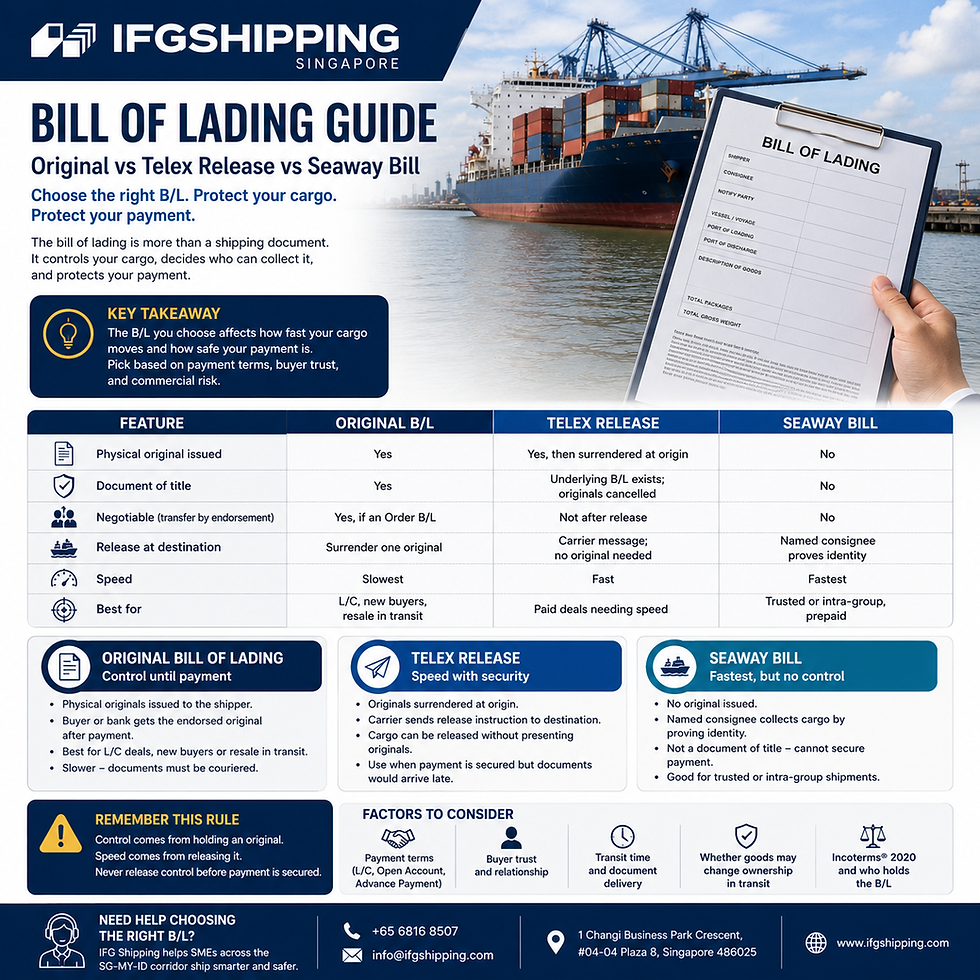
The bill of lading decides who controls your cargo and who gets paid. Pick the wrong type, and two things go wrong. Either your goods sit at the port while documents fly by courier. Or you hand over control before the buyer pays. Both cost money. This guide explains the Original bill of lading, the Telex Release, and the Seaway Bill in plain terms. More importantly, it shows you when to use each one.
I have watched this mistake play out for years. While running the Indonesia–Singapore corridor at IndoBox, I saw shippers release cargo too early and chase payment for months. Therefore, I treat the bill of lading as a financial decision, not just paperwork.
What is a bill of lading?
A bill of lading is the core shipping document issued by the carrier to the shipper. It does three jobs at once. It is a receipt, evidence of the contract of carriage, and a document of title. The third job matters most. As a document of title, it can control who is legally entitled to collect the cargo.
That control is the whole point. Consequently, how you issue and release the bill of lading decides your commercial risk. The three common options below differ mainly in one thing: how the goods get released at destination.
Original vs Telex Release vs Seaway Bill: what is the difference?
The three options differ in whether an original document exists and must be presented. An Original bill of lading is a physical document that someone must surrender at destination. Meanwhile, a Telex Release cancels those originals at origin, then authorises release without presenting them. In contrast, a Seaway Bill has no originals at all. Notably, speed rises across the three, while control falls.
Here is the practical comparison for an SME shipper:
Feature | Original B/L | Telex Release | Seaway Bill |
Physical original issued | Yes | Yes, then surrendered at origin | No |
Document of title | Yes | Underlying B/L exists; originals cancelled | No |
Negotiable (transfer by endorsement) | Yes, if an Order B/L | Not after release | No |
Release at destination | Surrender one original | Carrier message; no original needed | Named consignee proves identity |
Speed | Slowest | Fast | Fastest |
Best for | L/C, new buyers, resale in transit | Paid deals needing speed | Trusted or intra-group, prepaid |
Note one common myth. There is no separate B/L "type" called Original. Specifically, an Original simply means the physical paper of an Order or Straight bill of lading. An Order B/L is negotiable and transferable by endorsement. In contrast, a Straight B/L names one consignee and cannot be transferred.
When should you use an Original bill of lading?
Use an Original bill of lading when payment is not yet secured. It keeps title in your hands until the buyer pays or the bank releases the documents. Specifically, choose it for letter-of-credit deals, first-time buyers, or goods that may be resold while still at sea. In these cases, control is worth the extra time.
The mechanics are simple. Specifically, the carrier issues a full set of originals to the shipper. After payment, the bank passes an endorsed original to the buyer. Then the buyer surrenders that original to collect the cargo. As a result, no one takes the goods without settling the deal first.
This is why payment terms and documents move together. For the trade-off between secured and open terms, read our guide on letter of credit versus open account. In addition, your delivery term shapes who holds these documents; see how Incoterms 2020 split cost and risk.
When is a Telex Release the right call?
Use a Telex Release when payment is already secured but the cargo will arrive before the paper does. The shipper surrenders all originals at the origin office. The carrier then messages its destination agent to release the goods without an original. Consequently, you avoid courier delays and the demurrage that builds while documents travel.
The term is old, but the function is modern. "Telex" comes from the telegraph exchange service of decades past. Today, carriers handle it by electronic message. Notably, a Telex Release is not a separate document. Instead, it is a release instruction tied to a bill of lading whose originals no longer need presenting.
Timing is everything here. Therefore, release the telex only after the money is in. Otherwise, you give up control of paid-for goods. Late or missing documents also drive hidden costs. See our breakdown of hidden shipping costs that quietly erode margins.
When does a Seaway Bill make sense?
A Seaway Bill suits trusted relationships where ownership will not change in transit. No original is issued, so nothing must be surrendered. The named consignee simply proves identity and collects the cargo. Therefore, it is the fastest option and the lightest on paperwork. However, it is not a document of title and cannot secure payment.
For example, use it for shipments between related companies, branch transfers, or prepaid orders to a known buyer. In contrast, avoid it when a bank is involved or when you may resell the goods afloat. A Seaway Bill gives speed, not security. Match it to deals where trust already exists.
This choice also depends on your route and counterpart. For corridor-specific planning, our guide to shipping from Malaysia to Indonesia shows where trusted-buyer lanes are common. Similarly, mode and timing matter; compare options in our sea freight versus air freight guide.
How the bill of lading protects (or risks) your payment
The bill of lading is your main lever over payment risk in shipping. Hold an original, and you hold the goods until terms are met. Release a telex or issue a seaway bill, and you trade that security for speed. The right choice depends on trust, payment method, and whether a bank sits in the deal.
One rule keeps SMEs safe. Match the document to the payment term, not to habit. For example, an Original B/L pairs naturally with a letter of credit. Meanwhile, a Seaway Bill fits a prepaid order to a long-standing partner. Therefore, decide the payment structure first, then pick the bill of lading.
Electronic bills of lading: where Singapore stands
Electronic bills of lading (eBLs) are now legally valid in Singapore. In 2021, Singapore amended its Electronic Transactions Act to adopt the UNCITRAL Model Law on Electronic Transferable Records (MLETR). As a result, an eBL carries the same legal status as a paper bill of lading. The change took effect on 19 March 2021.
This matters for the whole region. Singapore is among the first major trading hubs to adopt the MLETR framework. According to the Infocomm Media Development Authority (IMDA), eBLs cut processing time, costs, and fraud risk. In fact, the cited industry estimate puts potential savings near USD 4 billion a year. That assumes half of container lines switch from paper.
For SMEs, the takeaway is practical. An eBL can do the work of an original, a telex, or a seaway bill. Yet it moves faster, with a clear audit trail. However, both sides and their carrier must use a compatible eBL platform. You can read the official position from the Ministry of Digital Development and Information.
Next step: moving the goods. Shipping less than a full container? See our LCL sea freight guide. Moving goods by road to Malaysia? Read our cross-border trucking guide. For a quote, send Iman the pickup point, destination, cargo, weight and ready date on WhatsApp.
Frequently asked questions
Is a Telex Release the same as a Seaway Bill?
No, they are not the same, though both speed up release. A Telex Release applies to a bill of lading where originals were issued, then surrendered at origin. A Seaway Bill has no originals from the start. In short, a telex cancels originals; a seaway bill never creates them.
Can I switch from an Original B/L to a Telex Release?
Yes, you can switch in most cases. Specifically, you return the full set of originals to the carrier at the origin office. The carrier then issues the Telex Release to the destination agent. However, do this only after payment is secured, because you give up physical control of the cargo.
Which bill of lading does a letter of credit require?
A letter of credit usually requires a full set of original negotiable bills of lading. The bank holds them as security until the buyer pays. Therefore, a Seaway Bill rarely works under a letter of credit. Always check the exact documentary terms stated in your credit before shipping.
Is an electronic bill of lading legal in Singapore?
Yes, an electronic bill of lading is legally valid in Singapore. The Electronic Transactions Act, amended in 2021, gives eBLs the same status as paper. Both trading parties and the carrier must use a compatible eBL system. Notably, recognition across borders still depends on the other country's law.
What happens if I lose an Original bill of lading?
Losing an original is a serious problem. Without it, the carrier may refuse to release the cargo. In practice, the carrier often demands a letter of indemnity, frequently backed by a bank guarantee, before releasing. As a result, prevention and careful document handling are far cheaper than the cure.
Not sure which bill of lading you need?
The right bill of lading protects your money and your schedule at the same time. Are you shipping to a new buyer, or to a partner you trust? Is a bank involved, or is the order prepaid? These answers decide your choice. Our team helps SMEs across the Indonesia–Singapore–Malaysia corridor get the documents right the first time.
Talk it through before you ship. See IFG's freight and documentation services, message us on WhatsApp, or email contact@ifgshipping.com. Let us match the right document to your deal.
Note: Bill of lading rules, carrier practices, and electronic-document recognition vary by carrier and by country. Some destinations still require an original paper bill of lading. Always confirm requirements with your carrier and the destination customs authority before shipping. This article is educational, not legal advice.
About the author. Iman Yusoff is Founder & Director of IFG Shipping, with more than 25 years in freight and cross-border trade. He previously built IndoBox Asia on the Singapore–Indonesia corridor. Now he teaches ASEAN business owners how to ship the right way.
SEO & content support by SingRank. IFG Shipping remains the author and full authority over this editorial.


Comments