
Shipping an ROV Through Singapore: Permits and Pitfalls

Updated: Oct 2

An ROV spread is not cargo in the ordinary sense. It is a working asset that leaves on a job and is expected back, often within the same quarter, usually still owned by a company that has no legal presence in Singapore at all. Declare it the way you would declare a shipment of goods being sold into the country and you have just told Customs something that is not true — and you have volunteered to pay tax on equipment you never intended to leave behind.
That single misclassification is the most expensive thing that happens to subsea equipment on this corridor. It is also completely avoidable.
This guide covers what actually governs the movement: which scheme an ROV or survey spread belongs in, the permit pair that scheme requires, the clock that starts the moment the equipment lands, and the control-list check that catches more subsea kit than most operators expect. Everything regulatory here is sourced to Singapore Customs and to the Strategic Goods (Control) Order. Where the answer is operational judgement rather than published rule, it is labelled as such.
The problem is not clearance. It is the category you declare.
Most delays on subsea mobilisations do not come from a container sitting in a yard. They come from a decision made weeks earlier, on paper, by someone choosing the wrong box on a declaration.
There are two very different ways an ROV can enter Singapore.
As a normal import. Duty and GST are assessed. The equipment is treated as having entered the economy. If you later ship it out, getting that money back is a separate process with its own evidence burden — and for equipment that was only ever visiting, it was never money that needed to be spent.
As a temporary import. The equipment is recognised as arriving for a defined purpose, for a defined period, and leaving again. This is the category that fits a survey spread, a rented ROV, or a contractor's own tooling arriving for a campaign.
Singapore Customs lists the approved purposes for temporary import explicitly. One of them describes the offshore case almost word for word: goods "used by a person established outside Singapore to perform a job or work in Singapore." That is a foreign contractor bringing their own equipment in to do a job. That is the entire subsea mobilisation model.
The qualifying goods categories reinforce it. The list includes "Professional equipment including spare parts" and "Scientific and technical goods." An ROV, its tether management system, its launch and recovery frame, its spares crate and its survey sensors sit comfortably inside those descriptions.
There is also a short exclusion list worth knowing before you plan anything: the scheme does not cover liquor, tobacco, motor vehicles, petroleum or biodiesel. Fuel and lubricants travelling alongside a spread are therefore not automatically part of the same conversation, and should be planned separately rather than assumed in.
The permit pair almost nobody names correctly
Temporary import is not one permit. It is two, and they are a matched set.
On the way in, you need a Customs In-Non Payment (Temporary Consignment) permit. The "non-payment" is the point: duty and GST are not collected at the border because the goods are not entering the economy.
On the way out, you need a Customs Out (Temporary Consignment) permit. This is the half that closes the loop. It is the document that proves the equipment left in the condition and quantity it arrived in.
Both are applied for through TradeNet.
The failure mode here is quiet and it is common: the inbound permit is filed correctly by whoever handled arrival, the job runs, the equipment demobilises months later under a different coordinator, and the outbound permit is filed as an ordinary export — or not tied back to the original consignment at all. On paper, the temporary import never closed. The equipment is, as far as the record shows, still in Singapore.
Treat the two permits as one instrument with two ends. Whoever files the first should own the second, or hand it over in writing.
If your team is new to how declarations are lodged and who is legally responsible for their accuracy, our guide to customs clearance in Singapore covers the TradeNet mechanics that sit underneath every permit type discussed here.
The 6-month clock, and what an extension actually buys you
Singapore Customs is specific about duration.
Goods may be temporarily imported into Singapore for a maximum of 6 months.
Extensions exist, and they are also bounded: a maximum of 3 months may be applied for each extension request. An extension is not a phone call. It is an amendment application submitted through TradeNet to change the temporary import end date, supported by documentation — including a cover letter explaining the reason.
Two practical consequences follow, and they are the reason this section matters more than it looks.
First, the clock is not aligned to your campaign. It starts on import, not on spread-up. Equipment that arrives early to clear, sits in a yard waiting on a vessel window, then works a two-month scope, can burn a surprising share of its six months before it has done anything at all. Plan the import date backwards from the vessel, not forwards from the purchase order.
Second, an extension needs a reason you can put in writing. "The project ran long" is a reason. "We lost track of it" is not. Weather standby, a scope variation, a client-directed hold — those are documentable. Build the habit of keeping the project correspondence that explains a delay, because that correspondence is what the cover letter is built from.
Singapore Customs does not, on the duration page, set out a published cumulative maximum across repeated extensions. Do not read that silence as permission for indefinite rolling extensions. Read it as a reason to ask before you assume, and to plan a re-export or a change of status rather than a fourth request.
The check that catches subsea equipment: strategic goods
This is the section most operators skip, and it is the one with real teeth.
Singapore maintains a Strategic Goods Control List under the Strategic Goods (Control) Act. The list is not a domestic invention. Singapore Customs states it is based on the Wassenaar Arrangement (WA), the Missile Technology Control Regime (MTCR), the Nuclear Suppliers Group (NSG) and the Australia Group (AG), and that it is organised into 10 categories covering broad technology or equipment areas.
The part that matters for subsea work: this is a dual-use regime. It does not only catch weapons. It catches civilian equipment whose capability crosses a threshold the international regimes care about. Underwater vehicles, certain sensors, certain navigation and autopilot systems, and certain pressure-rated components are exactly the kind of technology those lists were written around. The Strategic Goods (Control) Order's dual-use list, published in the Government Gazette, cross-refers automatic pilots for submersible vehicles to Category 8.
That does not mean every ROV is controlled. It means the question has to be asked against the actual specification of the actual unit — depth rating, sensor fit, navigation package — and not answered from memory or from what was true about a different vehicle two years ago.
Then there is the detail that turns this from a paperwork issue into a Singapore- specific trap. Singapore Customs states that controlled items may require permits for export, transhipment, or transit.
Read that last word again. Transit.
Singapore is one of the world's great transhipment hubs. A very large amount of subsea equipment passes through it without any intention of working there — coming off one vessel, sitting briefly, going onto another, bound somewhere else entirely. If that equipment is on the control list, the fact that it was only passing through is not a defence. The regulated activity is the movement itself.
If any part of your spread might sit in a controlled category, start with our guide to the strategic goods permit in Singapore before you book anything. And because control status is driven by classification, getting the HS code right is not a separate administrative task — it is the input to this decision.
Scientific and technical goods: the extra file you will be asked for
Where equipment is being brought in as scientific or technical goods, Singapore Customs sets out a documentation pack that goes beyond the usual commercial set.
Alongside the commercial invoice, packing list and bill of lading or air waybill, importers are asked to compile detailed technical specifications and a cover letter stating the purpose, the duration, the venue, the details of the work, and a local sourcing check.
That last item surprises people, so it is worth being plain about what it is. The local sourcing check asks whether the equipment could have been obtained in Singapore. It is not a trick question and it is not usually a barrier — specialised subsea assets frequently have no local equivalent available on the required dates. But it is a question you should be able to answer in a sentence, with a reason, rather than one you meet for the first time when someone asks for the file.
Customs also states plainly: if your scientific or technical goods are controlled, get approval from the relevant Competent Authority. That approval is upstream of the permit, not parallel to it. A permit application filed while a CA approval is still pending is a permit application waiting.
Container, flat rack, or charter?
Once the regulatory route is settled, the physical one has to be chosen — and for subsea equipment the standard container frequently is not the answer.
An ROV in its frame, a launch and recovery system, an A-frame or a winch package routinely exceed the footprint a dry box was built around. Our out-of-gauge cargo guide sets out the equipment logic in full: a flat rack takes over-width and over-length loads because its open sides and collapsible ends accept cargo that overhangs the standard footprint, while an open top suits over-height loads that still fit within length and width and load from above by crane. Where cargo is oversized in more than one axis, you are into flat rack or break bulk.
Above that, there is charter.
Chartering is usually framed as the expensive option, and per tonne on a single unit it often is. The framing changes when the shipment is not a single unit. A full spread moving together — vehicles, control cabin, workshop container, spares, launch system — is a different problem from a box. Consolidating an entire mobilisation onto one controlled movement removes the risk that half the spread arrives and the half that makes it functional does not.
IFG has done exactly this shape of move. Eight ROV units were transported from Vungtau, Vietnam to Gelang Patah, Malaysia by charter vessel — a single controlled movement of a full ROV fleet across a regional lane.
We are not going to publish a rate table here, because there is not an honest one to publish. Charter pricing moves with vessel availability, lane, season and lift requirement, and any number printed in an article would be wrong by the time you read it. What can be said usefully is what drives the decision:
Does the spread need to arrive together to be useful? If yes, the value of one controlled movement rises sharply.
Is anything oversized in more than one axis? If yes, container options narrow before cost is even discussed.
Is there a fixed vessel or platform window at the other end? A missed window is usually the largest number in the whole exercise.
Is the cargo controlled? Fewer movements and fewer handovers means fewer regulated events to get right.
A mobilisation sequence that survives an audit
Order matters more than speed. This is the sequence we would run, and the reasoning behind each step.
Classify before you plan. Get the HS classification against the real specification of the real unit. Classification drives duty treatment and it drives the control-list question.
Run the strategic goods check next. Export, transhipment and transit are all regulated activities. Establish control status before a routing decision locks you into a movement you cannot legally make.
Obtain Competent Authority approval if the goods are controlled. This is upstream of the customs permit, not concurrent with it.
Confirm the temporary import route fits. Match the job to a listed approved purpose — for a foreign contractor's own equipment, that is normally performing a job or work in Singapore.
Build the technical file. Specifications, commercial invoice, packing list, transport document, and the cover letter covering purpose, duration, venue, work details and the local sourcing check.
Set the import date from the vessel window, not from readiness. The six-month clock is unforgiving of equipment that clears early and waits.
File the Customs In-Non Payment (Temporary Consignment) permit.
Name the person who owns the re-export. In writing. Before the job starts.
Diarise the end date, and diarise the extension decision well before it. An amendment through TradeNet with a documented reason takes preparation.
File the Customs Out (Temporary Consignment) permit and close the loop.
Steps 8 and 9 are the two that get skipped, and they are the two that cause the problems that arrive months after everyone has moved on to the next campaign.
Where IFG fits
IFG Shipping lists Oil & Gas (ROV Transport) as one of its industry sectors. The services behind it are the ones this article describes: vessel chartering for oversized shipments, heavy lift transport for project cargo, MOB and DEMOB services for oil and gas and offshore projects, and customs documentation and compliance. We handle underwater survey equipment as a matter of routine, not as an exception.
Two companion guides cover the movements either side of this one: where MOB and DEMOB freight leaks money on the planned campaign legs, and moving critical spares when the asset is down on the unplanned one that follows a failure offshore.
If you are planning a mobilisation through Singapore, Malaysia, Thailand or Indonesia and you want the regulatory route settled before the vessel window is fixed, that is the conversation to have early rather than late.
See IFG's freight logistics services, or email contact@ifgshipping.com with the specification and the dates.
Frequently asked questions
Can an ROV be brought into Singapore without paying GST?
Where the equipment qualifies under the temporary import scheme, it enters on a Customs In-Non Payment (Temporary Consignment) permit, and duty and GST are not collected at the border. Qualifying goods categories include professional equipment including spare parts, and scientific and technical goods. The route depends on the purpose matching one of the approved purposes Singapore Customs publishes, and on the equipment being re-exported within the approved period.
How long can equipment stay in Singapore under temporary import?
A maximum of 6 months. Extensions are possible, with a maximum of 3 months applied for per extension request, submitted as an amendment through TradeNet with supporting documentation including a cover letter explaining the reason.
Does an ROV need a strategic goods permit?
It depends on the specification, not on the category of vehicle. Singapore's Strategic Goods Control List is based on the Wassenaar Arrangement, MTCR, NSG and Australia Group and covers dual-use items across 10 categories; the Strategic Goods (Control) Order's dual-use list cross-refers automatic pilots for submersible vehicles to Category 8. Check the actual unit's depth rating, sensors and navigation package against the list before booking.
Does equipment only passing through Singapore need a permit?
It can. Singapore Customs states that controlled items may require permits for export, transhipment or transit. Transhipment cargo that never leaves the port is still engaged in a regulated activity if the goods are controlled.
What is a local sourcing check?
For scientific or technical goods, the cover letter supporting a temporary import is expected to address whether the equipment could have been sourced locally, alongside the purpose, duration, venue and details of the work. Specialised subsea equipment often has no local equivalent available on the required dates — the point is to state the position clearly, not to pass a test.
Should a full ROV spread move as containers or on a charter?
It depends on whether the spread must arrive together to be useful, whether any item is oversized in more than one axis, and whether there is a fixed window at the receiving end. A single controlled movement removes the risk of a partial arrival. IFG has moved eight ROV units from Vungtau, Vietnam to Gelang Patah, Malaysia by charter vessel.
Sources
Singapore Customs — Qualifying Goods and Purposes for Temporary Import: customs.gov.sg
Singapore Customs — Temporary Import Duration and Extension: customs.gov.sg
Singapore Customs — Temporary Import of Scientific or Technical Goods: customs.gov.sg
Singapore Customs — List of Military Goods and Dual-Use Goods, Strategic Goods Control List: customs.gov.sg
Strategic Goods (Control) Order, Government Gazette No. S 660, 1 October 2025: egazette.gov.sg
IFG Shipping — Services and About: ifgshipping.com
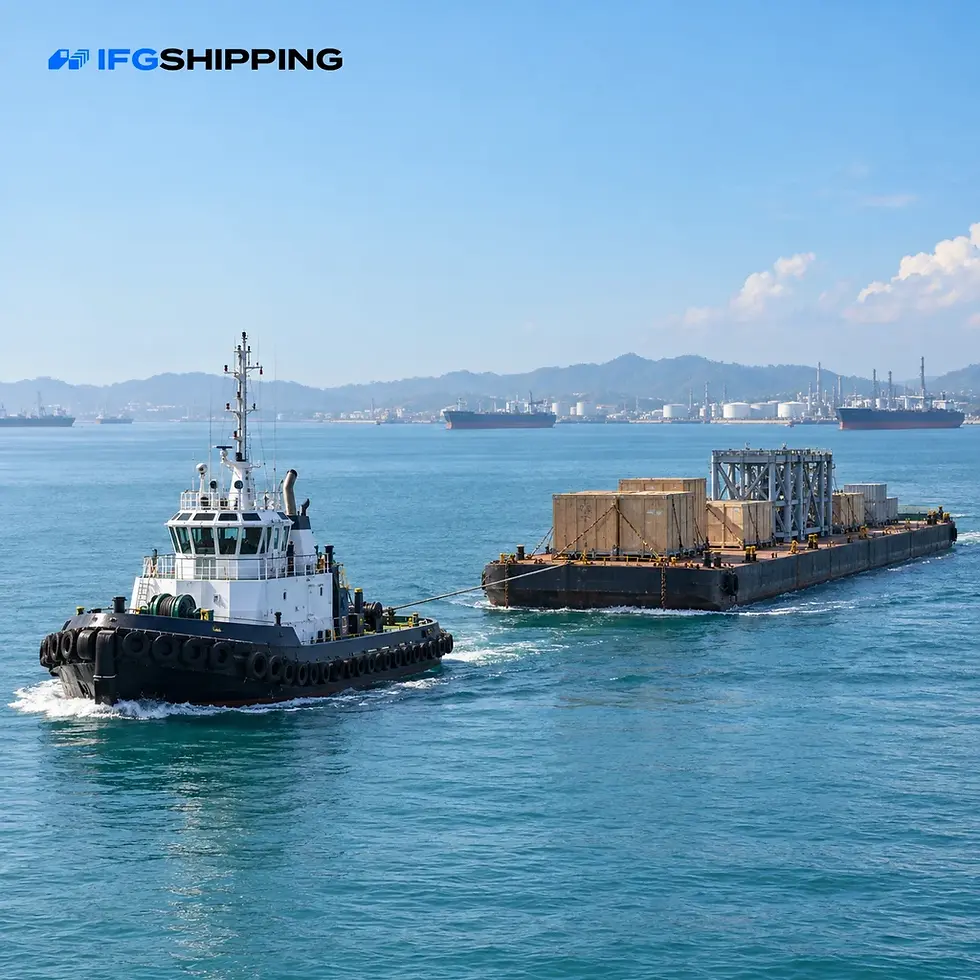
Image note: the header image is a generated illustrative scene, not a photograph of an IFG Shipping operation.
Note: customs schemes, control lists and permit requirements change, and control status depends on the specification of the individual item. Figures and requirements here are indicative and were verified against the sources above on 7 September 2026. Always confirm with Singapore Customs or your declaring agent before you ship. This article is educational and is not legal advice.
Iman Yusoff is Founder and Director of IFG Shipping, with more than 20 years in freight and cross-border trade across the Singapore, Malaysia and Indonesia corridor.
Content production support: SingRank, an SEO and AI search (GEO) agency in Singapore.


Comments