
Barge Charter Singapore to Indonesia: Time, Voyage, Bareboat

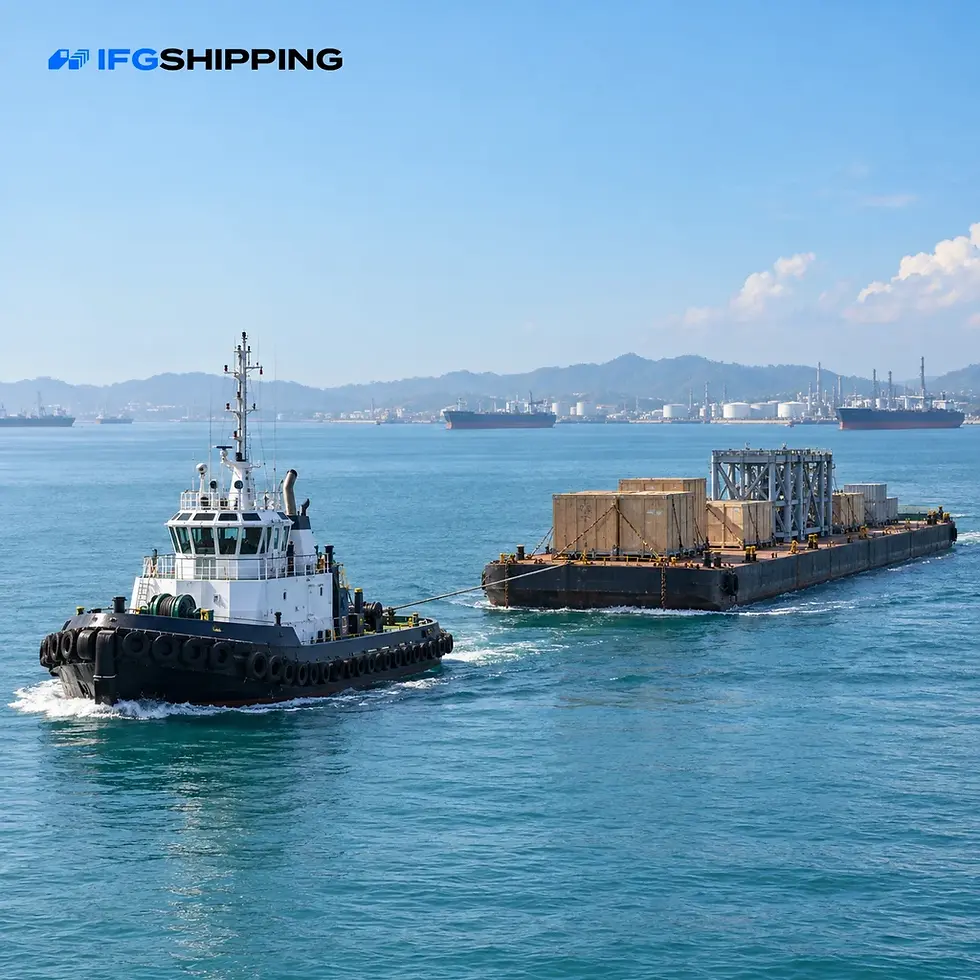
Which contract do you sign for a barge charter Singapore to Indonesia job: time, voyage or bareboat? Start one step earlier and check whether the tug and barge will ever carry cargo between two Indonesian points. Indonesian law keeps that leg for Indonesian-flag vessels. Once the route is clear, the contract almost picks itself.
The pages you meet while searching rarely raise it. On 5 October 2026, 16 tug-and-barge charter pages shown for four Singapore and Indonesia searches were checked, and 1 of 16 said anything about flag, cabotage or Indonesia's foreign-vessel permit.
Buyers skip the same step. On a public barge-listing board, one charterer wrote: "As we are looking for 10000mts SPB kindly offer your best hire idea for fixing within next week." Another asked only: "will u consider a long bb charter". Both named a contract and a deadline. Neither said where the cargo would load or land, or which flag the job needs.
If you're moving a full offshore spread, read this with our guide to MOB and DEMOB costs on offshore projects.
Sources and census checked 5 October 2026 · Iman Yusoff, IFG Shipping
Key takeaway: A foreign tug and barge may carry your cargo from Singapore to an Indonesian port that is open to foreign trade. It may not then carry goods between Indonesian islands or ports. If the barge will work at an offshore site, its Indonesian operator needs a PPKA before it enters Indonesian waters.
What Is a Barge Charter, and Why Is the Tug a Separate Question?
A barge charter is a contract to use a barge you don't own, for one move or for a set period. Many project barges are flat-deck units with no engine, so something has to tow them. That tug may sit inside the same deal or come from a second owner. If a piece is too wide for a box but too small to justify a barge, see our explainer on out-of-gauge cargo.
BIMCO, the shipowners' body behind the standard forms, keeps separate paper for each piece. BIMCO's BARGEHIRE is a bareboat form for unmanned barges with no engine of their own. For the tow, BIMCO's TOWCON prices an ocean tow as one lump sum, while TOWHIRE runs on daily hire. Neither is meant for towing inside a port.
So ask every owner one thing first: is the tug included, and on what terms? A lump-sum tow puts weather delay on the tug owner. Daily hire puts it on you.
How Does a Voyage Charter Work?
You pay freight for one job: load here, discharge there. BIMCO describes GENCON as its standard voyage charter, "a general purpose agreement for the services of a ship in exchange for freight". The owner keeps running the vessel, the crew and the fuel. You agree the cargo, the ports and the time allowed to load and discharge.
For a tug and barge, that usually means a lump-sum tow plus the barge for the trip. It suits one move of known cargo between two named ports, and you don't pay for idle days at sea.
The weak spot is port time. If your cargo isn't ready, or the jetty at the other end is busy, the agreed time runs out and extra days get billed. It's the same logic as the box charges in our guide to demurrage and detention, only on a whole vessel.
What Do You Pay For on a Time Charter?
On a time charter, you pay hire for every day of a set period, whether the barge is moving, loading or waiting. You hire the barge, and usually the tug, and tell it where to go. The owner still supplies and crews the tug.
For time charters, start with NYPE. According to BIMCO, it is the most widely used time charter in dry cargo, and its 2015 edition was developed with the Singapore Maritime Foundation. For offshore work, there is BIMCO's SUPPLYTIME, a time charter for offshore support vessels. It runs "knock for knock": each side carries its own property and people, whoever is at fault.
Time charter fits when the barge must stay with the project: shuttles, standby at site, or a demob date nobody can promise yet. It's the wrong choice for one clean move on a fixed date, because you'd pay for days you don't need.
Why Does a Bareboat Charter Make You the Operator?
A bareboat charter is a lease of the vessel itself. BIMCO's BARECON says the charterer "obtains possession and full control of the ship along with the legal and financial responsibility for it", and generally pays fuel, crew, repairs, and P&I and hull insurance. Barges differ a little. BIMCO notes that a barge hired on BARGEHIRE often comes with the owner's insurance cover made available to the charterer.
For a firm that ships a few project loads a year, bareboat is rarely the answer. It suits an operator with its own tugs, crews and marine team. A buyer who asks for "a long bb charter" to cut the rate is also taking on the owner's job.
Time, Voyage or Bareboat Side by Side
Here is the difference between voyage charter, time charter and bareboat charter in one view. Read each column as a question of who pays and who carries the risk when a job goes off plan.
Question | Voyage charter | Time charter | Bareboat charter |
What you pay for | Freight for one move | Daily hire for a period | Hire for the bare vessel |
Who crews and runs it | Owner | Owner crews; you direct | You |
Who pays for idle days | Owner at sea; usually you in port past the agreed time | You, every day | You, every day |
Typical BIMCO form | GENCON; TOWCON for the tow | NYPE, SUPPLYTIME; TOWHIRE for the tow | BARECON; BARGEHIRE for unmanned barges |
Best fit on this lane | One move, known cargo, two named ports | Shuttles, standby, open demob date | Operators with their own tugs and crews |
The table tells you who pays. It doesn't tell you who may sail. That part comes from Indonesian law, and it beats whatever your charter party says.
Where Does Indonesia's Flag Rule Bite?
It bites on any leg between two Indonesian islands or ports. Indonesia keeps domestic sea transport for its own fleet. Article 8(1) of Indonesia's Shipping Law, UU 17/2008, says national shipping companies carry it, using Indonesian-flag vessels with Indonesian crews. Article 8(2) goes further:
Foreign vessels are prohibited from carrying passengers and/or goods between islands or between ports in Indonesian waters. (UU 17/2008, Article 8(2), our translation)
The penalty went up in 2024. UU 66/2024, the third amendment to the Shipping Law, dated 28 October 2024, sets up to 11 years in prison or a category VII fine for operating a foreign vessel in breach of Article 8(2).
The rule itself hasn't moved. The 2023 Job Creation Law changed other parts of the Shipping Law, but its list of amendments in UU 6/2023 leaves Article 8 as it was. So the flag test is old, stable law; only the punishment is new.
What Does the Flag Rule Mean on a Singapore Job?
One extra stop can turn an international trip into a domestic one. Say you load in Singapore and discharge in Batam: that is one international leg. Now discharge half the cargo in Batam and carry the rest to a second Indonesian port. That second leg is domestic.
A Singapore-flag or Malaysian-flag barge can't sail it, whatever the charter party says. This is where a barge time charter from Singapore to Indonesia can trip you up. The contract is lawful. The order you give the barge halfway through may not be.
Why a Foreign Tug Can Reach an Indonesian Port
International carriage is open to foreign vessels. Article 11(1) of UU 17/2008 says national or foreign companies may carry goods to and from abroad, on Indonesian-flag or foreign vessels. So a Singapore-registered tug and barge can bring your cargo into Indonesia.
Article 11(4) adds two conditions. A foreign shipping company may only call at Indonesian ports open to foreign trade, and it must appoint a national company as its general agent.
That makes the discharge point as important as the flag. A private jetty on a remote coast may be exactly where the project needs the cargo, and exactly where a foreign tow can't go direct. In practice that can mean two steps:
A foreign tug and barge run from Singapore to an Indonesian port open to foreign trade.
An Indonesian-flag vessel takes the last domestic leg to site.
Plan both legs, and both contracts, from day one.
What 16 Barge-Charter Pages Say, and Leave Out
Of the 16 pages checked, most say where they sail and almost none mention the flag test. To see what a buyer actually meets, 20 provider pages were taken from four searches on 5 October 2026 and read line by line. Four could not be fetched, which leaves 16.
What the page states | Pages (of 16) |
Names Indonesia, or an Indonesian port or island, as served | 12 |
A charter basis (time, voyage or freight, bareboat) | 6 |
A barge size or capacity figure | 5 |
Insurance of vessel or cargo | 2 |
Any flag, cabotage or PPKA wording | 1 |
A rate or price | 1 |
A BIMCO standard form | 0 |
Laytime or demurrage | 0 |
The one page that mentions a flag does so in its footer, stating its own fleet's flag; it doesn't explain the rule. None of the 16 explains the Indonesian test, names a standard form or says how waiting time is paid.
That isn't a charge against any provider. A service page is built to start a conversation; the binding terms sit in the charter party, not on the web page. It does mean that the flag and route questions are yours to raise. If you don't ask them, nobody on these pages will.
What Is the PPKA for Barges That Work at Site?
The PPKA is Indonesia's approval to use a foreign vessel, and it covers barges that work rather than just carry cargo: barges that lift, drive piles, house crews or lay cable.
Permenhub PM 2/2021 dates from 29 January 2021 and is listed as in force by Indonesia's official legal database on 5 October 2026. It lets a foreign vessel do work other than carrying passengers or goods where no Indonesian-flag vessel is yet available, and the vessel must hold a PPKA before it enters Indonesian waters.
Under Article 2 and Annex I of PM 2/2021, six kinds of work qualify: drilling, dredging, oil and gas surveys, building offshore, supporting offshore operations, and salvage or underwater jobs. Power generation and jetty building are added on top. Its annex names barge types: a piling barge with a hydraulic hammer of at least 200 tons, a semi-submersible accommodation barge with more than 120 rooms or a crane of at least 100 tons, jack-up barges, cable barges, and concrete-mixing barges for jetty work.
The PPKA Rules That Change Your Plan
The PPKA isn't yours to apply for. Five articles of PM 2/2021 shape who files, what they need and how long it lasts.
Article 1 grants the PPKA to the Indonesian shipping company that operates the foreign vessel.
Article 4 makes that company file the charter party with the foreign owner, a work plan with site coordinates, and proof that an Indonesian-flag vessel was sought first. Article 11(2) says that search must be announced in national media at least 3 months before the application.
Article 8 caps a PPKA at 6 months, and an extension must be filed before it expires. Under Article 9, a contract longer than 2 years means the vessel must be registered under the Indonesian flag, drilling aside.
On paper, the ministry moves fast: it checks documents within 4 working days of a complete file, then prepares the legal review within 3 working days. The 3-month advertising rule is the real clock. Your contract chain must be settled before the permit file can even be complete.
Which Barge Charter Singapore to Indonesia Contract Fits Your Job?
Here is a verdict for five common job shapes. These are judgement calls, not rules; your site, cargo and client may change them.
One move to one Indonesian port open to foreign trade: voyage terms, or a TOWCON lump sum plus the barge. A foreign flag is fine. Pay for the delivery, not the days.
Cargo to a site with no open port nearby: split the route, foreign tow first, Indonesian-flag vessel last. Don't accept a "door to site" quote on one foreign barge.
Shuttles between Indonesian points: that's domestic transport under Article 8. Time charter makes sense, but only with an Indonesian-flag tug and barge.
A crane, piling or accommodation barge working offshore: the Indonesian operator needs a PPKA first. Plan for 6-month renewals if the work may run long, and start the vessel search early.
Bareboat: only if you already run tugs and crews.
IFG has handled a version of this planning problem, chartering a vessel to carry a fleet of eight ROV units from Vietnam to Johor in a single controlled lot. Our guide to shipping an ROV spread through Singapore covers the container-or-charter choice for subsea kit.
What Must Clear Before a Tow Leaves Singapore?
On the Singapore side, the vessel and the cargo clear separately, and for the vessel the Maritime and Port Authority of Singapore sets the rule. Under Section 46(1) of the MPA Act, a vessel may leave port only once the Port Master grants port clearance. Section 47(1) then gives the vessel 48 hours to sail, or less if the Port Master sets a shorter period. The tug owner's agent files this, but late cargo can still push the tow past that window.
For the cargo, there are two filings: the export declaration to Singapore Customs, and import clearance with Indonesia's customs service, Bea Cukai. Your declaring agents handle both, and the charter party replaces neither. Keep the cargo list and values identical on both filings. If the Indonesian side stalls, our guide to cargo held at Indonesian customs covers the usual causes.
When Does the Monsoon Matter for a Tow?
The Meteorological Service Singapore says the Northeast Monsoon runs from December to early March and the Southwest Monsoon from June to September, the latter with occasional Sumatra squalls gusting at 40 to 80 km/h.
A slow tow with a tall deck load feels both seasons. On daily hire, you pay for every hour it waits at anchor. On a lump sum, the tug owner carries that wait and prices it in. Either way, a sailing window that avoids the worst weeks is worth more than a small rate cut.
If your cargo fits in containers, you may not need a barge at all: our guide on shipping from Singapore to Indonesia by container covers that simpler path.
What Moves the Price of a Barge Charter?
Our MOB and DEMOB guide names four things that move a charter price: how many vessels are free, the lane, the season and the lift itself. Rates are not printed here, and only one of the 16 pages above printed a figure at all. A rate given before the owner has seen your deck plan and route can only be an estimate.
What you can control is what drives the number:
Tug terms: lump sum or daily hire decides who pays for waiting.
Route: a split route adds a second vessel and a second contract.
Positioning: a barge that sails in from elsewhere may bill that trip.
The cargo itself: weight, footprint, lashing and sea-fastening design.
Redelivery: where and when the barge goes back to its owner.
7 Checks Before You Fix a Tug and Barge
Map every leg. Mark each leg that starts and ends in Indonesia. Those need an Indonesian flag.
Confirm the discharge port is open to foreign trade. If not, plan the split route before you ask for rates.
Decide if the barge will work at site. Lifting, piling, housing crews or laying cable means a PPKA first, and a vessel search announced months ahead.
Ask whether the tug is included. Get the tow terms in writing, including who pays for weather days.
Match the contract to the job. One move means voyage terms. Shuttles or standby mean time charter.
Settle insurance and liability. Ask who insures the barge and who insures the cargo; our guide to marine cargo insurance explains what cargo cover does.
Line up both customs filings. The cargo list and values must match on both sides.
If cargo lands damaged despite all this, start with who pays when cargo is damaged. When one part fails and the job can't wait for a tow, read moving critical spares fast.
Method
Frame: the results of four searches run on 5 October 2026 through a self-hosted metasearch tool set to Singapore English. The queries were "barge charter singapore indonesia", "tug and barge charter singapore", "tug and barge charter indonesia" and "barge rental singapore".
The 51 result rows, with repeats, were filtered to providers' own pages offering, or showing a project of, tug, barge or landing-craft charter in Singapore, Malaysia or Indonesia. News, directories, marketplaces, social profiles, papers and out-of-region providers were excluded, keeping one page per provider. That left 20 pages.
Each page was fetched once with a named crawler that respects robots.txt; 4 failed (two refusals, one expired certificate, one empty response) and were kept as failures, not replaced. The text of the other 16 was coded with AI assistance against eight written definitions fixed before collection. An item was coded "yes" only when the term or an unambiguous equivalent appears.
The frame, rules and scripts were frozen with checksums before collection. Every "yes" on flag wording and at least ten "no" answers were re-checked against the saved page text; no code changed.
Limits
This is a snapshot of 16 pages on one day, not a full count of every barge provider. The metasearch blend is not Google's exact ranking, and several engines returned errors that day.
Only one page per provider was read, so a provider may explain flag rules elsewhere on its site or in a quote. Text in images or scripts may have been missed, and coding was a single AI-assisted pass, not independently double-coded. The count shows what a buyer sees while searching; it says nothing about how these providers run their charters.
Cite this
"Barge-charter provider pages census, 5 October 2026", published by IFG Shipping in "Barge Charter Singapore to Indonesia: Time, Voyage, Bareboat" (canonical path /post/barge-charter-singapore-to-indonesia on this site). Collected 5 October 2026; article published 8 October 2026. Dataset version 1.0, anonymised CSV of 20 rows: census-barge-charter-pages-2026-10-05-PUBLIC.csv.
Learn It With Iman, or Hand It to IFG
I've worked in shipping since 1999. I founded IOL Shipping in 2009 and IndoBox Asia in 2011, I've run IFG Shipping since 2021, and I served as Honorary Secretary of SMCCI from 2023 to 2025.
If you'd like to learn the contract logic yourself, the guides on this site cost nothing to read, and I post shorter lessons on LinkedIn and on TikTok as @freightsifu. Read more about how I teach; there are no courses, workshops or certificates to buy. Ask me in English, Malay or Indonesian.
If you'd rather hand the job to a forwarder from Singapore to Indonesia, IFG lists vessel chartering for oversized shipments, heavy lift and MOB & DEMOB among its sea freight services. For a barge charter Singapore to Indonesia enquiry, send IFG the cargo list, the sizes, the load point and the Indonesian destination, or WhatsApp +60 14 325 8325. IFG replies on the route and the documents before any rate is discussed.
Disclaimer: This guide is general education, not legal advice. It summarises Indonesian and Singapore rules as published when checked on 5 October 2026. Indonesian shipping rules change, so confirm the current PPKA rules with the Directorate General of Sea Transportation and a qualified Indonesian adviser before you fix a vessel. Customs and the port authorities decide every clearance.
Content production support: SingRank, an SEO and AI search (GEO) agency in Singapore.


Comments