
Air Waybill Explained: Why It Won't Hold Your Cargo Like a Bill of Lading

Updated: Oct 2

Updated 13 September 2026 · By Iman Yusoff
You shipped by air because your buyer needed the goods fast. The cargo landed, your buyer collected it, and the payment you expected against documents still hasn't come. Nothing went wrong with the flight. What went wrong was assuming an air waybill works like a bill of lading.
An air waybill (AWB) is the transport document for air cargo: evidence of the contract of carriage and of the airline's acceptance of your goods. Unlike a bill of lading, it won't hold your cargo until you're paid. It is not negotiable, and the named consignee can require delivery once the cargo arrives.
Key Takeaway: On air freight, the consignee box does the job a paper original does at sea. Nobody surrenders an original before the named consignee collects. So decide who goes in that box, and how you get paid, before you book the flight.
Key Takeaways
Article 7 of the Montreal Convention 1999 requires 3 original parts: one for the carrier, one for the consignee, one for the shipper.
An AWB can't be negotiated the way an order bill of lading can, according to US Department of Commerce guidance.
On arrival, the consignee can require delivery on payment of the charges due, and your right to stop or redirect the cargo ends at that moment (Articles 12 and 13).
An AWB number has 11 digits in the format 000-00000000: a 3-digit airline code, then an 8-digit serial ending in a check digit.
On Singapore Customs' postal and courier import page, the importer is whoever is consignee on the freight paperwork, such as the house AWB.
What is an air waybill, in plain terms?
It's the record that proves an airline agreed to carry your goods. Article 4 of the Montreal Convention 1999 requires a waybill to be delivered for the carriage of cargo, though Article 4(2) lets another record of the carriage stand in its place. Under Article 11(1), the document is prima facie evidence of 3 things. Those are the conclusion of the contract, the carrier's acceptance of the cargo, and the conditions of carriage written on it.
For a Singapore business this isn't distant law. Singapore wrote the Convention into its own statute book: section 3 of the Carriage by Air Act 2007 makes its rules on carriers, consignors and consignees binding here. IATA treats the AWB as the carriage contract itself, struck between the shipper and the airline. Its paper form falls under IATA Resolution 600a.
If you want the air waybill meaning in one line, here it is: proof of carriage, not proof of ownership. Hold on to that. Every payment problem below grows out of forgetting it.
What must the form show, and who answers for it?
Legally, the form needs very little. Article 5 asks for only a few entries: where the cargo departs, where it's going, and how much it weighs. Article 10(1) makes the shipper, called the consignor, responsible for the correctness of the cargo particulars it supplies. So the description, weight and piece count you hand your forwarder are your statements, not the airline's.
One more rule surprises people. Article 9 goes further: get Articles 4 to 8 wrong, and your carriage contract still stands. In short, the document proves the deal. It doesn't create the deal, and it doesn't transfer the goods either.
Who holds which of the eight AWB copies?
Article 7 requires the shipper to make out 3 original parts. Part 1 is marked "for the carrier" and signed by the shipper. Part 2 is marked "for the consignee" and signed by both shipper and carrier. For part 3, the carrier signs and hands it back to the shipper after accepting the cargo.
Airlines print more paper than the Convention asks for. IATA Resolution 600a, reproduced in UNCTAD's guide to the carriage of goods by air, sets the airline's printed form as a set of at least 8 copies. Each copy has a fixed title and an optional colour code.
Part | Who it is for | Colour code |
Original 3 | Shipper | Blue |
Original 1 | Issuing carrier | Green |
Original 2 | Consignee | Pink |
Copy 4 | Delivery receipt | Yellow |
Here's the trap. "Original" sounds like the power of a sea original, so sellers treat the blue Original 3 as if it held the goods. It doesn't. Your copy gives you something narrower and time-limited, as the next 2 sections show.
Air waybill vs bill of lading: the difference that decides payment
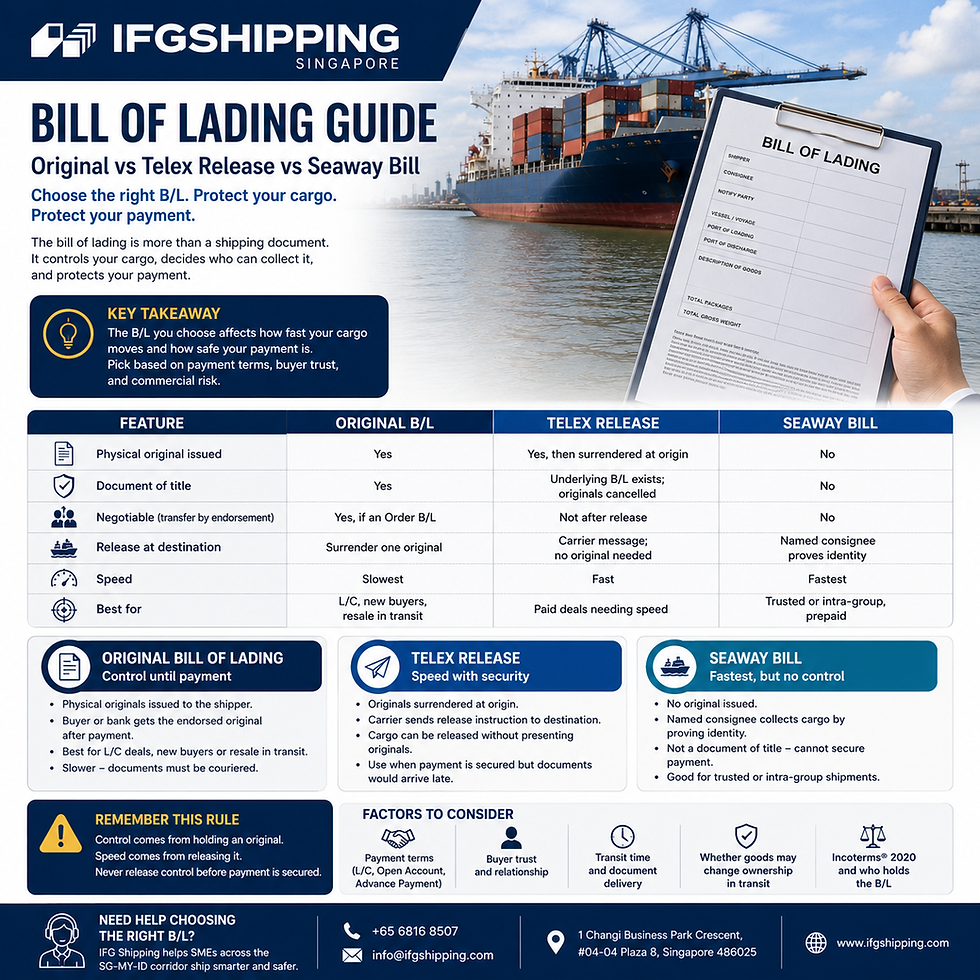
Both documents look alike on a desk. At sea, an original B/L is a document of title, and an Order B/L can pass by endorsement. That transfer is what lets a bank hold sea cargo until your buyer pays. I set out the 3 sea-side options in our comparison of original, telex and seaway bills of lading compared.
Air paperwork doesn't work that way. Guidance from the US Department of Commerce ties the AWB to one shipper and rules out negotiating it, which is exactly where it parts company with an order bill of lading at sea.
UNCTAD gives the reason. Air transport is fast, so there's normally no need for a document that lets goods be sold in transit. UNCTAD adds that many forms print the not-negotiable status in the top right-hand corner.
Feature | AWB | Original B/L | Telex release | Seaway bill |
Mode | Air | Sea | Sea | Sea |
Negotiable | No | Yes, if an Order B/L | Not after release | No |
Original surrendered to collect | No | Yes | No, originals surrendered at origin | No originals issued |
Who collects | Named consignee on arrival | Holder of an endorsed original | Named consignee after carrier release | Named consignee |
Holds cargo until payment by itself | No | Yes | No | No |
Is an air waybill a document of title?
No, and some published advice still gets this wrong. You'll find export glossaries that call the AWB a document of title that proves ownership. Montreal's own wording doesn't support that reading.
Article 13(1) gives the consignee its right the moment cargo reaches destination. The consignee pays "the charges due", meets the conditions of carriage, and can then demand delivery. Nowhere in Article 13(1) is an original surrendered. Treat the air waybill and bill of lading difference as a difference in control, not paperwork, and you'll price payment risk correctly.
Who can collect the cargo when it lands?
Two parties hold rights, and they take turns. Before arrival, you as shipper hold a right of disposition. Article 12(1) lets you withdraw the cargo at the airport of departure or destination. You can also stop it mid-journey, call for delivery to someone other than the named consignee, or have it returned to the airport of departure.
Your blue Original 3 earns its keep here, and only here. Under Article 12(3), a carrier that follows your instructions without asking for your part of the document is liable to whoever lawfully holds that part. Keep it until delivery. It's your authority to redirect a consignment.
When does your control of the cargo end?
Then the rights switch. Article 12(4) ends your right at the moment the consignee's right begins. That right starts under Article 13 on arrival at destination. The carrier has a duty too, under Article 13(2): tell the consignee as soon as the cargo lands, unless the parties agreed something else.
One exception hands control back. If the consignee declines the cargo or can't be reached, your right of disposition revives under the second sentence of Article 12(4). A buyer who turns up and collects hasn't declined anything. Don't build a payment plan on that exception.
Set the 2 modes side by side and the stake is plain. At sea, a held original keeps control after the ship arrives. By air, your control ends when the aircraft lands and the named consignee claims the cargo.
Why documents-against-payment breaks on air freight
Documentary collection works at sea because a bank holds the document your buyer needs to collect. Under an AWB, your buyer needs no such document. The US Trade Finance Guide warns that under documentary collections, air cargo is harder to control than ocean cargo. A foreign buyer can take the goods whether or not they've paid, unless the exporter has its own agent at destination holding delivery until payment arrives.
I've seen the sea-side version of this mistake for years. Running the Indonesia–Singapore corridor, I saw shippers release cargo too early and chase payment for months. Air freight writes that early release into the paperwork by default.
Which payment terms fit air freight?
So our position on air cargo is blunt:
Skip documents against payment on air freight with a buyer you haven't traded with before. Under an air waybill, your buyer doesn't need the papers a bank is holding to collect the cargo.
Never name an unpaid first-time buyer as consignee if your payment depends on controlling the goods.
Choose terms that settle payment before the flight. Or name a party in the destination country who takes delivery for you until you're paid, the route the US Trade Finance Guide itself describes.
Which structure fits depends on your buyer, not on the mode. Compare letter of credit versus open account and telegraphic transfer versus letter of credit. For D/P and D/A mechanics, see documentary collections (D/P and D/A) explained. We don't set out letter-of-credit document rules for air cargo here, because they turn on the exact terms of your credit.
Air freight or sea freight for SMEs: on payment control alone, sea wins, because a held original B/L keeps the goods until you're paid. Cost, weight and deadline belong in the same decision, and our sea freight versus air freight break-even guide works through that side.
If you're comparing air freight quotes from several forwarders, use our 7-point method to compare freight forwarder quotes.
Which AWB names your importer, master or house?
Consolidated air cargo carries 2 waybills. An airline issues a Master Air Waybill to the freight forwarder that consolidated the cargo, and that forwarder issues a House Air Waybill to you. Under IATA's Singapore e-AWB Handling Guideline, forwarders tender no physical master waybill or house manifest to the airline from origin.
The importer rule comes from Singapore Customs' page on importing by postal or courier service. On that page, the importer is whoever appears as consignee on the freight paperwork, with the house waybill (HAWB) and the consignment note given as examples. Where end buyers are each named as consignee on their own separate consignment notes, the same page says each of those buyers may be considered an importer.
Arriving by air, you'll need the AWB, the commercial invoice, the packing list and a copy of the permit in hand at the checkpoint, per its documents for clearance page. Our guide to air freight clearance rules in Singapore walks the checkpoint process in full.
What Singapore Customs says about master waybills
Singapore Customs also answers the permit questions traders keep raising about master waybills on its official Q&A:
One permit application can carry only 1 Master AWB. Several House AWBs can sit under 1 permit only for the same consignee, and only if different Competent Authorities don't control them (Singapore Customs).
You may declare the same MAWB on 2 separate permits by writing "Partial shipment of MAWB XXXX" under Trader's Remarks (Singapore Customs).
Cargo shipped in separate shipments under new MAWBs needs a new export permit for each new MAWB (Singapore Customs).
For an SME, the lesson fits in 1 line. Under that postal and courier guidance, whoever sits in the consignee box on the house document is the importer. Check that name matches the business filing the import declaration before cargo moves, and follow our customs clearance in Singapore step by step guide if that business is yours.
How do you read an air waybill number?
Every airline AWB carries an 11-digit number, and you'll quote it whenever you chase a shipment. IATA's standard format is 000-00000000. Digit 11 is a check digit under the unweighted Modulus 7 method. The US Department of Commerce notes that the waybill allows a shipment to be tracked, so your air waybill tracking number and your AWB number are one reference.
IATA Resolution 600a, as reproduced by UNCTAD, fixes the structure: the issuing carrier's 3-digit IATA airline code, then an 8-digit serial number with the check digit in the extreme right position.
Part of the number | Digits | What it tells you |
Airline code | 3 | Issuing carrier's IATA airline code |
Serial number | 7 | Consignment serial |
Check digit | 1 | Validates the number under Modulus 7 |
Two habits save time. If a tracking page rejects a number, re-check all 11 digits and the hyphen after digit 3 before you chase anyone. On a consolidation, ask your forwarder for both master and house references, since the airline issues one and the forwarder issues the other.
When the waybill goes electronic
Air cargo doesn't always travel with paper. Montreal anticipated that. Article 4(2) allows any other means that preserves a record of the carriage to replace the waybill, and the carrier must give you a cargo receipt on request.
IATA's Resolution 672, the Multilateral e-AWB Agreement, removes the requirement for a paper AWB. Singapore's e-AWB Handling Guideline, version 6.0 dated 8 October 2015, sets local practice. Forwarders transmit master and house records electronically instead of tendering paper at the airline counter.
None of this changes the rights described above. An electronic record proves the contract of carriage just as paper does. If you want something in hand, ask for the cargo receipt Article 4(2) entitles you to.
Before you book: a 6-point AWB check
Agree how you'll be paid before booking, not before release. On air freight there's no original to hold back.
Decide who goes in the consignee box. That party can require delivery on arrival under Article 13(1), and Singapore Customs' postal and courier import page treats the consignee on the House AWB as the importer.
Check the description, piece count and weight you give the forwarder. Article 10 makes you responsible for their correctness, and Article 5 makes weight a required entry.
Keep Original 3, the blue part, until delivery. Article 12(3) is why a carrier should ask for it before redirecting your cargo.
Ask for both numbers on a consolidation, master and house, so your permit and tracking line up.
Know the 7-day line. If cargo hasn't arrived 7 days after the date it ought to have arrived, the consignee can enforce the contract rights against the carrier under Article 13(3). For what a claim is then worth, read who pays when cargo is damaged or lost.
Not sure the paperwork protects your deal?
An AWB is quick to issue and easy to misread, and misreading it costs sellers control of the goods. Before you book the flight, send us the draft AWB, the commercial invoice and your payment terms. We'll tell you whether the consignee you've named still leaves you in control until you're paid. Start with IFG freight and documentation services.
Frequently Asked Questions
How does an air waybill differ from a bill of lading?
An AWB covers air cargo and isn't negotiable, so the named consignee can require delivery on arrival under Article 13(1) of the Montreal Convention 1999. A sea original bill of lading is a document of title, and the holder of an endorsed original controls collection. That gap decides whether documents alone can secure your payment.
Is an air waybill negotiable?
No. US Department of Commerce guidance ties each AWB to one shipper and treats it as non-negotiable, which order bills of lading are not. According to UNCTAD's 2006 guide, air transport is fast enough that there's normally no need for a document enabling sale of goods in transit, and many forms print the not-negotiable status in the top right-hand corner.
What is an air waybill number?
It's the 11-digit reference on every airline AWB, written 000-00000000. Digits 1 to 3 are the issuing carrier's IATA airline code. Next comes an 8-digit serial number whose last digit is a check digit, calculated with the unweighted Modulus 7 method under IATA standards.
Can I track a shipment with an AWB number?
Yes. The US Department of Commerce states that the waybill provides detailed information about the shipment and allows it to be tracked. On a consolidated shipment, ask your forwarder for both master and house numbers, because an airline issues the master and your forwarder issues the house document.
How is a MAWB different from a HAWB?
An airline issues the master waybill (MAWB) to the freight forwarder that consolidated the cargo. That forwarder issues the house waybill (HAWB) to the shipper. On Singapore Customs' postal and courier import page, the importer is whoever appears as consignee on the freight paperwork, the HAWB included, so check that name before cargo moves.
Do I still need a paper AWB?
Often not. Article 4(2) of the Montreal Convention lets another record of the carriage replace paper, with a cargo receipt on request. IATA Resolution 672 removes the paper requirement, and Singapore's e-AWB guideline, version 6.0, has forwarders transmit master and house records electronically.
Written by Iman Yusoff, Director of IFG Shipping Pte Ltd. In shipping since 1999.
Disclaimer: air waybill practice, carrier conditions and customs requirements vary by airline, lane and date. Rules above are as stated in the linked sources at the date of writing. Confirm current requirements with your airline, freight forwarder, Singapore Customs or the relevant authority before you ship. This article is general education, not legal or trade-finance advice, and IFG Shipping is not affiliated with any airline or government body named here.
Content production support: SingRank, an SEO and AI search (GEO) agency in Singapore.


Comments