
How to Compare Freight Forwarder Quotes Without Getting Burned

Updated: 21 hours ago
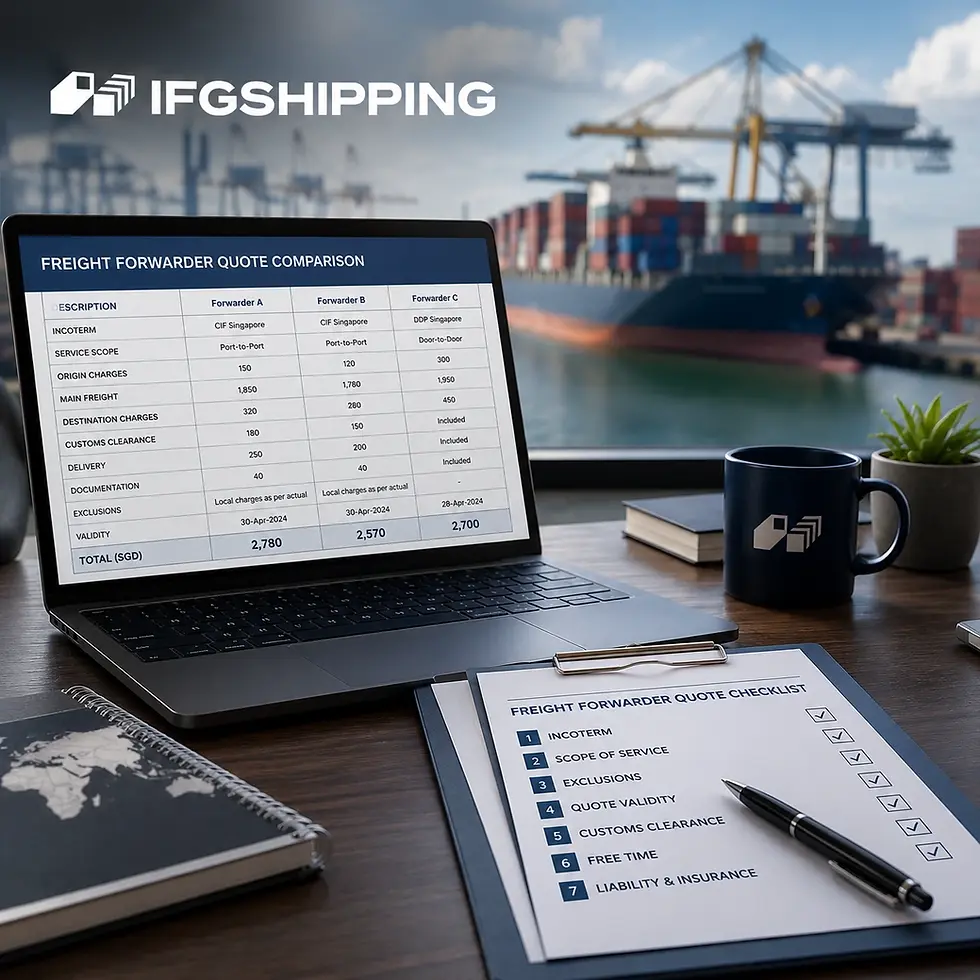
Compare freight forwarder quotes by normalising them before you price them. Force every forwarder onto the same Incoterm, the same service scope and the same cargo data. Only then does the cheapest number mean anything. Skip that step and you are comparing three different jobs, not three prices.
Most SME importers ask three forwarders for a quote and pick the lowest. That method fails almost every time. One forwarder quoted port-to-port. Another quoted door-to-door. The third quoted DDP and buried the duty inside. Consequently the "cheapest" quote often produces the largest final invoice.
This guide gives you the method IFG uses internally to compare freight forwarder quotes. It also covers the ASEAN-specific charges that global comparison guides ignore entirely.
Why two freight quotes are almost never comparable
Freight quotes differ in scope before they differ in price. Each forwarder decides where their responsibility starts and stops. One includes origin handling and customs clearance. Another excludes both. Therefore the two numbers describe different amounts of work, and comparing them directly tells you nothing.
Three variables cause most of the confusion:
The Incoterm. EXW, FOB, CIF and DDP each move the cost boundary somewhere else.
The service scope. Port-to-port and door-to-door are separate jobs with separate risk.
The exclusions. A line reading "local charges as per actual" is not a price.
Fix all three before you look at a single dollar figure. Our Incoterms 2020 guide to costs and risk transfer explains where each term draws the line.
Step 1: force every quote onto the same Incoterm
Send all forwarders one identical brief. Name the Incoterm, the origin address, the destination address, the gross weight, the exact dimensions and the commodity. Add the HS code if you have it. Then instruct every forwarder to quote that brief and nothing else.
This single discipline removes the most common comparison error. A CIF quote already carries freight and insurance. An FOB quote does not. Consequently an FOB number will always look cheaper until you add the legs it excludes.
Step 2: demand a line-item breakdown, not an all-in number
Ask for both figures: the all-in total and the itemised breakdown. The total tells you the likely invoice. The breakdown tells you where the risk sits. A forwarder who refuses to itemise is telling you something useful about how they will behave later.
Insist on separate lines for origin charges, main freight and destination terminal handling. Customs clearance, delivery and documentation each need their own line too. Additionally, ask which charges are fixed and which float with the market.
The 7-point comparison checklist
Compare freight forwarder quotes against the same seven points every time. Price is one point of seven, not the whole decision. Run the checklist in a spreadsheet with one column per forwarder. The winner is usually visible before you reach the total.
Seven points to score on every freight forwarder quote
Point | What to confirm in writing | Why it changes the real cost |
Incoterm | The exact term and named place | Decides which legs sit inside the price |
Scope | Port-to-port, door-to-port or door-to-door | Missing legs reappear as separate invoices |
Exclusions | A written list of what is not included | Vague exclusions become uncapped charges |
Validity | The date the rate expires | An expired rate is requoted at market |
Customs | Whether declaration and permits are included | Clearance is a separate professional service |
Free time | Free days at terminal and for the container | Short free time triggers demurrage and detention |
Liability | Cover limits and whether cargo insurance is included | Standard liability rarely equals cargo value |
Two quotes that pass all seven points are genuinely comparable. At that stage, and only at that stage, the lower number wins.
What a higher freight quote does to your GST bill
Singapore Customs requires importers to include freight and insurance charges in the declared value of the goods. Therefore your freight cost is not only a cost. It forms part of the base your import GST is calculated on. A higher quote raises the duty and tax figure alongside the freight figure.
Singapore Customs states the rule plainly. Importers must give full supporting documents to their declaring agent. They must also include freight and insurance charges in declared value (Singapore Customs, Import Procedures Overview). All goods imported into Singapore fall under three statutes. Those are the Customs Act, the GST Act and the Regulation of Imports and Exports Act.
This is the compounding effect global quote-comparison guides miss entirely. Additionally, it means a padded freight quote costs you twice. Work the full figure through our landed cost calculation method for Singapore importers before you commit.
The charges that decide the real winner
Destination charges separate a good quote from a bad one. Terminal handling, demurrage, detention, documentation and amendment fees rarely sit inside the headline rate. Consequently the forwarder with the lowest freight line can still deliver the highest invoice.
Ask three questions about every destination charge. Is it included? If not, what is the rate? What triggers it? Our breakdown of the hidden shipping costs that drain SME profit explains what triggers each one.
Free time is a price, not a courtesy
Free days decide whether demurrage ever starts. A quote with generous free time can beat a cheaper quote with a tight window. Therefore treat free days as a priced line item and compare them directly across forwarders.
ASEAN variables that global comparison guides ignore
Regional trade adds cost drivers that generic checklists never mention. Four matter most across the Singapore, Malaysia and Indonesia corridor. Each one can outweigh the difference between two competing freight rates.
Preferential duty eligibility. A forwarder who handles your ATIGA Form D claim can remove duty entirely on qualifying goods.
HS code accuracy. The declared code sets the duty rate and the permit requirements before any freight is paid.
Checkpoint procedure. Land freight through Woodlands and Tuas follows clearance rules that differ from sea cargo.
Free trade zone handling. Goods moving through an FTZ follow different permit paths and different timing.
Ask each forwarder how they handle all four. A cheap quote from a forwarder who cannot process a preferential certificate is not cheap. Our HS code classification guide for Singapore shows why the code drives everything downstream.
Ask these questions before you accept any quote
Six questions expose a weak quote within minutes, whichever forwarder sent it. Send them by email so the answers exist in writing. A forwarder who answers all six clearly has already proven more than their rate does.
What exactly is excluded from this quote?
Until what date is this rate valid?
How many free days apply at the terminal and on the container?
Does the price include the customs declaration and permit application?
What is your liability limit, and is cargo insurance included or extra?
What happens to the price if the weight or volume changes after booking?
Question four matters more than most importers realise. Singapore Customs lets importers appoint a registered declaring agent to obtain permits. It also requires the permit, invoice, packing list and bill of lading at cargo clearance (Singapore Customs, Import Operations Overview). Someone must do that work. Confirm it is priced.
What forwarders will not volunteer
I have quoted freight for 25 years. I have also watched SME owners choose the wrong quote for the right reasons. Here is what the industry rarely says out loud. A quote is a sales document first and a cost estimate second. Consequently the incentive is to look competitive on the lines you compare. The lines you skip stay quiet.
That is not fraud. It is structure. Forwarders quote against each other on the visible lines, because that is where deals are won. Meanwhile the invisible lines — terminal handling, free days, amendment fees, clearance scope — carry the real margin. A forwarder who itemises everything upfront is choosing a harder sale on purpose.
Iman Yusoff founded IFG Shipping Pte Ltd and has spent 25 years in freight across Southeast Asia. His career spans global forwarding at Panalpina, now DSV, and SDV, now Bolloré, plus NVOCC operations along the Singapore–Malaysia–Indonesia corridor. He served as Hon. Secretary (2023–2025) of the Singapore Malay Chamber of Commerce and Industry. See Iman Yusoff's freight background.
What good forwarding actually looks like
A strong forwarder quotes every charge before you book, not after. They tell you when your requested Incoterm creates risk you did not intend. Additionally, they flag a classification or permit problem while it is still cheap to fix. Read what a freight forwarder actually does if you are new to the role.
Questions SME importers ask about comparing quotes
How do I compare freight forwarder quotes fairly?
Send every forwarder one identical brief: same Incoterm, same origin and destination, same weight, dimensions and commodity. Require an itemised breakdown alongside the all-in total. Score each quote on scope, exclusions, validity, customs, free time and liability before you compare price.
Why is the cheapest freight quote often the most expensive?
A low headline rate usually excludes legs the other quotes include. Origin handling, destination terminal charges, customs clearance and delivery reappear later as separate invoices. The gap between quote and final invoice is where the saving disappears.
What should an all-in freight quote include?
An all-in quote should state origin charges, main freight, destination terminal handling, customs declaration, delivery and documentation. It should also list exclusions explicitly. Treat "local charges as per actual" as an unpriced line, not an inclusion.
Does the freight cost affect my import GST in Singapore?
Yes. Singapore Customs requires freight and insurance charges to be included in the declared value of imported goods. Therefore a higher freight figure increases the value your GST and duty are calculated against. Freight is not a tax-neutral cost.
How long is a freight quote usually valid?
Validity varies by forwarder, lane and market conditions, so confirm the expiry date in writing on every quote. Ocean rates move with capacity and season. An undated quote gives the forwarder room to requote at booking.
Should I use my supplier's freight forwarder?
Using the supplier's forwarder removes your control over cost and communication. You cannot compare what you did not tender. Appointing your own forwarder gives you direct visibility over charges, timing and the customs declaration made in your name.
Send us the quotes and we will read them with you
Email or WhatsApp the freight quotes you are weighing up. We will tell you what each one excludes and which charges land later. Then we will show you which quote wins once the scopes match.
WhatsApp: +60 14-325 8325
Email: contact@ifgshipping.com
Office: 51 Changi Business Park Central 2, Singapore 486066
Sources
Singapore Customs — Import Procedures Overview: customs.gov.sg
Singapore Customs — Import Operations Overview: customs.gov.sg
Singapore Customs — Types of Import Permits: customs.gov.sg
Disclaimer. This guide provides general trade information, not legal, tax or financial advice. Freight rates, surcharges, free time and customs requirements change and vary by carrier, lane and jurisdiction. This article states no rate figures because rates move constantly. Confirm current requirements with Singapore Customs, your carrier and your forwarder before you book.
Editorial note: written for ASEAN SME importers and exporters. SEO, AEO and GEO editorial support by SingRank.


Comments