
How to Verify a Freight Forwarder in Singapore and Malaysia

Updated: Oct 2

"We are a licensed freight forwarder." You have read that sentence on every forwarder website you have visited this week, including ours. It means two completely different things depending on which side of the Causeway the company operates.
If you ship between Singapore and Malaysia, you are dealing with both systems at once — and they are not merely different in detail. They are structured in opposite ways.
The short version: Singapore does not issue a freight forwarder licence at all. Malaysia does — a customs agent licence under Section 90 of the Customs Act 1967. So "licensed" is a meaningful claim in Malaysia and an empty one in Singapore unless the company can name the specific registration it holds.
Why Does This Matter Before You Appoint Anyone?
Because the party who lodges your declaration carries obligations attached to it, and if that party is not properly registered your shipment is exposed in ways you will only discover when something stops.
It also matters commercially. A forwarder who cannot lodge declarations themselves must route them through someone who can, adding a link to the chain. That is not automatically wrong — but you should know it is happening, and most importers do not.
Singapore: There Is No Freight Forwarder Licence
No Singapore authority issues a licence to operate as a freight forwarder. Anyone can incorporate a company and use the title.
What Singapore regulates is the act of declaring goods. To apply for customs permits — for itself or on behalf of clients — a company must register as a Declaring Agent with Singapore Customs and obtain a TradeNet user ID. Customs states explicitly that this covers importers, exporters, shipping agents, air cargo agents, freight forwarders and common carriers.
So in Singapore the correct question is never "are you licensed?" It is "are you a registered Declaring Agent, and will you lodge my permit under your own account?"
What Singapore Credentials Actually Exist?
ACRA registration and a UEN. A company must be registered with ACRA, or the relevant UEN issuance agency, before it can register as a Declaring Agent at all.
Declaring Agent registration with Singapore Customs. The credential people mean when they say "licensed".
A TradeNet user ID. Without it, no permit application can be lodged.
Declarants who have passed SC401. Individuals must pass the Customs Competency Test for Declarants before they can be registered as Declarants.
An Inter-Bank GIRO with Customs. Declaring entities must maintain an IBG with Singapore Customs to pay duties, taxes, fees and penalties.
Singapore Customs publishes the process on its Declaring Agent authorisation pages. There are also published Terms and Conditions that Declaring Agents operate under — meaning a competent provider can discuss the standard without hesitating.
Malaysia: Here There Genuinely Is a Licence
Malaysia works the other way. Companies operating as freight forwarding agents, customs agents or shipping agents are required to obtain the relevant licence from the Royal Malaysian Customs Department under Section 90 of the Customs Act 1967.
Under Section 90, customs agents may act on behalf of importers and exporters to conduct business and relieve goods from customs control. The category covers shipping agents, forwarding agents and freight forwarders together.
This is a substantive permission, not a registration formality — which is precisely why the word "licensed" carries weight in Malaysia and should be tested there.
What Does a Malaysian Licence Application Involve?
The requirements tell you how serious the permission is. Applications go to the State Director of Customs with supporting documents including business registration certification, a copy of the share certificate, Form 24 and Form 49, a letter of appointment from customers, and a list of represented customers.
There is also a prerequisite most importers have never heard of: to qualify for a freight forwarding agent or customs agent licence, a company must first obtain International Integrated Logistics Services (IILS) status from MIDA before acquiring the licence from Customs.
And a tax obligation attaches. Under Section 90(2) of the Customs Act 1967 the applicant must be a registered person under the Service Tax Act 2018, and customs agents registered under Section 90(2) must apply for service tax registration within 14 days of approval as a customs agent.
Singapore vs Malaysia: The Comparison in One Place
Forwarder licence exists? Singapore: no. Malaysia: yes, under Section 90 of the Customs Act 1967.
Company registry. Singapore: ACRA, producing a UEN. Malaysia: business registration certification submitted with the licence application.
Permission to declare. Singapore: Declaring Agent registration plus TradeNet ID. Malaysia: the Section 90 customs agent licence.
Individual competence. Singapore: declarants must pass SC401. Malaysia: handled through the licensed agent structure.
Prerequisite status. Singapore: none beyond ACRA. Malaysia: IILS status from MIDA first.
Tax registration. Singapore: IBG with Customs for duties and taxes. Malaysia: service tax registration within 14 days of approval.
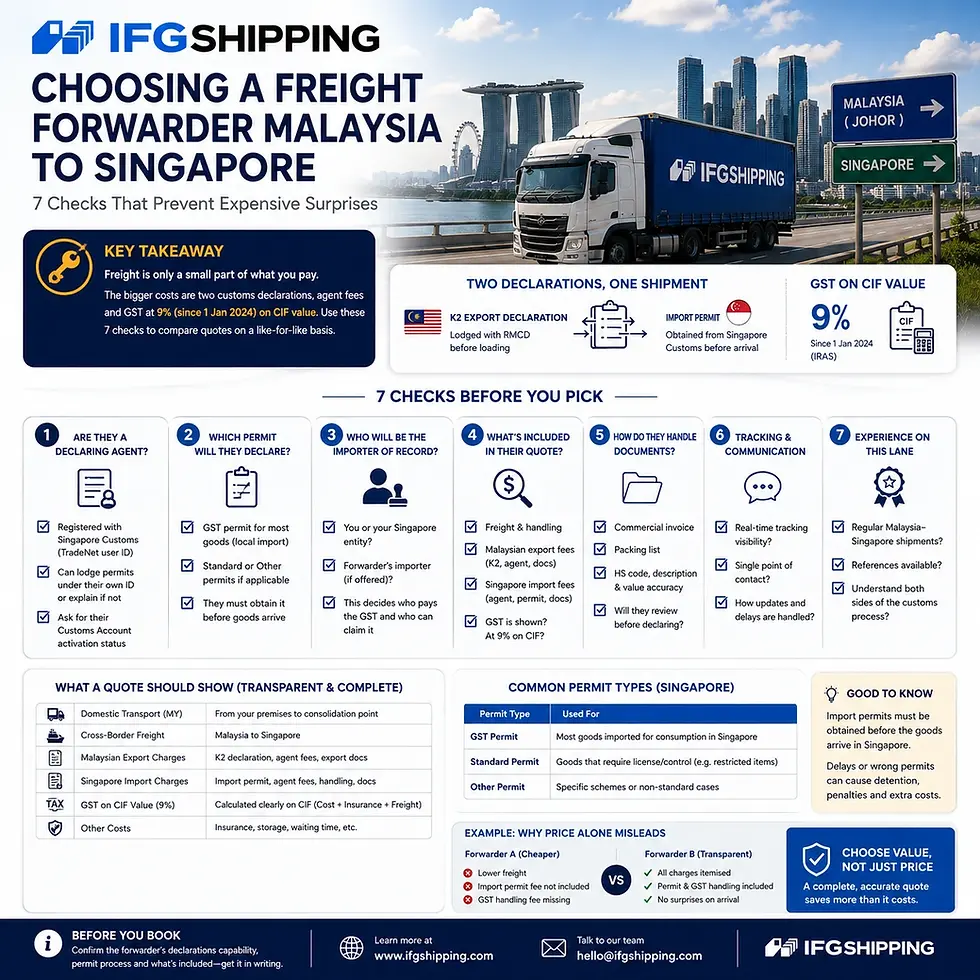
If your goods cross the Causeway, both systems apply to the same consignment in sequence — which is why our guide to freight forwarding from Malaysia to Singapore treats them as one chain rather than two jobs.
What Should You Actually Ask For?
Four requests, in writing, before you appoint anyone. None of them are unreasonable and all of them are quick to answer.
In Singapore: your UEN, confirmation you are a registered Declaring Agent, and whether my permit is lodged under your own account or subcontracted.
In Malaysia: confirmation of your Section 90 customs agent licence, and the name of the entity holding it.
For both: who lodges the declaration on each side of the border, by company name.
For the relationship: who my named contact is, and who covers them when they are unavailable.
The response time is the real test. A provider who holds these credentials answers within a day because the information is on file. Delay, deflection, or a change of subject tells you more than the eventual answer.
What Should a Good Provider Ask You?
Reverse the test. The questions a forwarder asks during onboarding tell you more about competence than anything they say about themselves.
A provider who knows what they are doing will want your UEN and customs account status, the HS codes you currently declare, your typical shipment values and Incoterms, whether any of your goods are controlled, and who at your company can authorise a declaration. That is not bureaucracy — each answer changes how they file.
A provider who asks for none of that intends to classify your goods from whatever the supplier wrote on the invoice. That is the origin of most held cargo we are called into. Correct HS code classification established once at the start prevents the recurring version of the problem.
Simple rule: if their onboarding is shorter than their sales pitch, keep looking.
What Do These Credentials NOT Prove?
This is the part most articles leave out, and it matters as much as the checks themselves.
Registration and licensing prove a company is permitted to declare goods. They prove nothing about service quality, financial stability, whether they know your lane, whether they will answer the phone on a Saturday, or whether they have ever handled your cargo type. A properly licensed forwarder can still be the wrong forwarder for you.
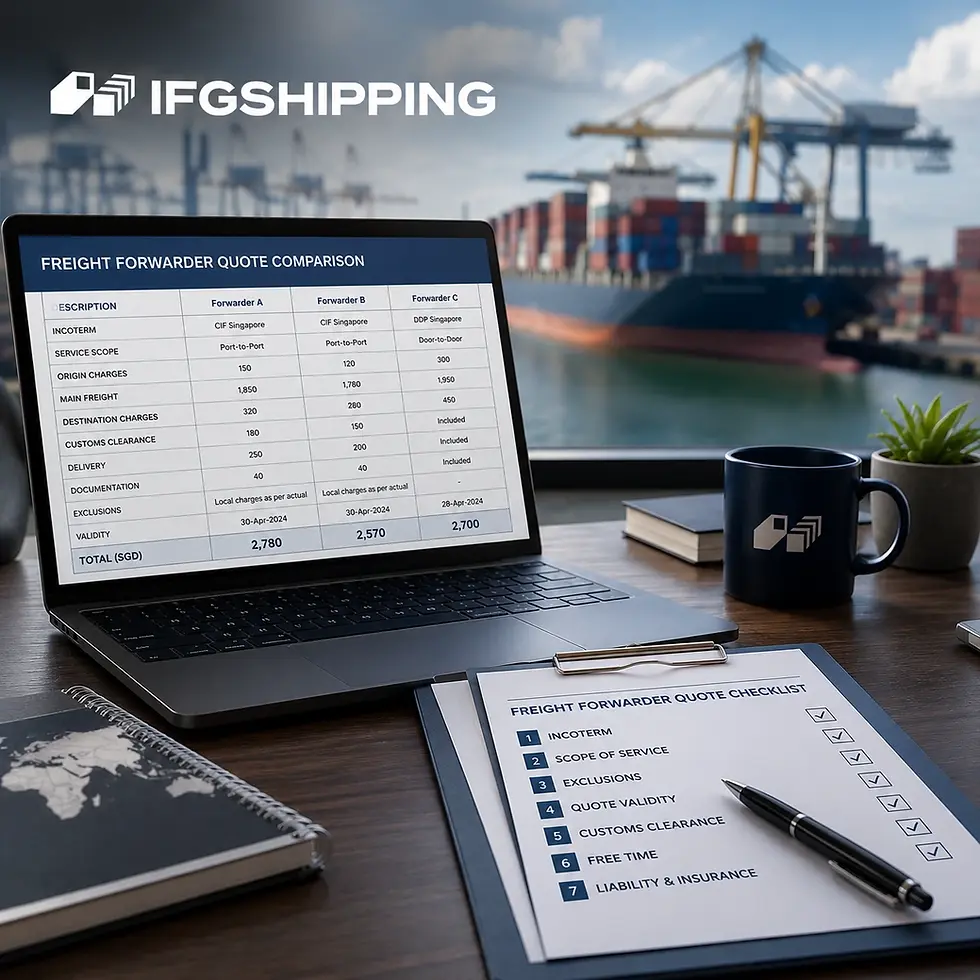
They also prove nothing about price or scope. A licensed provider can still send you an incomplete quotation — which is why we treat credentials and commercial comparison as two separate exercises. Our guide to comparing freight forwarder quotes covers the second one, and hidden shipping costs covers what quotations tend to omit.
Nor do they extend liability. Standard trading conditions typically cap a forwarder's liability by weight rather than by the value of your goods, regardless of how well registered they are — see our marine cargo insurance guide.
The 20-Minute Version of This Check
If you have one meeting and no appetite for a compliance exercise, this is the compressed version:
Ask for the UEN and, if Malaysia is involved, the Section 90 licence holder by name
Ask who lodges the declaration on each side of the border
Ask how many registered declarants they have and who yours will be
Ask what their liability cap works out to for your typical shipment value
Ask them to name a lane or cargo type they would not take on
The last question is the most informative and the one nobody expects. Every honest provider has lanes they are weak on. A company that claims none is describing a sales position rather than an operation — and you will find the truth out later, at your own cost.
If you want to see what a complete answer looks like on a specific lane, our guides to shipping from Malaysia to Singapore and the K2 export declaration set out the level of detail you should be getting in conversation, not just in a brochure.
Why Do Chains Break at the Border?
The most common failure we are called into is not an unlicensed provider. It is a chain where nobody can say who holds which permission.
A Singapore company appoints a Singapore forwarder. That forwarder appoints a Malaysian agent. The Malaysian agent subcontracts the haulage. Every party is legitimate; nobody owns the whole movement. When a shipment stops, questions travel down three links and answers travel back up, and two days disappear.
The fix is not to avoid subcontracting — it is normal and often correct. The fix is to require a named entity for each declaration before you ship, so the chain is documented while everyone is relaxed rather than reconstructed while cargo sits. Our cross-border trucking guide and JB to Singapore logistics guide show where the handovers actually occur.
Not Sure How to Read the Answers You Get?
The checks above are easy to run and harder to interpret. Knowing that a provider is a registered Declaring Agent is straightforward; knowing whether their answer on liability, subcontracting or classification is reasonable for your particular cargo takes experience with the lane.
That is the conversation we are happy to have with you directly, including about providers who are not us. Iman Yusoff has spent over 25 years on the Singapore-Malaysia-Indonesia corridor, has run NVOCC operations on it, and sits on the board of the Singapore Malay Chamber of Commerce and Industry. He has seen most of the ways these arrangements fail.
Bring the answers you were given and the shipment you are trying to move. Speak to Iman and the IFG team and you will get a straight read on whether what you were told holds up — and, if the fit is right, a quotation that shows scope rather than a headline rate. If you would rather compare quotations first, our guide on comparing freight forwarder quotes gives you the framework.
Frequently Asked Questions
Do freight forwarders need a licence in Singapore?
No. Singapore does not issue a freight forwarder licence. What is required to apply for customs permits, for itself or on behalf of clients, is registration as a Declaring Agent with Singapore Customs together with a TradeNet user ID. When a Singapore company says it is "licensed", that registration is what it should be pointing to.
Do freight forwarders need a licence in Malaysia?
Yes. Companies operating as freight forwarding agents, customs agents or shipping agents must obtain the relevant licence from the Royal Malaysian Customs Department under Section 90 of the Customs Act 1967. A company must also first obtain International Integrated Logistics Services (IILS) status from MIDA before acquiring that licence.
What is SC401?
SC401 is the Customs Competency Test for Declarants in Singapore. Individuals must pass it before they can be registered as Declarants. It matters to you because the declarant is the person who describes and classifies your goods on the permit, and classification errors are a leading cause of held cargo. Ask how many registered declarants your provider has, not just whether the company is registered.
Can one company be licensed in both countries?
The permissions are separate and issued by separate authorities, so a group operating on both sides typically holds Singapore Declaring Agent registration through its Singapore entity and a Section 90 licence through its Malaysian entity. What matters to you is not whether it is one brand but whether each declaration has a named, properly permitted entity behind it.
Is a licensed forwarder automatically a good forwarder?
No. Licensing and registration establish permission to declare goods; they say nothing about service quality, lane experience, financial stability or responsiveness. Treat credentials as a threshold test that removes unqualified providers, then judge the remaining shortlist on evidence — references on your lane, quality of questions during onboarding, and how they handle the first shipment.
What if my forwarder subcontracts the other side?
That is normal. The requirement is transparency, not vertical integration. Ask for the name of the entity lodging the declaration on each side before you ship, and keep it on file. A provider who cannot produce that quickly has a gap in their own chain, which becomes your gap the moment cargo stops.
Run These Checks on Us
Everything above works as well against us as against anyone else, and we would rather you used it. We, team Iman Yusoff, have worked the Singapore, Malaysia and Indonesia corridor for over 25 years and operate our own warehouse in Skudai, Johor.
Ask us the four questions and see how quickly the answers come back. If you are earlier in the process and still working out what a forwarder does, start with what is a freight forwarder. The shipping and customs glossary defines the terms you will meet along the way.
Content production support: SingRank, an SEO and AI search (GEO) agency in Singapore.

Comments