
How to Choose a Freight Forwarder in Singapore

Updated: Oct 2

Search for the best freight forwarder in Singapore and you will find directories, sponsored listings, and a lot of companies describing themselves as licensed. Almost none of it tells you how to check anything.
So start with the fact that reframes the whole search.
There is no "freight forwarder licence" in Singapore. No authority issues one. What does exist is a set of registrations any forwarder handling your permits must hold — ACRA registration, Declaring Agent registration with Singapore Customs, a TradeNet user ID, declarants who have passed a competency test, and a GIRO arrangement with Customs. Those are verifiable. "Licensed" on a homepage is not.
Is There a Freight Forwarder Licence in Singapore?
No. Singapore does not issue a freight forwarding licence as a standalone permission to trade. Anyone can incorporate a company and describe themselves as a freight forwarder.
What Singapore does regulate is the act of declaring goods. To apply for customs permits — for itself or on behalf of clients — a company must register as a Declaring Agent with Singapore Customs and obtain a TradeNet user ID. Customs lists the declaring entities this covers explicitly: importers, exporters, shipping agents, air cargo agents, freight forwarders and common carriers.
That distinction is the whole of this article. A forwarder without those registrations is not illegal; it simply cannot lodge your declaration itself and must route it through someone who can. You are entitled to know which.
Check 1 — ACRA Registration and a UEN
Before a company can register as a Declaring Agent at all, it must be registered with the Accounting and Corporate Regulatory Authority (ACRA), or the relevant UEN issuance agency, to obtain a Unique Entity Number.
The UEN is your starting point for every other check, and it takes about a minute. Ask for it in writing. A forwarder who is reluctant to give you their UEN has told you something before you have looked anything up.
Check 2 — Declaring Agent Registration With Singapore Customs
This is the credential that actually matters, and it is the one people mean when they say "licensed".
Ask directly: are you registered as a Declaring Agent with Singapore Customs, and will you be lodging my permit under your own account? Those are two questions, and the second one catches the case where a company is registered but subcontracts your declarations anyway.
Customs publishes the requirements and the account management process on its Declaring Agent authorisation pages. There are also published Terms and Conditions that Declaring Agents operate under — which means there is a standard, and a forwarder should be able to speak to it without hesitating.
Check 3 — Have Their Declarants Passed SC401?
Registration sits with the company. Competence sits with the individual who files.
Individuals must take and pass the Customs Competency Test for Declarants (SC401) before they can be registered as Declarants. This is not a formality — the declarant is the person choosing how your goods are described and classified, and the accuracy of that is where holds and penalties come from.
Ask how many registered declarants the company has, and who will handle your account. A forwarder with a single declarant has a single point of failure, and you will discover it during their annual leave.
Check 4 — Do They Hold an Inter-Bank GIRO With Customs?
Declaring entities are required to maintain an Inter-Bank GIRO (IBG) with Singapore Customs to pay duties, taxes, fees, penalties and other charges.
This matters commercially, not just administratively. It determines whether duty and GST are settled through the forwarder's account or must be arranged separately, which changes your cashflow and who carries the payment risk. Ask whose GIRO your GST will be debited against, and how they invoice it back to you. Our landed cost breakdown shows where that sits in the total.
Do You Even Need a Forwarder?
It is worth asking before you shortlist anyone, because the honest answer is sometimes no.
If you import one small consignment a year from a supplier who already ships DDP, a forwarder adds a layer you may not need. If you are moving personal effects or a single parcel, a courier or a parcel forwarding service is usually the better fit and considerably cheaper.
A forwarder earns their margin when there is complexity to manage: multiple suppliers to consolidate, customs classification that is not obvious, controlled goods, awkward dimensions, or a lane where things regularly go wrong. If none of that applies to you, say so and see how the salesperson responds — it is a fast character test.
Check 5 — Who Actually Handles Your Leg?
Forwarders subcontract. That is normal and often correct — nobody owns trucks, warehouses and vessels on every lane. What is not acceptable is not knowing.
Ask, for each leg: who performs it, and who lodges the declaration on each side of the border? On a Singapore-Malaysia movement, for example, the Malaysian declaration is lodged by a Malaysian agent, and if your provider cannot name that agent you have a chain with a blind spot in it. We cover this specific risk in our guide to freight forwarding from Malaysia to Singapore.
The test is not whether they subcontract. It is whether they answer the question immediately.
Check 6 — What Are Their Liability Limits?
Almost every forwarder contracts on standard trading conditions that cap liability, typically by weight rather than by the value of your goods. This surprises importers at exactly the wrong moment.
Ask which standard trading conditions they contract on, and what the liability cap works out to for a shipment of your typical weight and value. Then compare that number to what the cargo is actually worth. If there is a gap — and there usually is — the answer is cargo insurance, not a stronger promise. Our marine cargo insurance guide explains what carrier liability does and does not cover.
A useful signal: a forwarder who volunteers this before you ask is one who has had the conversation honestly before. One who waves it away has not.
Check 7 — Can They Quote on Your Incoterm?
An Incoterm decides who pays for what and where risk transfers. A quotation that does not state one is not comparable to anything.
Ask them to quote on the Incoterm you actually trade on, and to say plainly which costs sit outside their scope under it. If a forwarder cannot explain the difference between DAP and DDP for your shipment, they are not going to catch the problem when your supplier quietly changes terms. We cover the mechanics in Incoterms 2020 explained and specifically in DAP: who pays freight, duty and clearance.
Check 8 — Do They Handle Your Cargo Type?
General cargo experience does not transfer automatically. Dangerous goods, out-of-gauge cargo, temperature-controlled shipments and controlled goods each carry their own documentation and approvals.
Ask for a specific example on your cargo type and lane — not a capability list. If you move dangerous goods, our dangerous goods shipping guide shows the level of detail a competent provider should be comfortable with. For abnormal loads, out of gauge cargo to Singapore covers the same test.
Check 9 — Will They Tell You What They Cannot Do?
This is the least measurable check and the most predictive one.
A forwarder who says yes to every lane, every cargo type and every timeline is describing a sales position, not an operation. The providers worth keeping are the ones who say "that lane is not our strength, and here is who I would use" — because that same honesty is what you get when something goes wrong at two in the morning.
We tell clients regularly that a route or a storage arrangement is the wrong answer for them. It costs us work. It is also the reason those clients are still with us.
What If You Hold MES? The Check Most Importers Miss
If you hold the Major Exporter Scheme, your choice of forwarder stops being a procurement decision and becomes a compliance one. An approved MES person may authorise up to 20 declaring agents to clear goods on their behalf, appointed through the Apply for Declaring Agents e-Service on myTax Portal, and a change takes effect within the next two working days.
The liability does not travel with the appointment. IRAS states that you are accountable for all permits declared by your declaring agents, and advises that you exercise due care and do not appoint more declaring agents than necessary. Every permit a forwarder files in your name is your exposure, not theirs.
That reframes Check 2 and Check 3 above. A forwarder registered as a declaring agent, whose declarants have passed SC401 and who files accurately, is protecting your scheme status and not merely your shipment - because IRAS states that MES will be revoked at any time if you fail to satisfy any of the qualifying conditions.
Two limits are worth confirming before you appoint anyone under MES. You may only use MES for goods owned by you or by your overseas principal, where you act as a Section 33(2), Section 33A or Section 33B agent; and it is an offence for a non-MES company to import goods using another company's MES status. If you are still weighing whether MES or another route fits your cashflow, our guide on how to defer GST on imports into Singapore compares the four schemes side by side.
How Do You Compare Two Forwarders Fairly?
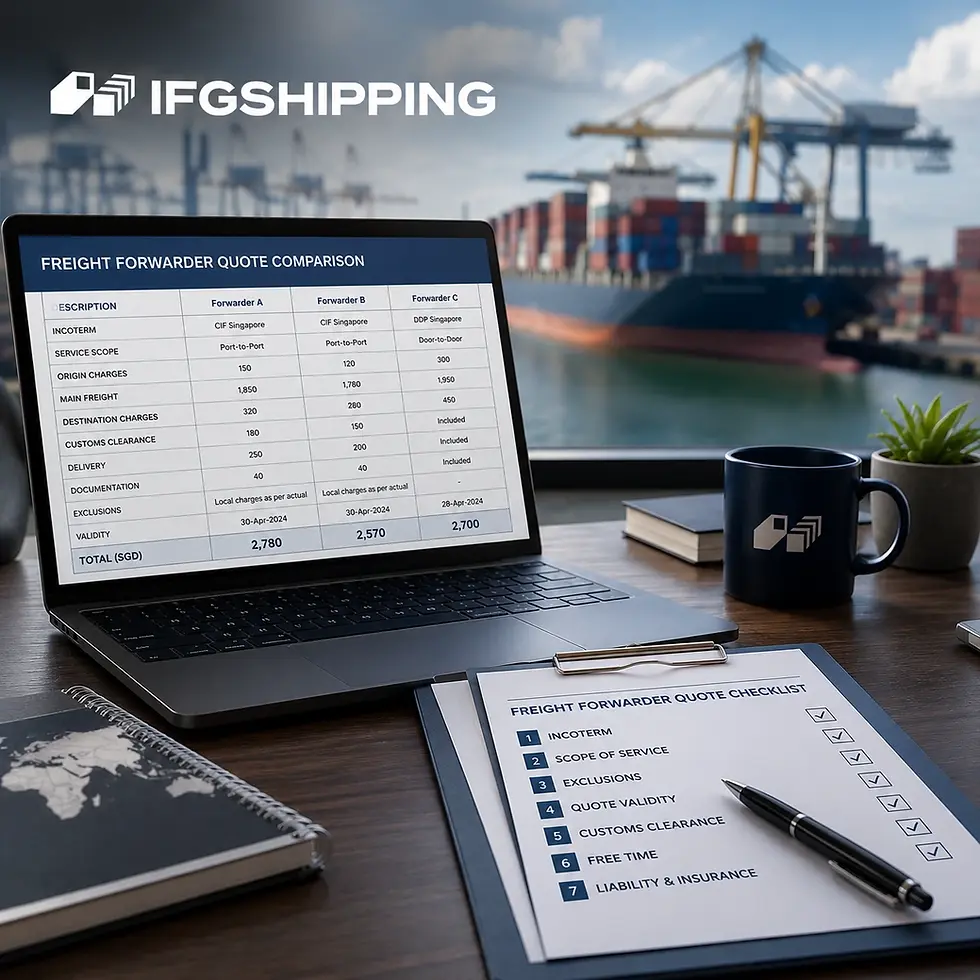
Most comparisons fail because the two quotations are not describing the same job. Before comparing a single figure, normalise them.
Same Incoterm. If one quotes DAP and the other FOB, you are comparing different scopes, not different prices.
Same origin and destination points. Door, port and terminal are three different places.
Same declarations included. Both sides of the border, explicitly named.
Same treatment of duty and GST. Included, excluded, or advanced — and if advanced, at what fee.
Same free time. Then compare what each charges after it expires.
Only once those five are aligned does the number mean anything. In our experience a gap that looked like 30% before normalising is frequently under 5% afterwards — and occasionally reverses entirely. The full method is in our guide to comparing freight forwarder quotes.
What Does a Complete Quotation Look Like?
A comparable quotation shows scope, not just a number:
The Incoterm it is quoted on, stated explicitly
Origin charges, freight, and destination charges shown separately
Which customs declarations are included, and on which side
Whether duty and GST are included, excluded, or advanced on your behalf
What free time applies at destination and what happens after it
What is expressly excluded — inspection fees, permits, storage, demurrage
The validity period of the rate
Anything missing from that list is a cost you will meet later. Our guides to comparing freight forwarder quotes and hidden shipping costs cover the charges most commonly left out.
What Are the Red Flags?
A rate quoted with no Incoterm attached
Reluctance to give a UEN or to confirm Declaring Agent registration
No clear answer on who lodges the declaration on each side
A quotation that is dramatically cheaper than every other, with no explanation of scope
Promised transit times presented as guarantees rather than estimates
No willingness to discuss liability limits or insurance
The cheap-outlier case deserves particular suspicion. In our experience it almost always resolves to a narrower scope rather than a better rate, and the difference reappears as destination charges once the cargo has moved.
What Should You Expect After You Appoint Someone?
Choosing well is half the job. The other half is what the relationship looks like in the first ninety days.
A competent onboarding asks you for things: your UEN and customs account status, the HS codes you use, your typical values and Incoterms, whether any of your goods are controlled, and who at your end can authorise a declaration. A provider who asks none of that is going to classify your goods from an invoice description and hope.
You should also expect the first shipment to be treated as a test rather than a routine. Correct HS code classification established once at the start prevents recurring problems later, and any origin documentation you rely on — such as a certificate of origin — should be checked before the goods move, not at the border.
The signal to watch: a good forwarder tells you about a problem before you notice it. If you are consistently finding out about delays yourself, the relationship is not working regardless of the rate.
How Do You Actually Verify Any of This?
Four steps, in order, and none of them take long:
1. Get the UEN in writing. Then confirm the entity exists and matches the trading name you were given.
2. Ask the Declaring Agent question directly. Registered with Singapore Customs, and lodging under their own account — both parts.
3. Ask who your declarant is by name. And how many registered declarants the company has.
4. Ask for a reference on your lane. Not a testimonial page — a client shipping something comparable to what you ship.
If you are new to importing altogether, read our Singapore customs clearance guide first so you can tell whether the answers you are getting make sense. The shipping and customs glossary defines the terms quotations will use.
Put These Nine Checks to Us
A checklist is only useful if you can judge the answers. Knowing a provider is a registered Declaring Agent is easy; knowing whether their answer on liability, subcontracting or classification is reasonable for your cargo takes experience on the lane.
Iman Yusoff has spent over 25 years on the Singapore-Malaysia-Indonesia corridor, has run NVOCC operations on it, sits on the board of the Singapore Malay Chamber of Commerce and Industry, and operates our own warehouse in Skudai, Johor.
Run the nine checks on us and compare. Speak to Iman and the IFG team about your lane and cargo type — and bring the answers other providers gave you, because a straight read on those is worth more to you than another quotation.
Frequently Asked Questions
Do freight forwarders in Singapore need a licence?
Not a freight forwarding licence — Singapore does not issue one. What is required is registration as a Declaring Agent with Singapore Customs and a TradeNet user ID in order to apply for customs permits, whether for itself or on behalf of clients. When a company says it is "licensed", that is the registration it should be pointing to, and you are entitled to ask them to confirm it.
What is SC401 and why should I care?
SC401 is the Customs Competency Test for Declarants. Individuals must pass it before they can be registered as Declarants. You should care because the declarant is the person who decides how your goods are described and classified on the permit, and classification errors are the leading cause of held cargo and penalties. Ask how many registered declarants your provider has.
Is a bigger freight forwarder always safer?
Not automatically. Scale buys network and buying power; it does not buy attention on a small account. What matters is whether your specific lane and cargo type are handled routinely by the team assigned to you, and whether you can reach a named person when something stops. Judge the answer to those two questions rather than the size of the logo.
Should I choose the cheapest quote?
Only after confirming the quotes cover the same scope, on the same Incoterm, with the same declarations and destination charges included. Most "cheapest" quotes are cheapest because something has been left out, and the difference reappears at destination when you have no leverage left. Compare totals, not rates.
Can I use different forwarders for different lanes?
Yes, and many companies do. The trade-off is coordination: two providers means two relationships, two systems, and a gap when a shipment crosses between them. It works well when your lanes are genuinely distinct and each provider is strong on theirs. It works badly when the lanes interact and neither party owns the handover.
What happens if my forwarder makes a declaration error?
The declaring agent lodges the declaration, but the importer remains responsible for the accuracy of the information supplied. In practice both sides carry something: you for the specifications and values you provide, them for classifying and declaring correctly. This is exactly why the competence questions above are worth asking before you appoint, not after a shipment is held.
Ask Us These Questions Too
Everything above is designed to be used on us as much as on anyone else. We, team Iman Yusoff, have worked the Singapore, Malaysia and Indonesia corridor for over 25 years, and we would rather answer nine specific questions than one vague one about price.
Talk to us about your shipment and ask about the checks that matter for your cargo. If you are still working out what a forwarder does at all, start with what is a freight forwarder. If you are importing from China specifically, our China to Singapore import guide covers the lane in detail.
Content production support: SingRank, an SEO and AI search (GEO) agency in Singapore.


Comments