
Freight Forwarder Malaysia to Singapore

Updated: Oct 2
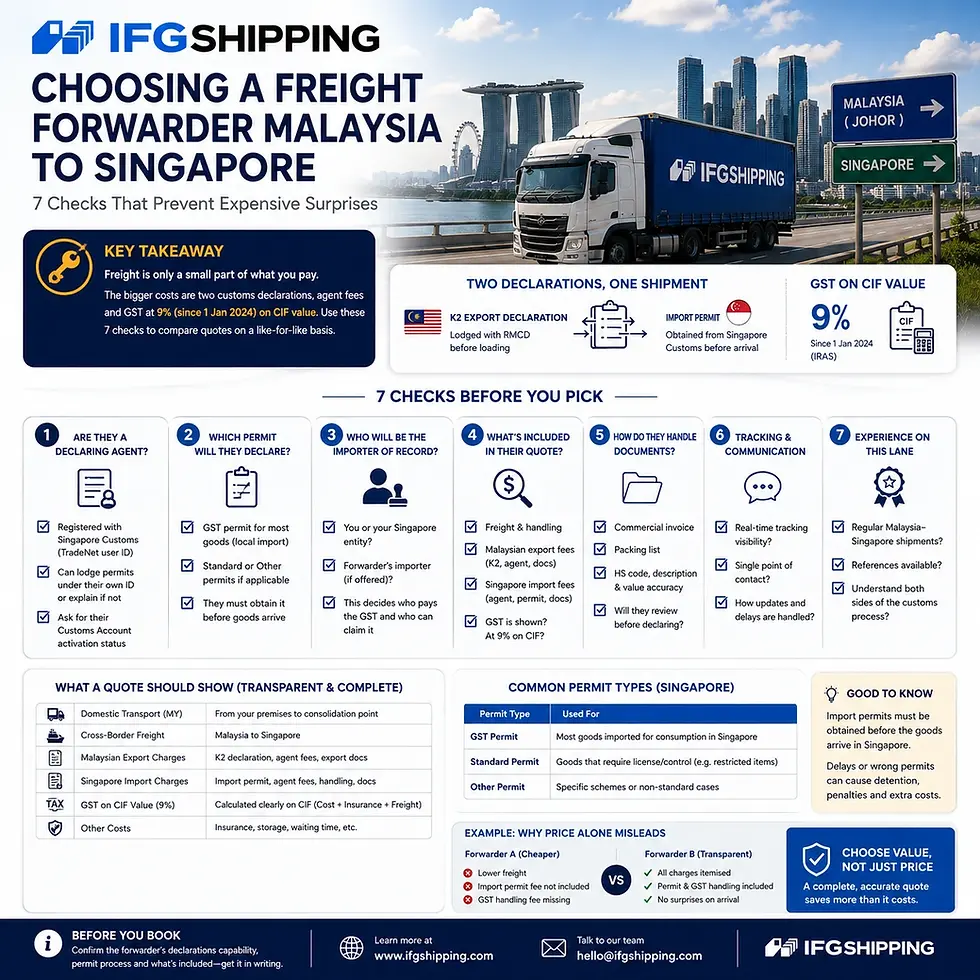
Three quotes arrive for the same pallet from Johor to Singapore. One is cheaper by a couple of hundred ringgit. Most people pick that one, then find out later that the difference was never the freight. It was what the cheaper quote left out. Picking a freight forwarder Malaysia to Singapore on price alone goes that way surprisingly often.
The reason isn't carelessness. It's that on a lane this short, price is the least informative thing on the page.
Freight is a small share of what you pay. The larger share is two customs declarations, two agent fees and import GST attached to whoever gets named as importer. A forwarder who is sharp on freight and vague on declarations is optimising the small number.
Key Takeaway: To lodge your Singapore import permit, a company must be registered with Singapore Customs as a Declaring Agent with a TradeNet user ID, and maintain a valid Inter-Bank GIRO arrangement with Singapore Customs. Ask any prospective forwarder to confirm that status and to name the permit type they will declare. Both answers take seconds and both are verifiable.
We are IFG Shipping — we, team Iman Yusoff, work this corridor daily, and yes, we are one of the companies you would be evaluating. So this guide is written to be usable against us too. Every check below is one you can run yourself, without taking our word for anything.
What a freight forwarder Malaysia to Singapore actually charges for
Split any Malaysia-to-Singapore quote into its real components and the proportions become obvious.
Component | Who it goes to | Why quotes differ here |
Freight and handling | The carrier or haulier | Barely — short lane, competitive market |
Malaysian export side | RMCD, plus the agent lodging the K2 | Often bundled into freight, or omitted |
Singapore import side | Singapore Customs, plus the declaring agent | Often unstated until the invoice |
Tax | Singapore Customs — GST at 9% since 1 January 2024 (IRAS) on CIF value | Depends entirely on who is named importer |
Three of those four are administrative, and administrative work is where quotes diverge. A forwarder can be genuinely cheaper on freight, or they can simply have omitted a declaration fee that'll appear later. From the outside, on a one-page quote, those look identical.
Our general method for putting competing quotes onto one basis is in comparing freight forwarder quotes. What follows is the part specific to this border.
Start by knowing what you are buying
A freight forwarder is not a trucking company with a nicer invoice. The role is to take a chain of carriers, ports, customs authorities and taxes and turn it into one accountable point of contact. On a cross-border lane, that accountability is the product. If you want the full definition of the role and where it stops, our explainer on what a freight forwarder does covers it.
On Malaysia to Singapore specifically, the forwarder is coordinating two national systems that do not talk to each other. Malaysia wants a K2 export declaration; Singapore wants an import permit obtained "before the goods are imported into Singapore" (Singapore Customs). Getting those two to describe the same consignment identically is the actual job — our K2 export declaration guide sets out where they most often diverge.
What is a Declaring Agent, and is your forwarder one?
This is the highest-value question on the list, and almost nobody asks it.
In Singapore, a Declaring Entity is any importer, exporter, shipping agent, air cargo agent, freight forwarder, common carrier or other person seeking a customs permit. To apply for permits — your own or a client's — a company must register as a Declaring Agent and obtain a TradeNet user ID (Singapore Customs).
That registration is not a rubber stamp. Singapore Customs assesses applicants under a Declaring Agent Governance Framework covering five areas: personnel management, training on customs procedures, the company's processes and procedures, SOP documentation, and information management and controls. Applications are processed in around three working days for straightforward cases where all supporting documents are provided, and the company must maintain a valid Inter-Bank GIRO arrangement with Singapore Customs. Only Key Personnel registered with ACRA or the relevant UEN issuance agency, or Authorised Personnel they appoint, can submit the application.
Separately, activating a Customs Account carries no fee to Singapore Customs, with the outcome notified within four working hours where no supporting documents are needed, or three working days once complete documents are received.
The check: ask "are you a registered Declaring Agent with Singapore Customs, and will you be declaring my permit under your own TradeNet ID or subcontracting it?" A serious operator answers in one sentence. Subcontracting isn't disqualifying, and plenty of good forwarders do it. But you should know, because it adds a party between you and the declaration.
Which permit type will they declare?
Singapore has no single generic import permit, and the type changes what you pay and when.
The common ones are In-Payment permits. A GST permit is "for paying GST on goods imported for local consumption, including goods that qualify for duty exemption". A Duty and GST (DNG) permit is "for paying duty and/or GST on dutiable goods imported into Singapore" (Singapore Customs).
There is a whole second family — In-Non-Payment permits — for movements into licensed or zero-GST warehouses and approved schemes, storage in a free trade zone, temporary consignments for exhibitions or repair, and re-export of an entire consignment. If your cargo is transiting onward, going into bonded storage, or coming for a trade show and leaving again, the ordinary permit is the wrong one and the cost profile is different.
Ask which type. Then ask why. A forwarder who names the permit and explains the choice is thinking about your consignment; one who says "we'll sort it at the border" isn't.
The wider process around that declaration is in our Singapore customs clearance guide.
Who will they name as importer of record?
Singapore Customs defines the importer as "the party who brings the goods into Singapore: for their own account or use; or for the account or use of another party" (Singapore Customs). That party carries the declaration and the 9% GST.
The asymmetry decides real money. A GST-registered Singapore business can generally reclaim import GST as input tax. A Malaysian seller without Singapore GST registration cannot. So the name on the permit determines whether that tax washes through or stays as cost.
Our position, stated plainly: a forwarder who does not raise this before quoting has skipped the single most consequential decision on the shipment. It is not a difficult conversation. It is just one that nobody has if the quote request only asked for a rate.
The Incoterm you agree with your counterparty drives this. Our breakdowns of DDP and DAP set out where the obligation lands under each, and the Incoterms 2020 overview covers the alternatives. If you are the seller weighing this up, our guide to selling to Singapore from Malaysia works through the consequences.
Do they know the schemes that change your cash flow?
This one separates a booking desk from an adviser, and you can ask it in one sentence: "would MES or IGDS apply to us?"
The Major Exporter Scheme lets approved businesses suspend GST on "non-dutiable goods imported into Singapore" and on "goods removed from a Zero-GST warehouse", aimed at businesses that "re-export a significant portion of their imports". It requires an In-Non-Payment (Approved Premises/Schemes) permit with the place of receipt code declared as "ME" — and critically for your forwarder, a declaring agent can only obtain those permits where the MES-approved business "has authorised them via IRAS' online e-Service" (Singapore Customs).
The Import GST Deferment Scheme instead lets approved GST-registered businesses defer import GST to the monthly GST return, accounting for it and claiming it as input tax in the same return (Singapore Customs).
Neither is the forwarder's decision — both are IRAS schemes your business applies for. But a forwarder working this lane should recognise the names, know that MES needs a specific permit type and an authorisation step on your side, and tell you to raise it with your accountant. A blank look here tells you what kind of relationship you are buying.
What happens when a declaration is wrong?
Ask this before you need the answer, because the correction window is narrower than most people assume.
Singapore Customs allows an approved permit to be amended in TradeNet "as long as it is still valid", with "no limit to the number of amendments you can make". Amendment is blocked once the permit "has already been used for cargo clearance", once it has expired, or where the field is non-amendable. Where a permit must be cancelled instead, timing depends on payment method: Inter-Bank GIRO cancellations must be made before 11:59 pm for same-day processing, otherwise five working days, and cash or cheque payments take five working days (Singapore Customs).
And when both routes are closed, whether because the permit was already used for clearance, expired for more than one calendar day, or requested for audit by the Manifest Compliance Unit, the stated route is a voluntary disclosure to Singapore Customs.
So the real question for a prospective forwarder is: "what is your process when a declaration is wrong, and who tells me?" An operator with an answer has been through it. An operator who says it never happens has either been lucky or is not counting.
Seven checks to run on any quote for this lane
Take the quote you are holding. Every "no" is a question to ask, not necessarily a reason to walk away.
Is the company a registered Declaring Agent with Singapore Customs, declaring under its own TradeNet ID?
Does the quote name the Singapore permit type it will declare?
Is the Malaysian export declaration fee itemised separately from freight?
Is the importer of record named in writing?
Is import GST shown as included, excluded, or payable by the named importer?
Are waiting time, lifting and handling charges stated, with the point at which waiting time starts?
Is insurance included, declined, or arranged separately — and is that stated rather than assumed?
Point seven catches people out most often. A carrier's liability is capped and conditional; it is not cover for the value of your goods. Our guide to marine cargo insurance explains exactly what the gap is.
And the charges that most reliably appear after the fact are catalogued in hidden shipping costs.
The record-keeping duty you share
One obligation sits on both of you, and it is longer than most SMEs plan for. Traders and their declaring agents must keep documents relating to the purchase, import, sale or export of goods for at least five years from the date the permit is approved, under a record-keeping obligation Singapore Customs describes as a legal requirement, and produce them to Singapore Customs on request (Singapore Customs).
Note the word "and". Your forwarder keeping records does not discharge your obligation, and yours does not discharge theirs. Ask how they store declarations and how you get copies — scanned images are acceptable where the digital storage guidelines are met, so there is no good reason for you not to hold your own set.
A forwarder who sends you the permit copy automatically after every shipment has just saved you a job you did not know you had.
The steelman for the cheaper quote
Let us be fair to the low bid, because sometimes it is the right answer.
A forwarder can legitimately be cheaper because they already run a scheduled service on your exact lane and your pallet fills space they were moving anyway. They can be cheaper because their declaration volume gives them real efficiency. They can be cheaper because they are lean and want the account. None of that is a red flag.
The line is whether the scope matches. If two quotes cover the same seven points and one is lower, that one is genuinely cheaper — take it. If the lower quote is silent on three of them, you are not comparing prices, you are comparing a complete quote with an incomplete one. The gap will close on your invoice.
That is why the checks above are about disclosure, not about who is expensive. A forwarder who tells you exactly what is and is not included has given you something you can act on, whatever the number says.
What to send so the first quote is the real one
Most quote revisions happen because the first brief was thin. Send this once and you will get a number that holds.
What the goods are, with HS codes.
Pickup address and delivery address, both sides of the border.
Weight, dimensions and packaging type.
Whether anything is temperature-controlled, hazardous or oversized.
Who you want named as importer of record, or that you need help deciding.
Whether this is one-off or repeating, and at what frequency.
If your cargo is dangerous goods or out of gauge, say so upfront — those change the whole plan, and our guides to dangerous goods into Singapore and out-of-gauge cargo explain why. Food cargo has its own approval chain — see exporting food from Malaysia to Singapore.
Put us through the same seven checks
Send the brief above and we will come back with a quote that answers all seven points explicitly, including the ones that are inconvenient for us. If the answer to any of them is "that depends", we will tell you what it depends on rather than leaving it off the page.
And if your consignment is better served by a mode or a structure we don't run, we'll say so. A freight forwarder Malaysia to Singapore who only ever recommends what they happen to sell isn't advising you — they're selling.
Working out the whole lane first? Start with our Malaysia to Singapore shipping guide, then landed cost calculation to see how the numbers combine at arrival. Shipping from further north? Shipping from Kuala Lumpur to Singapore covers the domestic leg.
Frequently Asked Questions
Must a freight forwarder Malaysia to Singapore be registered with Singapore Customs?
To lodge your Singapore import permit, yes — the company must be registered with Singapore Customs as a Declaring Agent with a TradeNet user ID and maintain a valid Inter-Bank GIRO arrangement. Some forwarders subcontract this to a registered agent, which is common; ask which arrangement applies to you.
Why are two quotes for the same pallet so different?
Usually scope, not price. Freight on this short lane has limited spread between serious operators. The variance comes from whether export declaration fees, import permit fees, handling, waiting time and insurance are itemised or omitted. Compare the seven checkpoints, not the totals.
Should the forwarder decide who the importer of record is?
No, but they should raise it before quoting. The importer carries the declaration and GST at 9%, the rate since 1 January 2024 (IRAS), and only a GST-registered Singapore party can generally reclaim it as input tax. The decision is yours and your counterparty's; the forwarder's job is to make sure it gets made.
Can a wrong permit be fixed after it is issued?
While it is still valid, yes, with no limit on amendments. Once it has been used for cargo clearance or has expired, amendment is blocked and cancellation may also be unavailable — in which case Singapore Customs directs traders to submit a voluntary disclosure instead.
Is a cheaper forwarder always cutting corners?
No. Genuine reasons exist: an existing scheduled service on your lane, declaration volume, or simply wanting the account. The test is whether the cheaper quote covers the same scope. Same scope and lower price is a better deal; narrower scope is a deferred cost.
How long does declaring agent registration take in Singapore?
Singapore Customs indicates around three working days for straightforward applications where all supporting documents are provided. Separately, activating a Customs Account is free, with the outcome notified within four working hours where no supporting documents are required.
Who has to keep the shipping records?
Both parties. Traders and their declaring agents must retain documents relating to the purchase, import, sale or export of goods for at least five years from the date the permit is approved. Your forwarder holding a copy does not discharge your own obligation.
About this guide. Requirements cited here are attributed to Singapore Customs and were correct at the time of writing, 6 August 2026. Registration criteria, processing times, scheme conditions and permit types change; verify current requirements at customs.gov.sg and iras.gov.sg before relying on them.
We are a freight forwarder Malaysia to Singapore and therefore an interested party — the checks in this guide are written so you can apply them to us on the same terms as anyone else. Views expressed on quote scope and importer of record are our opinion, based on our operational experience.
Content production support: SingRank, an SEO and AI search (GEO) agency in Singapore.


Comments