
Packing List for Shipping: 14 Sample Cases Tested (2026)


What does a packing list for shipping need to show when the commercial invoice already lists the goods? It records what is physically inside each carton or pallet: marks, quantity, both weights and dimensions, package by package. To make that practical, we built a small checker that compares a packing list with its invoice and bill of lading. On 5 October 2026 it matched independently worked answers in 14 of 14 sample document sets. Most of what it is built to catch is a package count or a weight, not a product name.
That is the part most owners miss. The invoice tells everyone what the goods are worth. The packing list tells them what they should find when the container door opens. When its numbers drift from the invoice or the bill of lading, the shipment stops while someone works out which document is wrong.
Pricing and valuation are covered in our piece on what the commercial invoice must say about price and value; this guide stays with the boxes, the weights and the checks. I've worked in shipping since 1999.
Sources and test cases checked 5 October 2026 · Iman Yusoff, IFG Shipping
What Is a Packing List for Shipping?
A packing list for shipping is the exporter's itemised record of how the goods are packed. The US International Trade Administration says it "itemizes the contents of each package (box, pallets, etc)". It lists the goods in each package, with weights and measurements. Forwarders use it to work out weights and freight costs, and customs officers use it to check a specific carton.
Where the invoice is about money, the packing list is about the boxes: how many, how heavy, how big, and what sits inside each one. Neither replaces the other, which is why every customs authority in this corridor asks for both.
It isn't a packing slip, the note an online shop drops into a parcel, and it isn't the carrier's manifest. A packing list for international shipping covers one consignment, and the declaration is typed from it.
Who Reads Your Packing List, and What Each One Checks?
Owners picture one reader, the customs officer. In practice five parties act on it, and each takes a different figure.
Reader | What they take from it | Where a mistake bites |
Customs (Singapore Customs, RMCD, Bea Cukai) | Package count, weights, description, quantity | A declaration that doesn't match; a wider inspection |
Your forwarder or declaring agent | Weights and measurements for the booking and the declaration | A quote or declaration built on the wrong figures |
Carrier and terminal | Gross weight and package count | A weight query; a container that waits on the quay |
CFS or warehouse (LCL) | Marks, carton count, dimensions | Cartons mixed with another shipper's cargo |
Your buyer | Carton-by-carton contents | Short-shipment claims and slow payment |
Four of the five work from the count and the weight.
The Fields a Packing List Must Carry
Singapore Customs states that it "does not dictate the details to be stated in the trade documents", as long as they reflect the actual transaction and cargo movement. So there is no official packing list format. The 12 fields below follow from what the declaration needs and the inspecting officer checks.
Field | What to write | Why it matters |
Shipper, consignee, notify party | Full legal names and addresses, as on the invoice and B/L | A name that differs from the B/L raises the first question |
Packing list number and date | Its own reference, plus the invoice number it belongs to | Bea Cukai checks the number and date you type against the scan |
Booking, B/L or AWB number | Add it once known | Ties the boxes to the transport document |
Marks and numbers | The marks printed on the cartons, e.g. buyer code, order number, destination, "C/NO. 1-40" | Lets an officer find carton 17 without emptying the container |
Package type and count | Cartons, pallets or crates, per line and in total | Becomes the outer pack count and the B/L package count |
Description per package | The invoice wording, not internal SKU names | Officers match description to description |
Quantity per package and total | Units and unit of measure | Must equal the invoice total |
Net weight | The goods alone, per package and in total | The item-level weight in the declaration |
Gross weight | Goods plus packing and pallets, per package and in total | The total weight in the declaration and on the B/L |
Dimensions and volume | L x W x H per package, and total CBM | Drives LCL pricing and stowage |
HS code and origin (optional) | Only if they match the invoice and your HS code classification | A second, different code is a question you created |
Signature or stamp | The person who checked the packing | Someone who saw the goods vouches for the figures |
Leave prices off. The value belongs on the invoice, and a second set of prices gives an officer one more thing to reconcile. Two of our 14 sample sets test exactly that.
Net Weight, Gross Weight and CBM
Net weight is the goods alone. Gross weight is the goods plus everything they're packed in. Singapore Customs uses that exact split: its guidance on weights puts net weight at item level and defines total gross weight as "the item net weight plus packing weight".
Units follow the transport mode. Singapore Customs' answer on the Total Gross Weight field says it includes packing materials, in tonnes (TNE) for sea and kilogrammes (KGM) for air. If your packing list says 4,820 kg and the B/L says 4.82 TNE, the two agree. If the B/L says 4.28, they don't, and that transposed figure is one of our sample cases.
Volume is simple arithmetic, and it's where typing errors hide. Measure each carton in metres and multiply. A 60 x 40 x 40 cm carton is 0.6 x 0.4 x 0.4 = 0.096 CBM, so 50 cartons come to 4.8 CBM. Measure cartons as packed, bulges included. LCL consolidation is built on the volume and weight each shipper declares.
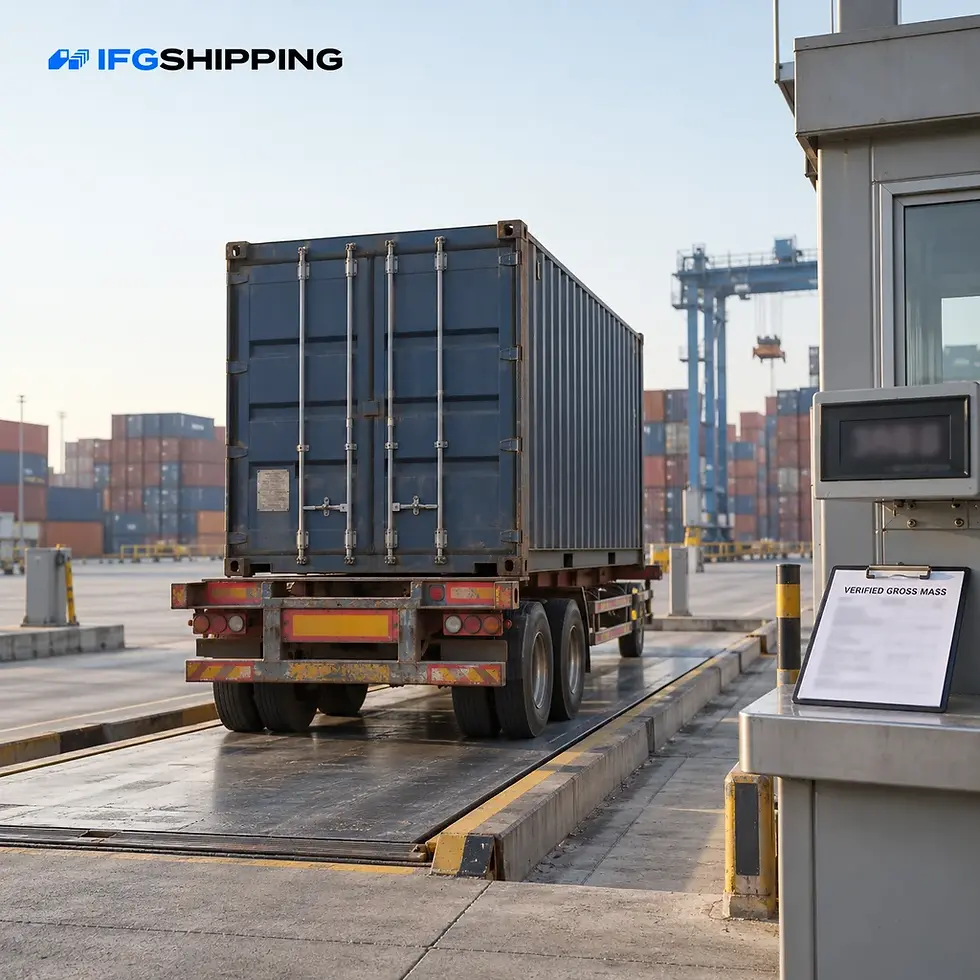
For a full container, gross weight has a second job. The IMO explains that under SOLAS regulation VI/2, in force since 1 July 2016, whoever appears as shipper on the B/L owes the carrier a verified gross mass, written into the shipping document. Without it, a packed container isn't loaded. One permitted method adds up every package, pallet and piece of securing material, then the container's tare. That is your packing list's gross weight doing the work.
Does the Packing List Have to Match the Invoice and the B/L?
Yes. Singapore Customs says the permit "should be supported by and verifiable against the corresponding trade documents (e.g. Bill of Lading (B/L), packing list, commercial invoices)", in its published answer. For exports, its answer on export permits says the permit "should correspond against the supporting documents". Matching doesn't mean identical layouts. It means one shipment, described the same way wherever two documents overlap:
Figure | Packing list | Commercial invoice | B/L or AWB |
Number and type of packages | Per carton and total | Often stated | Stated |
Gross weight | Per carton and total | Sometimes | Stated |
Quantity of goods | Per carton and total | Per line | Not usually |
Description | Per carton | Per line | General description |
Marks and numbers | Yes | Optional | Yes |
The quantity row catches owners most often. A 480-unit invoice against a 500-unit packing list is a customs query on either side of the crossing. As our guide to shipping from Indonesia to Singapore explains, we have seen that exact mismatch hold cargo that was otherwise compliant.
The B/L is the other trap. The carrier types it from your shipping instruction, not your packing list, so check the count and weight on the draft B/L before you approve it. Our guide to the three types of bill of lading explains what the B/L does once it's issued.
We Tested a Mismatch Checker on 14 Sample Document Sets
Advice to "make sure the documents match" is easy to give and hard to act on. So we wrote the matching down as seven mechanical checks, turned them into a short script and fed it 14 sample document sets. Each set is a made-up test case: a packing list, an invoice and a B/L figure built to probe one rule. None is a real shipment. The script returned the answer we had worked out by hand in 14 of 14 sets, and a separate reader who never saw our answers reached the same 14.
The seven checks are invoice reference (REF), description (DESC), total units (QTY), gross equals net plus packing (GW_PACK), gross weight against the B/L in tonnes or kilogrammes (GW_BL), B/L package count against the visible outer packs (OUTER), and any prices against the invoice (PRICE). You'll find them as steps you can run yourself further down.
Case | Sample set (test case, not a shipment) | Checker result |
1 | Clean sea set: 40 loose cartons, 1,800 kg net + 120 kg packing = 1,920 kg; B/L 1.92 TNE, 40 packages | Consistent |
2 | Packing list 500 mugs, invoice 480 | Mismatch: quantity |
3 | Boundary: 40 cartons on 2 pallets, B/L says 2 packages | Consistent |
4 | Same pallets, but B/L counts 40 cartons | Mismatch: outer pack count |
5 | Boundary: 4,820 kg against 4.82 TNE | Consistent |
6 | Boundary: 4,825 kg against 4.82 TNE (rounds to 4.83) | Mismatch: B/L weight |
7 | B/L typed 4.28 TNE for 4,820 kg | Mismatch: B/L weight |
8 | Gross typed as 905 kg against 950 kg net | Mismatch: gross vs net plus packing |
9 | SKU code on the packing list, trade name on the invoice | Mismatch: description |
10 | Packing list prices 2.50 a unit, invoice 2.80 | Mismatch: price |
11 | Packing list prices equal the invoice | Consistent, with a note to remove prices |
12 | Packing list with no gross weight | Refused: cannot check |
13 | Air set: packing list cites invoice INV-1013, invoice reissued as INV-1013A; 152.5 kg matches 152.5 KGM | Mismatch: invoice reference |
14 | Short quantity and B/L counting cartons on pallets | Mismatch: quantity and outer pack count |
Read the table for its pattern, not its score. We chose the cases, so 14 of 14 shows the checker does what it says, not how often shipments go wrong. We weighted the cases towards weights and package counts on purpose: five of the nine mismatches turn on one of those, because those are the figures the B/L and the inspector check against each other.
Case 6 is the one owners argue with. The checker is strict on purpose: 4,825 kg rounds to 4.83 tonnes, so a B/L showing 4.82 gets flagged, and you re-type one of the two figures before anyone else has to ask. Case 12 matters as much: a checker that guesses a missing weight is worse than no checker.
How Singapore, Malaysia and Indonesia Use It
All three customs authorities name the packing list. They differ in when you hand it over and who reads it.
Singapore. Singapore Customs' page on documents for clearance of goods says containerised sea imports don't present the permit and supporting documents at the inward checkpoint. Air and land imports do: they show the permit with the invoice, packing list and air waybill or consignment note. For exports, its export overview tells exporters to have the packing list ready with the permit, invoice and transport document. Its record-keeping page asks the trader and the declaring agent to keep documents, packing lists included, for at least 5 years. If something goes wrong on arrival, read seven reasons cargo is held at Singapore Customs.
Malaysia. RMCD's MyCIEDS FAQ is plain about who uploads: importers, exporters and customs agents alike, whether the goods move by sea, air or land. The packing list is an upload category of its own. Files go in after the declaration form, as PDF, JPEG or PNG of up to 4MB, at most 10 files per category. Companies with AEO status are exempt from the upload. RMCD's exporter guide lists the packing list among the supporting documents for the K2 export declaration from Malaysia and keeps export records in Malaysia for seven years. When a clearance stalls, why cargo is held at Malaysian customs covers the usual causes.
Indonesia. Bea Cukai's mandatory upload notice applies from 3 August 2026, under ND-1569/BC.07/2026 and Article 12 of PMK 155/PMK.04/2022. When the exporter submits a PEB, scans of the invoice and the packing list now go up with it; without them, CEISA won't accept or process the PEB. The B/L or AWB can follow by amendment, approved automatically when filed within 3 days of departure.
On imports, Bea Cukai's inspection FAQ describes the physical inspection: the inspector counts the packages, confirms what kind of package each is, and compares what is inside with your packing list. Depending on the level set, either 10% or 30% of the goods get that check. DJBC charges nothing for the inspection itself, but storage and handling are still paid to the terminal while it runs. For what follows a hold, see cargo held by Indonesian customs.
Why Pallets Change the Outer Pack Count
This one catches careful people, and it is behind cases 3, 4 and 14. Singapore Customs' answer on the Total Outer Pack Quantity says it is "the total visible outer packing of goods". Ten packages packed into one main pack are declared as 1 pack. The same 10 loaded loose are declared as 10.
So the count changes the moment someone palletises your cartons, often after the packing list is printed. Write both, for example "2 pallets (containing 40 cartons)", and tell your forwarder which figure is the outer pack. Bea Cukai's inspectors count packages and check their type, so the habit pays off in Indonesia too. Choosing FCL or LCL changes the stakes. In a shared LCL box, unmarked cartons are the ones that go astray.
Seven Checks Before the Packing List Leaves Your Warehouse
These are the checker's seven rules, written as things you can do with a printout and a pen.
Reference. The packing list cites the current invoice number. If the invoice was reissued, reissue the packing list too.
Description. Copy the invoice descriptions word for word. Keep SKU codes in an extra column if you need them.
Quantity. Add up units on both documents. The totals must be equal.
Net plus packing. Weigh a sample of cartons as packed, add pallet weight, and confirm gross equals net plus packing.
B/L weight. Convert kilogrammes to tonnes for sea and compare with the draft B/L at the decimals it shows.
Outer packs. Count packages after palletising, not before, and compare with the B/L package count.
Prices. Remove them from the packing list. If they stay, they must equal the invoice.
Then photograph the marks on two or three cartons and compare them with the marks column, and send the final packing list to your forwarder before the declaration is filed.
Is a Packing List Legally Required? Our Verdict
You'll read online that customs doesn't strictly need a packing list. In this corridor, treat it as required. Indonesia's CEISA won't accept a PEB without it, RMCD wants it in MyCIEDS whatever the mode, and Singapore Customs expects your permit to be verifiable against it.
As our guide to why cargo is held at Singapore Customs puts it, the packing list is a clearance document, not an internal note for your warehouse. Sign it like one.
Method
We wrote the seven checks from fetched Singapore Customs answers on trade documents, gross and net weight, TNE and KGM, outer pack quantity and export permits, from our own Indonesia-to-Singapore guide and from the Bea Cukai inspection FAQ, all read on 5 October 2026. The 14 sample sets and their expected answers were fixed and saved on 5 October 2026 before the script was written or run. Four sit on a boundary (pallets, 4,820 kg, 4,825 kg, equal prices), nine contain a mismatch and one is designed to be refused. After the run, a separate reader given only the rules and the inputs re-derived all 14 blind. Each set's outcome is a verdict (consistent, mismatch or cannot check) plus the exact list of failed checks. A set counts as matched only when both agree.
Limits
The test covers the checker's logic on made-up document sets, not real shipments and not how any officer uses discretion. One team wrote both the expected answers and the script, which is why a blind reader re-checked them. The rounding rule in check 5 is our own convention and is stricter than any published tolerance; we found none on the pages we read. Permit fields, HS codes, valuation and dangerous goods are outside the test. A consistent result doesn't mean cargo will clear.
Cite this
IFG Shipping. "Packing List for Shipping: 14 Sample Cases Tested (2026)". Test cases collected 5 October 2026. Dataset version 1: the 14-row case table above, also published as a CSV with this page. This page is the canonical source.
Two Ways Forward
If you want to read an invoice, packing list and B/L the way an officer does, the guides on this site cost nothing to read, and I post lessons on LinkedIn and on TikTok as @freightsifu. You can also ask me directly on WhatsApp at +60 14 325 8325, in English, Malay or Indonesian. There are no courses, workshops or certificates to buy.
If you'd rather hand it over, send IFG your draft invoice, packing list and booking or WhatsApp the same number. We'll reply on the route and check the three documents against each other before your cargo moves. Customs still makes the final call, but your documents will tell one story.
FAQ
Shipping manifest vs packing list: what is the difference?
Your packing list describes one shipment, carton by carton, and you prepare it. The manifest is the carrier's list of every consignment on the vessel or flight, typed from bookings and documents. An error on your packing list can travel into the B/L and from there into the manifest, which is why checking the draft B/L matters.
Who prepares the packing list?
Normally the seller or exporter, because they packed the goods. A forwarder can format it, but only someone who saw the cartons packed can vouch for the count and the weights. If your supplier prepares it, ask for it before the goods leave their warehouse so you can run the seven checks while changes are still cheap.
How long must I keep a packing list?
In Singapore, at least 5 years from permit approval, and the rule binds both you and your declaring agent. In Malaysia, RMCD's exporter guide sets seven years for export records, held inside the country unless its Director General agrees otherwise. Keep the final version, the one the declaration was built on.
Disclaimer: This guide to the packing list for shipping is general educational information, not legal, customs or tax advice. The 14 document sets in the test are fabricated samples, not shipments. Rules change and vary by product, carrier and port; sources were checked on 5 October 2026. Confirm the current position with Singapore Customs, the Royal Malaysian Customs Department, Bea Cukai, your carrier or your declaring agent before you ship.
Content production support: SingRank, an SEO and AI search (GEO) agency in Singapore.


Comments