
Verified Gross Mass (VGM): Who Weighs It and When (2026)

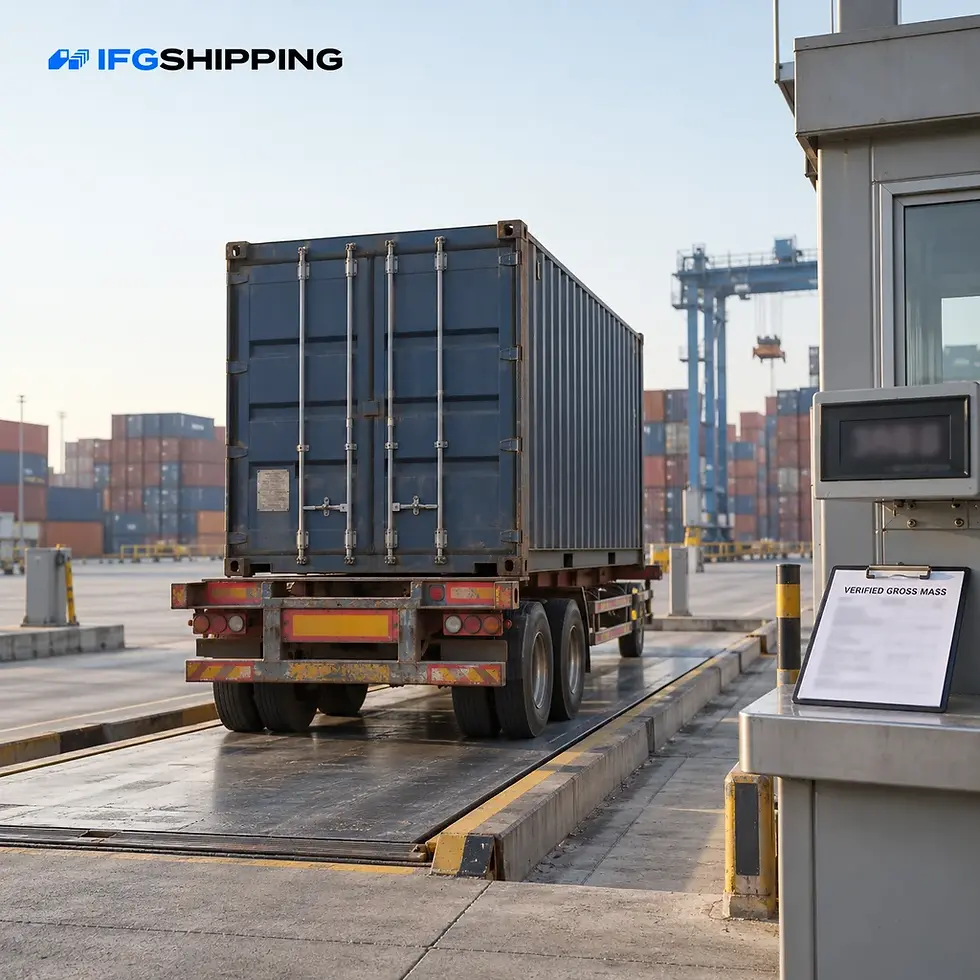
What is the verified gross mass, and who has to give it? The verified gross mass (VGM) is the weight of a packed container: cargo, pallets, dunnage, lashing and the empty box itself. The shipper must give it to the carrier before loading, or the container stays on the quay. The weight rule is global, but the deadline and the tolerance are local. When we read 10 container lines' public VGM pages on 5 October 2026, only 1 of 10 stated a weight tolerance.
That gap matters on your first full container: the rule says declare a verified weight, but not how far off you can be, or by when. If you are still deciding between a full box and a shared one, read our guide to choosing between FCL and LCL first, because the VGM duty lands differently on each.
Checked 5 October 2026 · By Iman Yusoff
What Is Verified Gross Mass (VGM)?
The verified gross mass is the total weight of a packed container, obtained by an approved weighing method and declared by the shipper before the box is loaded. The International Maritime Organization's guidelines, MSC.1/Circ.1475, define gross mass as the container's tare mass plus every package and cargo item, counting the pallets, dunnage, packing and securing material inside the box.
The rule is chapter VI, regulation 2 of the SOLAS convention. According to the IMO's page on verification of the gross mass, its Maritime Safety Committee adopted the amendment at its 94th session (17 to 21 November 2014) through resolution MSC.380(94), and it entered into force on 1 July 2016. The IMO's reason: a misdeclared container weight can lead to wrong stowage decisions, collapsed stacks or boxes lost overboard.
The word that matters is "verified". A weight copied from the commercial invoice, or a buyer's estimate, is not a VGM; it must come from one of the two methods below.
Who Is Responsible for the VGM?
The shipper is. MSC.1/Circ.1475 puts the duty to obtain and document the VGM on the shipper (paragraph 4.1). It defines the shipper as the party named as shipper on the bill of lading or sea waybill, or the party that concluded the contract of carriage with the shipping company.
So who is the shipper when the buyer's forwarder books the box? Whoever the carrier's bill of lading names. That is often the forwarder, not you, so ask: that party signs the VGM.
The VGM can be part of the shipping instructions or a separate declaration. Either way, the verified gross mass declaration must say clearly that the figure is the VGM and be signed by a person the shipper has authorised. An electronic signature or the person's name in capitals counts.
For a shared (LCL) container, paragraph 5.1.3 makes the shipper of the whole box responsible even when several parties packed it; see the LCL question at the end.
Method 1 or Method 2: Which Can You Use?
SOLAS allows two methods, and the IMO describes both. Method 1 weighs the packed container. Method 2 weighs every package and cargo item, plus the pallets, dunnage and securing material, then adds the container's tare, using a weighing method certified and approved by the authorities of the country where the box was packed.
Question | Method 1: weigh the packed box | Method 2: weigh the parts, add the tare |
When | After packing and sealing | Before or during packing |
Equipment | Weighbridge or other device meeting the State's accuracy standards | Scales for each item, under the State's approved method |
Bulk-type cargo (scrap, loose grain) | Use this method | "Inappropriate and impractical" (Circ.1475 5.1.2.2) |
Sealed cartons with accurate mass marked | Not needed | No need to re-weigh those cartons (Circ.1475 5.1.2.1) |
Typical trap | Forgetting to deduct the truck and fuel | Forgetting pallets, dunnage or the tare |
Two details catch people out. If you weigh the box on a truck, paragraph 11.1 says to subtract the tare of the road vehicle and tractor, taken from their registration documents, and the fuel in the tank. If two containers sit on one trailer, paragraph 11.2 says each must be weighed separately; dividing the total by two is not allowed.
How to Calculate Verified Gross Mass With Method 2
The sum is cargo, plus packing and securing material, plus this container's tare, read from the CSC safety approval plate on its door, not from a generic list. We worked out nine constructed cases (not real shipments) arithmetically, then ran them through a small calculator: all 9 matched. The rules come from the IMO guidelines and Indonesia's regulation, both cited in this guide.
Case | Inputs (kg) | VGM (kg) | Result |
1. Normal Method 2 | Cargo 10,000 + packing 560 + tare 2,200 | 12,760 | Declare 12,760 |
2. Sealed, marked cartons | 400 × 18.5 + pallets 352 + tare 2,250 | 10,002 | Cartons not re-weighed |
3. Wrong tare source | As case 1, tare 2,300 from a list | 12,860 | 100 kg off from the tare alone |
4. Cargo weight given as VGM | Declared 10,000; true 12,760 | 12,760 | 21.6% off: fails a 5% test |
5. Exactly 5% off | Declared 19,000; true 20,000 | 20,000 | 5.0%: fails Indonesia's test |
6. Under 5% | Declared 19,100; true 20,000 | 20,000 | 4.5% (4.7% on the declared figure): passes Indonesia's test |
7. Over the plate maximum | 28,500 + 400 + 2,200; plate 30,480 | 31,100 | May not be loaded |
8. Method 1 on a truck | Scale 34,860 − vehicles 15,900 − fuel 350 | 18,610 | Declare 18,610 |
9. Loose scrap metal | n/a | n/a | Use Method 1 |
Case 4 is the mistake to avoid: sending the cargo weight from the packing list. A VGM without the pallets, dunnage and tare is short by the whole box. The 5% test in cases 4 to 6 is Article 45 of Indonesia's PM 53 of 2018, explained below. The regulation does not say whether the 5% is measured against your figure or the port's, so do not aim for the edge. Case 7 applies everywhere: paragraph 10.1 of the IMO guidelines bars a container heavier than the maximum gross mass on its CSC plate from loading.
When Is the VGM Due?
Before the carrier's VGM cut-off, which the carrier has to tell you. The IMO guidelines make the shipping company responsible for telling the shipper of any specific deadline. Singapore's circular asks for the signed VGM early enough for the ship's master to use it in the stowage plan.
Some guides quote a general window, such as a day to three days before the vessel arrives. Treat it as a guess. In our census, 4 of 10 carrier pages stated a cut-off or said where to find it: one gave a time rule, and three pointed to the booking office, the sailing schedule or the load-list cut-off. The other six said only "in advance" or nothing. Your binding date is the one on your booking, so get it in writing.
What Happens If the VGM Is Late, Missing or Wrong?
The container is not loaded. Singapore's MPA Shipping Circular No. 12 of 2016 rules that a packed container with no VGM is not loaded, and it bars the terminal operator from loading local export boxes that lack one. The IMO adds that an on-time VGM still gives no right to be loaded: the master decides.
Three practical consequences follow, all from MSC.1/Circ.1475:
Someone else may weigh it for you. Paragraph 13.1 lets the terminal and the carrier weigh a container that arrives without a VGM, with the costs settled between the commercial parties.
The terminal's weight wins. Paragraph 9.2 says a discrepancy with the terminal's own weighing is resolved by using the terminal's figure.
The costs follow your contract. Paragraph 15.2 says the costs of non-loading, storage, demurrage or return follow the contracts between the parties.
Our guide on what to do when a container is rolled puts it this way: "Rolled means the carrier bumped your container to a later sailing, usually because the vessel was overbooked." A missing VGM is a different cause with the same result: the box waits at the terminal while charges build, as our guide to demurrage and detention charges in Singapore explains.
What Singapore, Indonesia and Malaysia Say
Singapore. MPA Shipping Circular No. 12 of 2016, dated 27 May 2016, gives effect to the rule through the Merchant Shipping (Safety Convention) Regulations, enforced by the Maritime and Port Authority of Singapore. It covers both methods, the signed shipping document and the no-load rule, but states no weight tolerance.
Indonesia. Minister of Transportation Regulation PM 53 of 2018 covers container fitness and VGM. It has been in force since 7 June 2018, and the BPK legal database listed it as in force on 5 October 2026. Article 33 requires weighing equipment to be calibrated and certified by the metrology authority. Article 45 sets the number most guides leave out: if a port re-weigh differs from your VGM by less than 5%, no new certificate is needed. At 5% or more, the container may not be loaded until a new VGM certificate is issued.
Malaysia. We could not retrieve the Marine Department's own VGM notice on the day we checked, so this guide states no Malaysian rule. If you export from Port Klang or Johor, ask your carrier or forwarder for the current local procedure. Our guide on how to export from Malaysia covers the rest of the paperwork.
Enforcement is national: paragraph 15.1 of the IMO guidelines leaves non-compliance to each country's own law. That is why your tolerance depends on where the box is packed and loaded.
What 10 Carrier VGM Pages Tell You
We read the public VGM pages of the container lines on a fixed list. Of 23 lines, 18 had a VGM page in our searches, and 10 of those returned readable text. The others blocked automated reading or showed no VGM text, so they are excluded, not counted as "no".
What the page states | Lines (of 10) |
At least one way to submit the VGM (web form, EDI, email, shipping instruction) | 9 |
A box without a (timely) VGM will not be loaded | 7 |
Both SOLAS methods by name | 6 |
The cut-off, or where to find it | 4 |
The shipper bears the costs of a missing or wrong VGM | 3 |
A numeric weight tolerance | 1 |
A fee amount | 0 |
The one page with a tolerance gave a percentage-or-kilogram margin (the figures are in our dataset), but called it "not confirmed" and said local practice may change it. So no page we read gave a firm, universal margin. The table describes public pages on one day, not a ranking, and names no carrier.
Verdict: the pages tell you how to submit, but rarely the two numbers that decide whether your box sails. Get the cut-off and the tolerance from the carrier when you book.
Your VGM Checklist Before the First FCL
Confirm who the shipper is on the carrier's bill of lading. That party signs the VGM.
Ask the carrier or forwarder for the VGM cut-off and the channel (portal, EDI, email or shipping instruction), in writing.
Ask what tolerance applies at the load port, and who pays for a re-weigh.
Pick the method. Method 1 for loose or bulk-type cargo; Method 2 only with scales and a procedure that meet local rules.
Read the tare from the CSC plate on the box you were given, not from a list.
Add everything: cargo, pallets, dunnage, lashing, then the tare. Check the total against the plate's maximum gross mass.
Sign it properly. An authorised person signs, and the document must say "verified gross mass".
Keep the weighing record in case the terminal's figure differs.
If your container carries dangerous goods, the VGM is separate from the dangerous goods declaration. Our guide to dangerous goods shipping from Singapore covers that paperwork.
Method
An AI agent collected and coded the pages on 5 October 2026, against written definitions. No person hand-coded them. The frame began as a fixed list of 16 container lines: large global carriers plus lines based in, or feeding, Singapore and South-East Asia. Each line got one search through a self-hosted metasearch engine, and up to two VGM pages on a domain the line owns were kept. The list and outcomes were frozen before any page was read. Too few pages were readable, so before coding a written rule widened the frame to every other line-owned VGM page in the same day's results: 23 lines, 18 with a page.
A script fetched each page under a named user-agent that honours robots.txt. Pages that blocked it were fetched once through a public page-rendering service; any that still showed a bot check, or fewer than 150 words of real text, were excluded and logged. The tolerance question was checked twice against the saved text. The nine weighing cases were worked out arithmetically, then run through a short script.
Limits
This is a snapshot of public web pages on one day, found through one metasearch engine, not every line calling at Singapore. At most two pages per line were read, so a rule in a local notice, a booking confirmation or a tariff is not counted. Pages that hid text behind tabs or folded questions may say more. Thirteen lines were excluded for no page or no readable text, so 10 is a small base. The table describes what pages say, not how any carrier applies its rules. The weighing cases are constructed examples that test the arithmetic, not your cargo.
Cite this
IFG Shipping, "Verified gross mass: carrier VGM page census and Method 2 worked cases", collected 5 October 2026, published October 2026 on the IFG Shipping blog at /post/verified-gross-mass-vgm. Dataset version 1.0: vgm-carrier-census-2026-10-05.csv, 23 rows (10 coded, 13 excluded with reasons), anonymised, published with this page.
Learn It With Iman, or Hand It to IFG
Learn it yourself. Start with our roadmap for learning international shipping, which costs nothing to read. Iman, who has worked in shipping since 1999, posts short lessons on LinkedIn and on TikTok as @freightsifu. You can also ask him on WhatsApp at +60 14 325 8325. There is no course or certificate behind it.
Or hand the shipment to IFG. IFG is a forwarder. Send IFG your shipment details, or WhatsApp the same number, with the booking, the cargo list and how the box will be packed. We will reply with the VGM figure to check, the carrier's cut-off and what needs signing before the box leaves your premises.
Frequently Asked Questions
Verified gross mass vs gross weight: are they the same?
No. The gross weight on a bill of lading or packing list often covers only the cargo and its packaging. The VGM adds the pallets, dunnage, securing material and the empty container's tare, as defined in paragraph 2.1.6 of the IMO guidelines. In case 1 above, the cargo weight and the VGM differ by 2,760 kg.
Do I need a VGM for an LCL shipment?
Usually not yourself. For a shared container, the shipper on the carrier's bill is whoever booked the whole box, usually the consolidator. You still need to give the consolidator accurate weights for your cargo, because the container's VGM is built from them.
Disclaimer: this guide explains published verified gross mass rules and carrier pages as read on 5 October 2026. Cut-offs, tolerances and charges vary by carrier, port and date. Confirm them with your carrier, forwarder or the relevant port authority before you pack. It is not legal advice, and no forwarder can promise that a container will be loaded.
Content production support: SingRank, an SEO and AI search (GEO) agency in Singapore.


Comments