
Switch Bill of Lading: When Traders Use It, What Can Go Wrong (2026)

Updated: Oct 2

When do traders use a switch bill of lading, and what can go wrong? Traders use it to keep the factory's name away from the buyer: the carrier cancels the first set and issues a new one naming the trader as shipper. It goes wrong when it tries to change facts, not names, or arrives late.
Traders ask this in almost the same words. In one public comment thread, a reader wanted neither side to learn about the other, and wanted to "appear as the consignor" personally. Another wanted to know whether switching has "a time limit".
This guide is for the Singapore trader in the middle of that deal. It picks up where our explainer on which bill of lading type to choose stops. You'll see what may change on a switch, what it costs, how one carrier here handles it, and the traps to avoid.
Updated 23 September 2026 · By Iman Yusoff, IFG Shipping
Key Takeaway: A switch replaces the names on the paperwork, not the facts of the voyage. Cargo, port of loading and shipment date stay the same. Every original from the first set must come back first, and Maersk Singapore's switch guide (14 February 2025) wants your request 10 working days before arrival.
Key Takeaways
A switch is a second set of bills issued in exchange for every original of the first set, usually to show a trader as shipper instead of the factory.
Only a negotiable bill can be switched. Maersk's Singapore switch guide (14 February 2025) says a sea waybill cannot be switched.
Maersk Singapore charges SGD 270 per bill, plus SGD 140 per bill once the import manifest is filed at destination.
Parties, notify party and some references can change. Cargo, quantity, port of loading and shipped date cannot.
A switch does not guarantee secrecy, and it does not change where the goods were made.
What Is a Switch Bill of Lading?
Here is the switch bill of lading meaning in one line: a replacement set of bills for cargo already on board. NorthStandard, the P&I club, describes it as a stand-in for a bill already issued for loaded cargo, differing from the bill it replaces in some details, in its web alert on switch bills.
Only the carrier, or an agent with its authority, can issue one. The old set goes back and is cancelled first.
Why be so careful with it? Under section 4 of Singapore's Bills of Lading Act 1992, a signed bill saying goods were shipped is "conclusive evidence against the carrier" of that shipment, in favour of a lawful holder. So every line on the new set must be true, because a buyer or a bank will pay against it.
Section 1(2) of that Act leaves out any document that cannot be transferred by indorsement or delivery, which is why switches run on order bills. Our shipping and customs glossary covers the other terms.
A Switch Bill of Lading Example: The Singapore Trader in the Middle
Here is the deal I see most often. A Singapore trading company buys pumps from a factory in China and sells them to a buyer in Indonesia. The goods sail direct and never touch Singapore.
At origin the carrier issues the first set. It names the factory as shipper and, typically, the trader or "to order" as consignee. The trader pays the factory and receives all 3 originals.
Now comes the problem. If those bills go to Jakarta, the buyer reads the factory's name and address. Next year the buyer calls the factory direct, and the trader's margin is gone.
So the trader hands every original back to the carrier's office. The switch set names the trader as shipper and the buyer, or the buyer's bank, as consignee. That set then travels down the payment chain, perhaps under a documentary collection (D/P and D/A) or a letter of credit.
Vessel, voyage, loading port, cargo description, weight and the on-board date all stay as they were. Only the parties changed.
When Do Traders Use a Switch Bill?
P&I clubs insure the carriers, and they list the legitimate reasons plainly. Between them, NorthStandard and Skuld name three, and traders add a fourth:
A sale fell through or changed. NorthStandard: the cargo now goes to a different consignee, or to a different discharge port, with everyone's agreement.
Batches were consolidated. NorthStandard: cargo loaded in batches from different suppliers is traded onward as one cargo.
The delivery plan changed. Skuld's guidance on switch bills: the consignee's logistics change and the cargo now has to go to a different port than planned.
A trader sits in the middle. The sale has a party the first set does not show, as in the example above.
NorthStandard also draws the line. Under English law, it says, there is "no legal objection" to switching as long as everyone party to the carriage contract agrees and nobody intends fraud. Singapore courts may see a case differently, so ask your own adviser before you lean on that sentence.
Most readers name the margin motive: hiding the supplier. That motive is commercial, and the club guidance raises no objection to it in itself, provided every party consents. My rule is simple, and it has served me for over 25 years. A switch may hide a party; it must never hide a fact.
What Can and Cannot Change on a Switch Bill?
Most online answers go vague here. Skuld's line is that the replacement keeps the original's format and clauses. Cargo description, loading and discharge ports, and weight or quantity all stay identical.
Both clubs still accept a new discharge port where the sale genuinely changed. Treat that as an exception you agree with the carrier, not a right.
Field on the bill | Can it change? | Source |
Shipper (factory to trader) | Yes | Maersk Singapore guide; Hapag-Lloyd switch LOI |
Consignee and notify party | Yes | Maersk Singapore guide; Hapag-Lloyd switch LOI |
Document type of the new set | Yes: original set or sea waybill | Maersk Singapore guide |
Sales and letter of credit reference numbers | Yes | Hapag-Lloyd Hong Kong request form |
Discharge port | Only for a genuine change, with the carrier's agreement | Skuld; NorthStandard |
Cargo description, weight, quantity | No | Skuld |
Port of loading | No: a red flag for hidden origin | Skuld |
Shipped-on-board date | No; the new set shows its own issue date | Skuld |
Value or price | No; only reference numbers may be amended | Hapag-Lloyd Hong Kong request form |
Hapag-Lloyd's Hong Kong switch request form is blunt: the wording of the bill stays as it was, apart from the sales and letter of credit reference numbers. So the reader who hoped the switch could show "FOB+markup" as the value can't have it. Your markup belongs on your invoice.
Dates trip people too, because many assume the old issue date should be copied onto the new bill. Skuld calls that "a deliberate misstatement". Under a letter of credit that matters twice. Our guide to letter of credit or open account shows how a wrong date can trigger a refusal.
How Does the Switch Bill of Lading Procedure Work?
Each carrier writes its own rules. Maersk publishes its Singapore procedure for cross-trade switches, and it shows what any line will ask for. These are the steps in its guide dated 14 February 2025:
Check the bill type. It must be negotiable. Maersk says a sea waybill "cannot be switched", so its current receiver must first have it amended.
Surrender the first set. The first-sector original is printed and surrendered at the nearest Maersk office, which updates the system.
File the switch form. Maersk's team starts only once the surrender is confirmed.
Answer questions the same day. If details for the switch shipper, consignee or notify party are missing and nobody replies that day, the switch is "put on hold or rejected".
Pay and collect. A compliant request takes 4 to 8 business hours. The new set, originals or a sea waybill, is released once all prepaid charges are paid.
A deadline sits over all 5 steps, and it is the one traders miss. Maersk wants your request at least 10 working days before the ship is due at its final discharge port. Anything later may be turned down on manifest-compliance grounds.
On a short Asian voyage, that window can shut before the ship even sails. So plan the factory payment, the courier and the switch request together, not one after another.
Where Can You Switch a Bill of Lading?
Where you switch is a carrier matter. Maersk's guide accepts the surrender at any of its offices, and it sends other cross-trade questions to its Singapore export desk. That is why a Singapore trader can switch here for cargo that never calls at Singapore at all.
Other carriers and NVOCCs set their own rules on place and timing. A small NVOCC may have no office in the country you need, and then a switch is slow or impossible. Ask three questions before the booking, not after loading: where can the first set be surrendered, where will the new set be issued, and by what date.
For our pumps, the answer decides whether the trader walks the originals to an office in Singapore or couriers them across two borders. On a short voyage, that difference alone can decide whether the switch happens before arrival, because the courier days come out of the same window.
Switch Bill vs Telex Release vs Sea Waybill
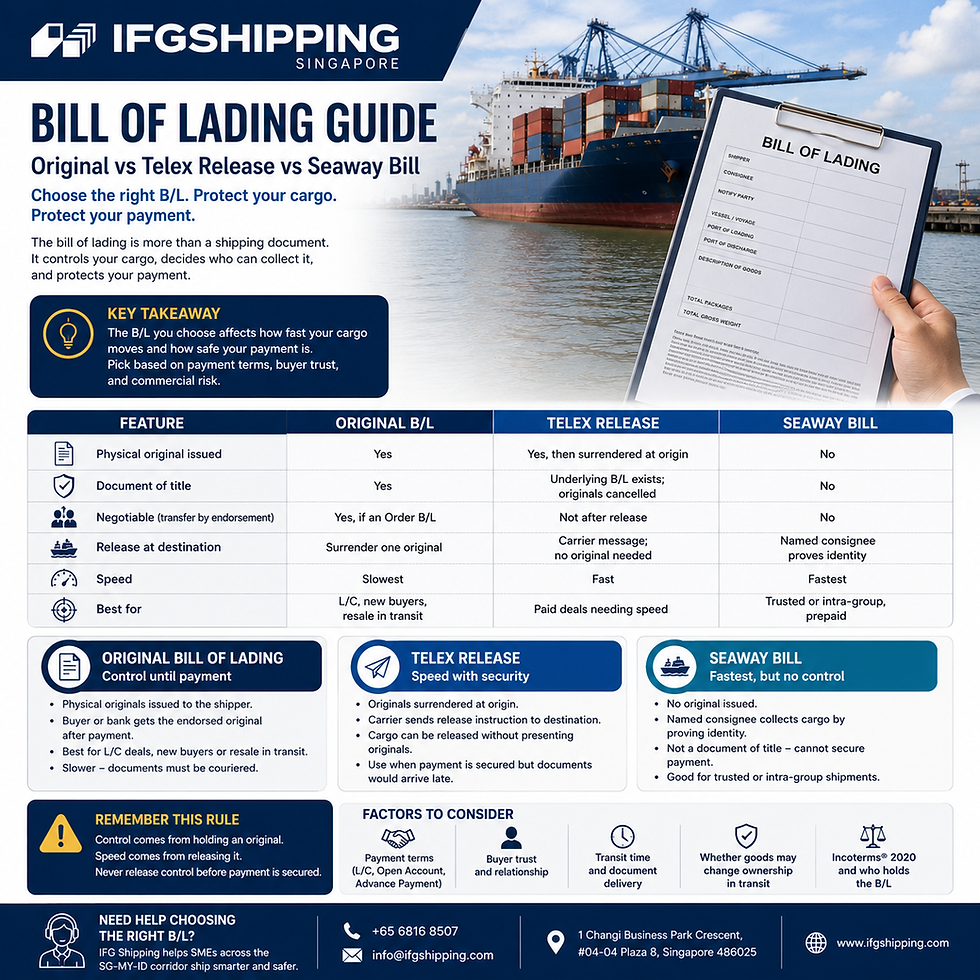
Traders often mix up three different tools. A switch replaces the set of originals with a new set. A telex release, as our guide to original, telex and seaway bills explains, cancels the originals at origin and authorises release without presenting them. Sea waybills have no originals at all, and they are not documents of title.
So the order of decisions is simple. First decide whose name must appear on the paper; that is the switch question. Then decide how the cargo will be released at destination: against originals, by telex release, or on a waybill.
A switch cannot rescue a waybill already issued, because Maersk says a waybill "cannot be switched". If you fly the goods instead, the rules differ again; see our comparison of air waybill vs bill of lading.
Switch Bill of Lading Charges and the Letter of Indemnity
You pay twice for a switch: a carrier fee and an open-ended indemnity. Maersk's Singapore guide prices the first.
Item (Maersk Singapore, 14 Feb 2025) | Figure |
Standard switch fee | SGD 270 per bill |
Late switch fee, after the import manifest is submitted at destination | SGD 140 per bill, on top |
Latest request | At least 10 working days ahead of ETA (final discharge port) |
Processing time, complete request | 4 to 8 business hours |
Those are one carrier's published figures, not a market rate. At Maersk's rates a late switch costs SGD 410 per bill, before any storage. Other lines charge differently, so get the current fee in writing.
The indemnity costs more, because it has no ceiling. Hapag-Lloyd publishes its switch bill letter of indemnity, and signing it means you:
warrant that you, and nobody else, have the right to take delivery of the goods;
cover the carrier for every loss, liability or cost the switch causes it, of any kind;
post bail or other security if the ship is arrested or held because of it;
surrender the complete first set;
accept that the carrier may refuse "on its sole discretion".
Skuld goes further and tells carriers to insist on a bank's co-signature on the indemnity. That means bank fees and a credit line tied up until the risk has passed.
Count it against the margin you are protecting. On a single small container, the fee and the bank line can cost you more than the secrecy is worth.
Does a Switch Bill Really Hide Your Supplier?
A reader raised the point most explainers skip: nothing seems to stop a buyer who is party to the bill from phoning the shipping line and asking who shipped the goods. Carriers' own paperwork gives a careful answer.
Clause 6 of Hapag-Lloyd's switch LOI makes you release the carrier from all liability if the "details of the original Shipper" reach a third party. The carrier promises no secrecy. It asks you to hold it harmless if the factory's details come out.
The Loadstar makes the same point from the buyer's side. Nothing on a switched bill marks it as a replacement, but the buyer can still ask the line whether a switch took place, and the line can confirm it.
My judgement: a switch keeps the factory's name off the buyer's desk. It won't stop a determined buyer, so your real protection is the relationship and a non-circumvention clause in your contract.
The Origin Paperwork Does Not Switch
A switch changes the shipper, not where the goods were made. Our pumps are still Chinese, whatever the new shipper line says.
Singapore Customs' rules of origin overview says goods with only minimal processing here "would not qualify as Singapore-originating". Its list of minimal operations includes "breaking up and assembly of consignments". Paperwork passing through a Singapore office isn't processing at all.
If your buyer claims an ASEAN or China free trade rate, the certificate still carries the real origin and must reconcile with the shipment. Our guides show where the trader appears on it: third-country invoicing on Form D (Box 13) and third-party invoicing on Form E. Take any origin question to Singapore Customs or your declaring agent before you switch.
What Can Go Wrong With a Switch Bill of Lading?
A switch filed early, inside the carrier's cut-off, is usually a clerical job. The ones that fail tend to fail in one of six predictable ways, listed below. Five of the six start with the paperwork, not the ship, which means you can prevent them from your desk.
Two sets in circulation. Skuld warns that releasing new bills before the old set is back and cancelled leaves two sets alive for one cargo. Two holders can then claim the goods, and the carrier can face a shortage claim for the cargo's full value. That's why every carrier insists on the complete first set.
The requestor doesn't hold every original. Most sets hold three originals, and one may still sit with a courier or a bank. Skuld expects the requestor to prove it lawfully holds every original.
The supplier loses control before payment. One exporter admitted on The Loadstar to letting the bills be switched before the buyer had paid. Once the first set is surrendered, the factory's security is gone.
A dated bill used against a letter of credit. Skuld says the courts treat backdated or post-dated switch bills, presented to draw on a credit, as "akin to fraud". Never let a switch "fix" a late shipment.
A new port of loading. Skuld says that request aims at hiding the cargo's true origin, possibly to get round sanctions or import duty. A reader who wanted to show "the origin as Thailand" for Chinese goods was asking for exactly that.
A late request. Miss the deadline and the cargo may arrive under the first set, factory name and all, while storage builds; our guide on a delayed or rolled shipment covers the recovery. Our guide to how demurrage and detention free time is calculated shows how fast that adds up.
NorthStandard adds a sting: if a switch misleads an outsider, the requestor's indemnity may not be enforceable at all. In plain words, the carrier loses its protection. You lose its goodwill, and the next request meets harder questions. Each of these six failures can delay the cargo by days and cost you far more than Maersk Singapore's SGD 270 fee.
My Verdict: Plan the Switch Before the Ship Sails
I've worked in shipping since 1999. I founded IOL Shipping in 2009 and IndoBox Asia in 2011, both NVOCC businesses. So I've sat on the side that is asked to switch bills, not only the side that asks, and I've seen what carriers check. Almost every painful switch I've seen was a timing problem wearing a legal costume.
Same factory, same buyer, every month. In that case, ask whether you need a switch at all. When your company books the freight, you may appear as shipper on the first set. Our guide to who books the freight under each Incoterm shows when that call is yours.
For a one-off deal where the buyer booked the ship, a switch is the right tool. Plan it on day one: pay the factory, courier the originals, and file inside your carrier's cut-off, which for Maersk Singapore is 10 working days before ETA (other lines differ).
For anything that needs a new origin, date, weight or price, don't switch. That isn't a paperwork job, and no indemnity makes it one.
Your Switch Bill Checklist
Before booking, ask the carrier or forwarder, in writing: negotiable bill, where to switch, fee, deadline.
Make sure the first set is issued as an order bill, not a sea waybill.
Agree with the factory how you get all three originals: against payment, by tracked courier.
Draft the new set with your forwarder (here is what a freight forwarder does). Only the parties and permitted references change.
Read the carrier's LOI before signing, and budget for a bank countersignature.
Surrender the complete first set and file inside the carrier's cut-off (Maersk Singapore: 10 working days before ETA; other lines differ).
Answer queries the same day, pay the fee, and check every field of the new set against the old.
Match the invoice, packing list and any origin certificate to the new set before it goes to the buyer or bank.
Learn It With Iman, or Hand It to IFG
Two doors lead on from here, and both are open. Pick the one that fits how much of this you want to own, and how often you trade this way through Singapore.
If you want to understand the document well enough to check your forwarder, follow me on LinkedIn (Iman Yusoff, IFG Shipping). I teach this trade in English, Malay and Indonesian. Our roadmap for learning international shipping is a good place to start.
If you'd rather not run a triangular shipment's paperwork yourself, send IFG your shipment details or WhatsApp +60 14 325 8325. Send the booking and bill of lading details before the vessel sails, and we'll handle the sea freight documents from there.
Frequently Asked Questions
How much does a switch cost in Singapore?
It depends on the carrier. Maersk's Singapore guide, dated 14 February 2025, charges SGD 270 per bill as its standard switch fee. A further SGD 140 per bill applies if the destination import manifest has already gone in. Other carriers set their own fees, so ask for the current figure in writing before you book.
Will the buyer know the bill was switched?
Not from the face of the bill, which looks like any other. But the buyer can ask the shipping line. Hapag-Lloyd's switch indemnity also makes you release the carrier from liability if the original shipper's details are disclosed. So treat a switch as keeping the factory's name off the paperwork, not as guaranteed secrecy.
Can a switch change the port of loading?
No. Skuld, a P&I club, says a request to show a different loading port is aimed at concealing the cargo's true origin, possibly linked to sanctions or duty. Loading port, cargo description, weight and shipped date must match the first set. A new discharge port needs a genuine reason and the carrier's agreement.
What goes in a letter of indemnity for switch bill of lading requests?
Hapag-Lloyd's published form shows the usual content. You warrant you are entitled to the goods, indemnify the carrier against any loss from the switch, and promise bail if the vessel is arrested. You also surrender the full first set and release the carrier over any disclosure of the original shipper. Some carriers want a bank to co-sign it.
Who can ask for a switch?
The lawful holder of every original in the first set, usually the trader who paid for the goods. Singapore's Bills of Lading Act treats a person holding the bill in good faith as a lawful holder. Even so, the carrier wants the surrender, a signed indemnity and its fee. It may refuse.
Disclaimer: This guide to the switch bill of lading is general education, not legal, customs or trade finance advice. Carrier procedures, fees and deadlines change by carrier, office and date; figures come from the documents named, as checked in September 2026, and the P&I guidance is framed under English law. Confirm the current position with your carrier, forwarder, bank or Singapore Customs before you act.
Content production support: SingRank, an SEO and AI search (GEO) agency in Singapore.


Comments