
Booking Confirmation in Shipping: 9 Checks to Run (2026)

Your carrier has sent a booking confirmation, and like every booking confirmation in shipping it is full of dates. Which ones bind you? Four: the empty pick-up, the SI cut-off, the VGM cut-off and the CY cut-off. Miss one and the box can stay on the quay. On 5 October 2026 we coded 17 pages that explain or show a booking confirmation, and only 6 of 17 named all four clocks. Below, we read the document line by line and give you a nine-point check, tested on 10 sample confirmations.
A booking confirmation is the carrier's written acceptance of your space request, with the deadlines that run backwards from departure. Read it the hour it arrives, against your request and your cargo-ready date: corrections are cheap then and expensive later.
Key Takeaways
An FCL shipper must meet four dates printed on the confirmation: the empty pick-up and the SI, VGM and CY deadlines.
Of 17 booking confirmation pages we coded on 5 October 2026, 6 named all four.
Our nine-point check matched worked answers in 10 of 10 constructed sample confirmations.
Evergreen's Netherlands export terms ask for discrepancies within 2 hours of receipt.
Since 1 July 2016, SOLAS makes the verified gross mass a condition for loading.
What Is a Booking Confirmation in Shipping?
The confirmation comes from the carrier, or from a forwarder booking for you, and confirms that space and containers are reserved on a named sailing. It answers your booking request, often with changes you did not ask for: a different vessel, a different depot or an earlier closing time.
Do not file it and forget it. Evergreen's published export booking terms for the Netherlands state that a booking confirmation is issued subject to the carrier's standard bill of lading conditions. The carrier's rules start to apply to your box here, well before any bill of lading exists.
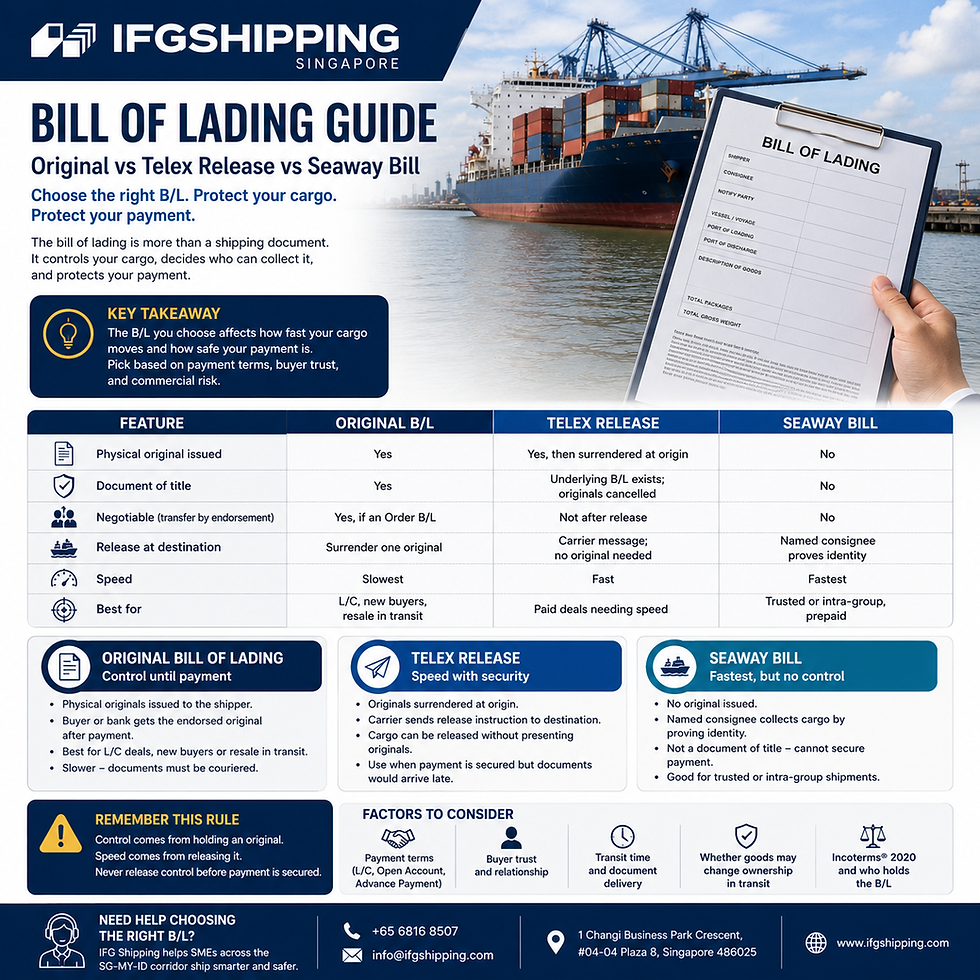
The paperwork around it is easy to mix up. The booking request is yours; the booking confirmation is the carrier's reply. Some carriers also issue a shipping order (in some countries called a container release order), which the haulier shows at the depot to collect the empty box. The bill of lading comes last, after loading, and is built from the shipping instructions you send before the SI cut-off. Our guide to original, telex and seaway bills of lading covers where that final document goes.
Who books the freight, and so who receives the confirmation, depends on your Incoterm. Our explainer on who books the freight under each Incoterm shows when that call is yours.
How Do You Read a Booking Confirmation, Line by Line?
Layouts differ by carrier, but the same fields recur. Hapag-Lloyd's booking note, for example, lists the booking reference, shipper, vessel and ETD, port of loading and discharge, equipment type, commodity, an "Export Empty Pick-up Depot(s)" line and a deadline block. Check each line against your own booking request.
Line on the confirmation | What it tells you | What to check |
Booking number | The reference every later step quotes: depot release, SI, VGM, gate-in | It is there, and you copy it exactly into every message |
Shipper | The party the carrier expects on the bill of lading | It is the exporter agreed in the sales contract, not a forwarder by mistake |
Port of loading / port of discharge | Where the box is loaded and where it comes off | Both match your request and your Incoterm |
Vessel, voyage and ETD | The planned sailing | Both are shown; ETD leaves room after your cargo-ready date |
Equipment type and quantity | 20GP, 40GP, 40HC and so on | Exactly what you asked for; a 40GP is not a 40HC |
Commodity and special cargo flags | What the carrier thinks is inside: general, dangerous, reefer | A dangerous-goods flag matches the cargo's real status |
Empty pick-up depot and release date | Where and from when your haulier can collect the empty box | The empty is available before the day you stuff |
SI, VGM and CY cut-offs | The deadlines for paperwork, weight and the laden box | All three are shown and all fall before ETD |
Free time or tariff reference | How many days you keep the box before charges start | It is stated, or you ask for it in writing |
Look at the free-time line even at the export stage. As our guide to demurrage and detention free time in Singapore explains, free time is set by the carrier's tariff and your booking terms; no Singapore regulation fixes it. Check that the confirmation states it at all, and if you negotiated extra days, get the extension in writing, on the booking.
If the cargo is dangerous goods, the confirmation must say so. A general-cargo flag on a DG shipment is a mismatch to raise at once, not at the gate. Our dangerous goods shipping guide covers what else the carrier will ask for.
What Are the Four Clocks: Empty Pick-Up, SI, VGM and CY Cut-Off?
An FCL booking typically runs on four clocks, and each belongs to a different person in your chain.
Empty pick-up. The depot, and the date from which the haulier can collect the empty container. Evergreen's Netherlands terms ask the shipper to inspect the container's type, size and condition before accepting it at pick-up. A wrong or damaged box is easier to refuse at the depot than to discover at your loading bay.
SI cut-off. The deadline for your shipping instructions: shipper, consignee, notify party and cargo description for the bill of lading. Hapag-Lloyd's booking note calls it "Shipping Instruction Closing" and asks you to "Provide your final BL/SWB instruction". Evergreen's terms warn that a late B/L instruction can mean the cargo is not loaded, plus a late-submission charge. The SI is paperwork, so you can send it before the box is stuffed.
VGM cut-off. The deadline for the verified gross mass: the weighed total of cargo, packing and container. Under SOLAS regulation VI/2, in force since 1 July 2016, the IMO makes the verified gross mass "a condition for loading" a packed container. The duty sits with the shipper named on the bill of lading. In a Singapore advisory still live on 5 October 2026, Maersk said it gives the cargo cut-off and the VGM deadline at booking, on the booking confirmation itself. A separate IFG guide on the verified gross mass, due later this month, covers weighing methods.
CY cut-off. The last moment the laden container can enter the terminal for that sailing, also called cargo closing or gate-in cut-off. Hapag-Lloyd's form labels it "FCL Delivery Cut-off": the latest time a standard container can be delivered to the export terminal. There is often an opening time as well: Evergreen's terms say the terminal turns away containers that arrive before its cargo opening time, so arriving too early can also be a problem.
Which clock falls first depends on the carrier and the port, so read the dates rather than assume an order, and plan backwards from the earliest deadline, not from ETD. LCL works differently: your cargo must reach the consolidator's CFS before its cargo-closing cut-off, and the consolidator deals with the container clocks. Our guide to how LCL consolidation works in Singapore explains that cut-off, and FCL or LCL helps you choose.
What Do 17 Booking Confirmation Pages Explain, and What Do They Skip?
Do the usual explanations prepare a shipper for these clocks? From four fixed searches on 5 October 2026 we coded 17 pages (carrier terms and forms, forwarder and educator explainers, and samples). An AI research agent did the fetching and coding, then re-read each page for the four clocks and for free time. The Method section below gives the full frame.
What the page names | Pages (of 17) |
SI or documentation cut-off | 11 |
Empty container pick-up or release | 10 |
CY or cargo cut-off | 10 |
VGM cut-off | 9 |
Free time, or demurrage and detention charges | 9 (5 use the words "free time") |
All four clocks | 6 |
So 11 of 17 pages left out at least one clock a shipper must plan around. Some define the confirmation by its booking number, vessel and ETD and stop there. One explainer near the top of our main search gives a full sample confirmation with a CY cut-off but no SI or VGM deadline and no depot. Of the 3 carrier documents we could code, the booking form carried all four: the depot as a field and the three cut-offs in a deadline block. In this set the explainers were stronger on definitions than on timing, and timing is what leaves a container on the quay. The full page-by-page table is published with this article.
A 9-Point Booking Confirmation Check, Tested on 10 Sample Confirmations
A list of fields helps only if you know what counts as a problem. So we wrote the reading down as nine pass-or-query checks, fixed them on 5 October 2026 and tested them on 10 constructed sample confirmations: made-up test cases, not real bookings.
# | Check | Query it when |
1 | Booking number | It is missing |
2 | Shipper | It differs from the shipper in your contract |
3 | Route | Port of loading or discharge differs from your request |
4 | Sailing | Vessel/voyage or ETD is missing |
5 | Equipment and cargo | Container type differs, or the DG flag does not match the cargo |
6 | Empty pick-up | No depot, or the empty is released after your cargo-ready date |
7 | Cut-offs | SI, VGM or CY cut-off is missing, or falls after ETD |
8 | Timeline | Cargo-ready time is not earlier than the CY cut-off |
9 | Free time | No free time or tariff reference is stated |
A query means "write to the carrier or forwarder now", not that the booking is lost.
Sample | What we built into it | Result |
S01 | Clean Singapore to Jakarta, 1 x 20GP | Ready |
S02 | Boundary: SI cut-off falls before cargo is ready | Ready (SI can go before stuffing) |
S03 | Port of loading Port Klang instead of Singapore | Query: route |
S04 | Cargo ready after the CY cut-off | Query: timeline |
S05 | No VGM cut-off, no free time stated | Query: cut-offs, free time |
S06 | 40GP confirmed against 40HC requested | Query: equipment |
S07 | Boundary: cargo ready exactly at the CY cut-off | Query: timeline |
S08 | Dangerous goods not flagged | Query: equipment and cargo |
S09 | Forwarder named as shipper; empty released a day late | Query: shipper, empty pick-up |
S10 | No booking number; VGM cut-off after ETD | Query: booking number, cut-offs |
The expected answer for every sample was worked out from the nine rules and saved before the checking script existed. The script returned the same verdict and the same checks in 10 of 10 samples. A separate AI agent, given only the nine rules and the sample inputs, reached the same answers in 10 of 10. In all 10 samples the earliest deadline was the SI cut-off (tied with the VGM cut-off in one). That is a property of our samples, not a rule, which is why step 3 below puts whichever clock falls first at the top of your plan.
Two boundary cases matter. S02 is not a problem, because the SI can go before stuffing. S07 is: a box that is only ready at the CY cut-off still has to be stuffed, trucked and gated in, so "on time" is already late.
What Happens If You Miss a Cut-Off?
Usually the box is rolled: it sails on a later vessel, and every date after it moves. For the VGM, Maersk's Singapore advisory says the container may be denied at the gate where a terminal applies a "No VGM, No Gate-in" policy, that no container will be loaded without a VGM, and that demurrage or detention may apply while it waits. Even with a VGM, the IMO notes that the master keeps the final say on whether a container is loaded.
Changes cost money too. Evergreen's Netherlands terms allow a cancellation fee when a booking is cancelled, reduced or moved to a later vessel within 24 hours (one working day) of the closing, or after it. If it has already happened, our guide on what to do when a shipment is delayed or rolled covers the questions to ask.
What Should You Do the Hour the Confirmation Arrives?
Read it against your booking request. Route, equipment, commodity and shipper must match what you asked for.
Report any difference in writing, at once. Evergreen's Netherlands terms ask you to email any discrepancy within 2 hours of receiving the confirmation. Other carriers set their own rules, but none rewards waiting.
Write the four clocks into one plan. Empty pick-up, SI, VGM, CY cut-off, plus any cargo opening time, with the earliest at the top.
Send each clock to the person who owns it. Depot and release date to the haulier, SI cut-off to whoever drafts the B/L data, VGM cut-off to whoever weighs, CY cut-off to the truck.
Test your cargo-ready date against the CY cut-off. If they fall on the same day, ask for a later vessel now rather than at the gate.
Find the free-time line. If none is stated, ask which tariff applies, and get any extension on the booking.
Keep the latest version. A revised confirmation replaces the old one, so work from the newest number and dates.
Verdict
Treat the booking confirmation as a timetable, not a receipt. The four clocks that can roll a box are printed on it, and Evergreen's Netherlands export terms give only 2 hours to report a discrepancy. The fix is dull: read it the hour it arrives, run the nine checks, and write back before anything moves.
Method
Frame: four fixed searches on our own metasearch tool on 5 October 2026 ("booking confirmation in shipping", plus three variants on cut-offs, empty pick-up and samples). Every result whose title or snippet named a booking confirmation, booking note, booking clause or booking terms for sea freight was eligible, except social-media posts: 20 pages. Each page was fetched once with a named research crawler; 2 returned HTTP 403 and 1 held under 200 words, leaving 17 coded. Coding: fixed text patterns for 11 fields, then a full re-read of every page for the four clocks and free time (85 cells; the re-read changed 5). An AI research agent ran the searches, fetching, coding and re-read; no person reviewed each page. The frame, scripts, rules and sample answers were saved with checksums before any page was fetched. The nine-point check was tested on 10 constructed samples and re-derived blind by a second, separate AI agent.
Limits
Our metasearch tool is not Google's ranking, and four searches on one day are not every booking confirmation page online. The count shows whether a page names a clock, not whether its explanation is right, and the coding and re-read were done by AI agents, not by a human panel. Carrier terms and explainers are different kinds of document, and pages change after the collection date. The nine-point check was tested only on samples we built; a clean result does not mean a carrier will load your box. The two carrier quotes about timing come from Evergreen's Netherlands export terms and a 2020 Maersk Singapore advisory, so check your own carrier's terms.
Cite this
IFG Shipping. "Booking Confirmation in Shipping: 9 Checks to Run (2026)". Census collected 5 October 2026; 9-point check tested 5 October 2026. Dataset version 1: the 20-page census table, published as a CSV with this page. This page is the canonical source.
Two Ways Forward
To learn to read these documents yourself, start with our shipping and customs glossary and a six-step roadmap for learning shipping; the guides on this site cost nothing to read. Iman Yusoff, IFG's founder, posts lessons on LinkedIn and on TikTok as @freightsifu. You can also send him a booking confirmation you don't understand, with prices and names blacked out, on WhatsApp at +60 14 325 8325. There are no courses, workshops or certificates to buy.
If you'd rather hand it over, send IFG your booking, cargo-ready date and route or WhatsApp the same number. We'll reply on the route and which deadline to plan around. The carrier still decides what loads, but you'll know your clocks before the truck moves.
FAQ
What is a booking number in shipping?
It is the carrier's reference for your reservation, shown on the booking confirmation. The depot uses it to release the empty container, and your shipping instructions, VGM and gate-in all quote it, so copy it exactly. At the other end, the delivery order uses the bill of lading number instead.
Is a booking confirmation the same as a shipping order?
Not always. Some carriers send one document that confirms the space and releases the empty box. Others issue a separate shipping order or container release order for the haulier to show at the depot. Ask your carrier or forwarder which document the depot will accept, and check that it carries the same booking number as the confirmation.
Can I change a booking confirmation?
Usually yes: ask the carrier or forwarder for an amendment, and the carrier sends a revised confirmation. Fees and deadlines vary. Evergreen's Netherlands terms, for example, may charge from the third amendment and charge to cancel or roll close to the closing. Ask before the cut-offs, not after.
Disclaimer: This guide to the booking confirmation in shipping is general educational information, not legal or customs advice. The 10 sample confirmations are constructed test cases, not real bookings. Carrier terms, cut-offs, free time and charges vary by carrier, port, terminal and date; sources were checked on 5 October 2026. Confirm current terms with your carrier or forwarder before you ship.
Content production support: SingRank, an SEO and AI search (GEO) agency in Singapore.


Comments