
Delivery Order Singapore: How to Get Your Cargo Released (2026)

Updated: Oct 2

Your freight is paid and the ship has berthed, so why won't the container leave the port? Nobody has released it to you yet. That release is the delivery order Singapore shipping lines and NVOCCs send to your haulier by computer.
They issue it once the bill of lading is surrendered and the local charges are paid. Customs clearance is a separate key.
If that surprises you, you're not alone. One importer asked in a public comment thread: "If I have paid for the Shipping freight to transport the products from country A to country B, do I still have to pay for the DO (delivery order charges)?" Another admitted: "And I am confused with original BL,Sea waybill,Express BL and so on."
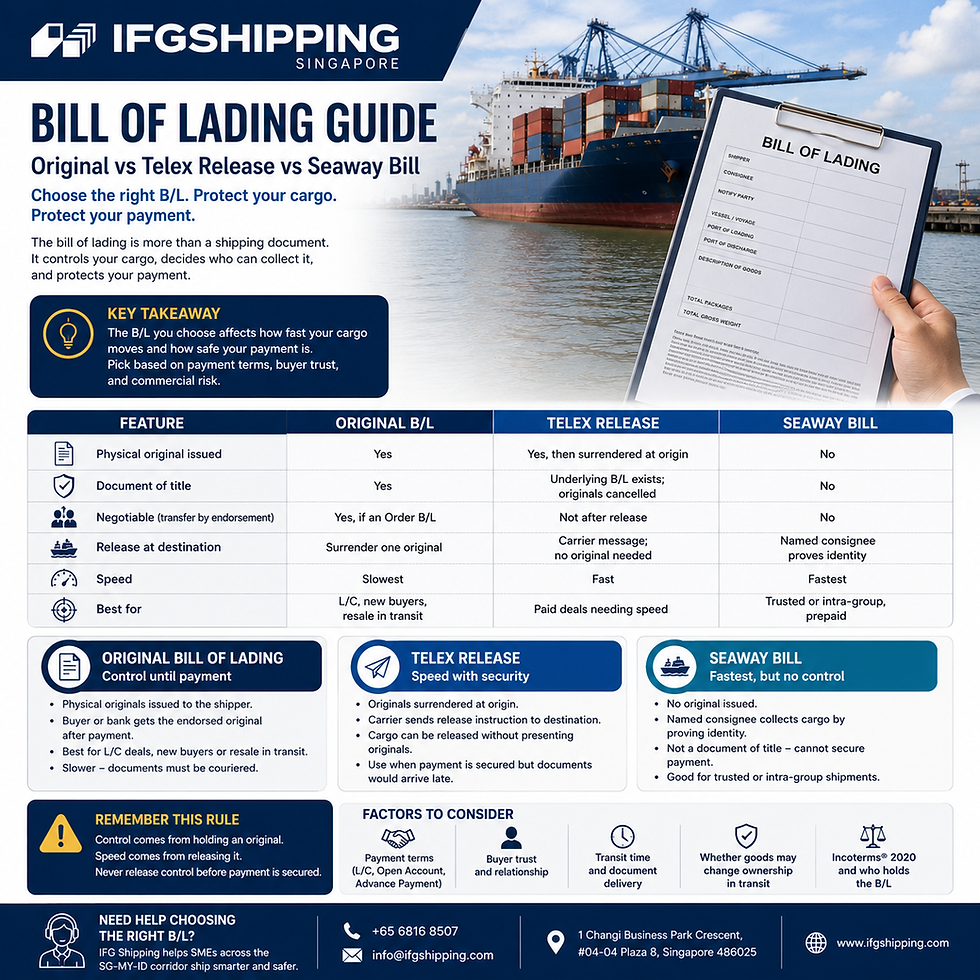
This guide starts where our explainer on which bill of lading type to choose stops. This one covers what happens after the ship arrives: who issues the D/O, what you hand over, what it costs, and the clocks.
Updated 23 September 2026 · By Iman Yusoff, IFG Shipping
Key Takeaway: In Singapore the carrier's delivery order and the Customs permit run on separate tracks. You can have one without the other. Free time runs from discharge whichever one is late, so settle both before the vessel berths.
Key Takeaways
The D/O comes from whoever issued your bill: the carrier's agent, or the NVOCC's or consolidator's agent.
Carriers release it against the bill and paid charges, then pass it to your haulier through Portnet.
The Customs permit is a separate key; one carrier reports it missing 10 days after ETA.
CMA CGM's 2026 Singapore tariff: SGD 200 per bill for documentation, SGD 150 more if the D/O isn't picked up within 3 calendar days of ETA.
ONE's Singapore import tariff gives 72 hours of demurrage free time from discharge.
What Is a Delivery Order in Shipping?
A delivery order is the carrier's instruction to hand your cargo to you, or to the haulier you name. It isn't a document of title. It's the key the terminal or CFS acts on. ONE's bill of lading terms say delivery is made by handing over "the Goods or a Delivery Order or the pin codes for any Electronic Release System".
Here's the short version of delivery order vs bill of lading. The bill proves who has the right to the goods, and you surrender it to receive the D/O. Once one original is surrendered, ONE's terms say the other originals become void.
Don't mix it up with the "delivery order" in a sales office, which is often a delivery note that travels with goods to a customer. In shipping, it's a release from the carrier's side, and it comes after the ship arrives, not before.
What Is an Electronic Delivery Order (EDO)?
In Singapore the D/O is normally electronic. At Jurong Port's documentation FAQ, the electronic delivery order (EDO) is "created by the Agent in exchange for the Bill of Lading". It gets an Authorised Slip Number, and the agent assigns it to the party that will collect the cargo and take it out of the port.
The same FAQ says the details reach Portnet, the port's shared system, the moment the EDO is created. The agent then releases it to the haulier the consignee appointed. So the release moves from system to system, from the carrier's agent to your trucking company.
That's why your haulier's details matter as much as your payment. If the EDO sits with the wrong trucking company, the right truck can't collect, however many documents you hold.
Who Issues the Delivery Order in Singapore?
Whoever issued the bill you hold issues your D/O. That sounds obvious, yet it's where importers go wrong first, because many shipments carry two bills.
Read up on how LCL consolidation works in Singapore if your goods share a box. A consolidator gives each shipper a house bill. The ocean carrier gives one master bill to the consolidator.
What you hold | Who issues your D/O | Where the cargo is released |
Carrier's own bill, in your name | The shipping line's Singapore office or agent | Container terminal, to your haulier (FCL) |
NVOCC house bill, full container | The NVOCC's Singapore agent, once it holds the carrier's release on the master bill | Container terminal (FCL) |
Consolidator's house bill, shared container | The consolidator's Singapore agent | Container freight station, after the box is unpacked (LCL) |
The port operator doesn't choose who gets the box. Singapore Customs lists the FTZ operators: PSA Corporation runs the Brani, Keppel, Pasir Panjang, Tanjong Pagar and Tuas Port zones, and Jurong Port runs its own. They act on the release the carrier's agent sends in.
So my first question to a new importer is simple. Whose name is at the top of your bill? That's the office you'll deal with for the D/O, the charges and any dispute.
What Must You Show to Get a Delivery Order?
Three things: proof you're entitled to the cargo, proof the charges are paid, and who will collect. ONE's bill of lading terms set the rules for originals and waybills; the telex row follows our bill of lading guide.
Bill type | What the carrier needs before release |
Negotiable (to order) original | One original, duly endorsed, surrendered with any unpaid freight |
Straight original, named consignee | One original from the named consignee, after unpaid freight is settled |
Telex release | Originals already surrendered at origin, so no original is needed here |
Sea waybill | Reasonable proof of identity from the named consignee |
Maersk's Singapore self-service delivery order guide is blunt. You can only send the request once "Prepaid charges payment is completed" and the "Bill of Lading has been surrendered". With collect charges unpaid, you may submit, but "release will only be processed after" payment.
A forwarder or broker asking on your behalf needs a letter of authorisation, the Maersk guide says. And the release follows the haulier's UEN, its company number, so a mistyped UEN sends it to a truck that isn't coming.
Watch the origin side too. Maersk's Singapore import page wants "All due payments" made by you and by "the exporter at the origin end". Where a bank holds the originals under documentary collection (D/P and D/A), you'll have nothing to surrender until you've paid or accepted.
Delivery Order Singapore: Two Keys on Two Clocks
A widely read D/O page says that "in most countries Delivery Order will be issued only after customs clearance has been done". Singapore carriers don't work that way.
Maersk's D/O guide sets two conditions, payment and bill surrender; the permit is an optional upload. CMA CGM's Singapore import guide (March 2024) sets a permit deadline of 10 days after vessel ETA. After that, "we will declare missing permit to Singapore Custom."
Singapore Customs' import overview, updated 7 May 2026, says every import needs a declaration through TradeNet. A container permit needs the container and seal numbers.
You need the arrival notice to fill in the permit, and Customs needs the permit to import the goods at all. Our guide to getting the TradeNet import permit covers that side.
Without the D/O the box can't leave; without the permit the goods aren't lawfully imported, and the carrier reports it missing. Why cargo gets held at Singapore Customs lists the usual causes. My rule: tick "D/O released" and "permit approved" separately, in writing.
How Is FCL Cargo Released From the Terminal?
For a full container, the order is fixed. First the carrier sends the arrival notice and invoice. CMA CGM's guide gives 3 working days before ETA on short routes and 5 on long ones.
You pay, surrender the bill or confirm the telex release, and ask for the D/O on the carrier's portal. CMA CGM names its MyCS site for this.
Next the carrier's agent creates the EDO and gives it to your haulier. Maersk says release on Portnet happens "immediately after Maersk has received and processed your delivery order submission". Your haulier books a slot and the box gates out. On ONE's Singapore import tariff, detention then runs until the empty is back at the depot.
Some boxes go out as direct delivery, straight off the ship. CMA CGM tells hauliers to check the box's status on Portnet. If the truck doesn't turn up, CMA CGM says PSA's no-show penalty lands on the consignee. That's your bill, unless your haulage contract says otherwise.
How Is LCL Cargo Released From the CFS?
LCL adds a layer. The carrier releases the whole box to the consolidator's Singapore agent on the master bill. That agent has it unpacked at a container freight station, where each shipper's cargo is sorted by its marks.
You then deal with the agent, not the shipping line. Surrender your house bill or confirm its telex release, pay the agent's local charges, and collect from the CFS. IFG's LCL guide notes that the agent releases goods to each importer "once the TradeNet import permit is approved and outstanding charges are cleared".
That answers the reader who asked if a shared box needs "four separate delivery orders for each consignee". The carrier gives one release, to the consolidator's agent. Each consignee then gets its own release from that agent, against its own house bill.
Free storage at the CFS and the agent's fees sit on the agent's arrival notice. Read it the day it lands.
What About Air, Truck and Courier Imports?
Everything above is sea freight. Other modes clear differently, and the D/O step may look quite different or not appear at all.
For containerised cargo by air or by land, Singapore Customs' import overview says you must produce the customs permit and supporting documents, such as the invoice and packing list, to the checkpoint officers. A permit condition can require the goods to be produced at Woodlands or Tuas Checkpoint. That's the route for cross border trucking from Malaysia to Singapore, covered in our guide to JB to Singapore logistics. For air cargo, read air waybill vs bill of lading and our rules for air freight clearance in Singapore.
If you buy from overseas and it arrives by courier, Singapore Customs' courier page (updated 17 February 2026) says the courier files the import declaration for you. It then collects GST or duty before or on delivery. Our guide to buying from overseas and shipping to Singapore compares the routes.
What Does a Delivery Order Cost in Singapore?
There's no government fee for a D/O. You pay the carrier's or agent's local charges, published per carrier. Here's one real example: CMA CGM's Singapore local charges, effective 1 January 2026. Treat it as one carrier's tariff, not a market rate.
Charge on the tariff | Published figure | When it applies |
Documentation Fee at destination | SGD 200 per bill of lading | Every import bill |
Terminal handling charge, dry box | SGD 250 (20') / 370 (40') / 370 (high cube) / 465 (45') | Per container, from 1 January 2026 |
Late Delivery Order Pickup Fee | SGD 150 for each bill of lading | Once 3 calendar days have passed since vessel ETA |
Late payment fee | SGD 150 per bill of lading | Cash customers not paid 3 calendar days after arrival (CMA CGM import guide) |
Notice what's missing: a line called "D/O fee". This tariff calls its per-bill charge documentation, while other carriers and most forwarders call it a D/O fee or release fee. When you compare offers, match lines by what they do, not by their names. Our guide to comparing forwarder quotes line by line shows how; then build every line into your landed cost calculation before you price the goods.
Who Pays the Delivery Order Charges?
Who pays depends on your bill and sales terms. ONE's bill of lading terms tie the release to any "outstanding Freight", so whatever is still unpaid on the bill gets settled first. Maersk's guide splits it the same way: prepaid charges before you can ask, collect charges before it's processed.
If you paid the freight and still got a D/O bill, that's normal: freight pays for the sea leg, while documentation and terminal handling are charged in Singapore, usually to the buyer. The exception is when your sales terms and the bill put them on the seller, so check both before you dispute it. More charges like this sit in our list of hidden shipping costs.
The Timing Traps That Turn Into Storage and Demurrage
Every clock below starts at discharge or at ETA, and none of them waits for your paperwork. Most late releases I see come from one of these six, and each one was fixable a week earlier.
The full maths sits in our guide to how demurrage and detention free time is calculated. Here I'll stick to what the D/O changes, because that's the part you control before the ship arrives.
Free time is short and backdated. ONE's Singapore import tariff (effective 1 April 2024, until further notice) gives the "First 72 hours free" from discharge. Go over and demurrage runs back to discharge in 24-hour blocks, with store rent on top.
Combined free time still starts at discharge. Maersk's Singapore import page starts its combined demurrage and detention clock on the discharge day. It stops only when the empty box is back in the depot, and both days count.
The D/O has its own clock. CMA CGM's 2026 tariff charges a late pickup fee on the D/O itself: SGD 150 a bill once 3 calendar days have passed since ETA.
Originals in the post. You can't surrender what you don't hold. Maersk's import page tells you to ask the supplier early which it is: original bills, a waybill, or a telex release.
The permit deadline. CMA CGM reports a missing permit to Singapore Customs if it hasn't received one 10 days after ETA.
Unclaimed cargo. ONE's terms give the carrier a lien on the goods for what's owed. Goods left "unclaimed during a reasonable period not to exceed 45 days" may be sold at the owner's risk and cost.
You won't find a public PSA storage rate to check these against. As our hidden-costs guide notes, PSA doesn't publish one, so the rate reaches you through the carrier or your forwarder. If a box is already stuck and the charges are running, start with what to do when a shipment is delayed.
My Verdict: Settle the D/O Before the Ship Berths
I founded IOL Shipping in 2009 and IndoBox Asia in 2011, both NVOCC businesses. So I've sat on the side that issues these releases. Almost every late D/O I've seen came from something the importer could have fixed a week earlier.
For a supplier you've paid in advance, ask for a telex release or a sea waybill. Your cargo shouldn't wait for paper. For a new supplier or a letter of credit, keep the originals but plan the courier. Get them to Singapore before ETA, not on it.
For LCL, get the consolidator agent's name and invoice before the vessel sails. That agent releases your cargo, not the shipping line.
And if you import only a few times a year, use a forwarder who handles both keys. The D/O and the permit are routine after a hundred shipments. They're slow and costly when you're learning on a live one.
Your Delivery Order Checklist, in Order
Before shipment, agree the bill type with your supplier: original, telex release or sea waybill.
Confirm whose bill you'll hold and get that Singapore office's contact.
Appoint your haulier and note its UEN. For LCL, confirm which CFS will unpack the box.
When the arrival notice lands, check the charges, ETA, and container and seal numbers.
Lodge the TradeNet permit with those numbers, or have your declaring agent do it.
Pay the local charges and confirm the origin charges are cleared.
Surrender one original, or get the telex release confirmed in writing, and ask for the electronic delivery order.
Check the EDO names your haulier and book the collection inside free time. Have the haulier check the box and seals: the CMA CGM guide wants any exception reported to the agent before the box leaves the terminal. If damage turns up later, see who pays when cargo is damaged or lost.
Return the empty to the depot the carrier names. Keep every document for 5 years, as Singapore Customs requires.
Learn It With Iman, or Hand It to IFG
Two doors lead on from here, and both are open. Pick the one that fits how much of this you want to own yourself, and how often you import.
If you'd like to understand releases well enough to check your forwarder, follow me on LinkedIn (Iman Yusoff, IFG Shipping). I've worked in shipping since 1999, and I teach this trade in English, Malay and Indonesian. Our roadmap for learning international shipping is a good place to start.
If you'd rather not chase the D/O yourself, send IFG your shipment details or WhatsApp +60 14 325 8325. The bill of lading number and the arrival notice are enough for us to start; we'll tell you what else the permit needs, then handle the collection and clearance.
Frequently Asked Questions
Is a delivery order the same as a bill of lading?
No. The bill of lading is issued at origin, and an original proves who is entitled to the goods. The delivery order is issued at the destination in exchange for it, and it tells the terminal or CFS to release the cargo to you or your haulier. You surrender the bill to receive the D/O.
Why do I pay a delivery order fee if the freight was prepaid?
Prepaid freight covers the sea leg, not the local handling. Carriers bill documentation and terminal handling in Singapore. CMA CGM's 2026 tariff shows SGD 200 per bill for documentation. Unless your Incoterm and the bill put local charges on the seller, the buyer usually pays.
Can my haulier collect the container with only the arrival notice?
No. An arrival notice is a heads-up and a bill, not a release. The terminal releases the box against the electronic delivery order given to your haulier. Maersk's Singapore guide says boxes are released based on the haulier UEN you enter, so the EDO must name the right firm.
Who issues the delivery order for LCL cargo?
The consolidator's Singapore agent, not the shipping line. First the carrier releases the whole box to that agent on the master bill. Next the agent unpacks it at a container freight station. Each shipper's cargo is then released against its own house bill, once charges are paid and the permit is in place.
What happens if the original bill of lading is lost?
The carrier won't release against a missing original. As our bill of lading guide explains, it usually asks for a letter of indemnity, often backed by a bank guarantee. That takes time and money while free time runs, so track the originals by courier.
What happens if nobody collects the cargo?
Charges keep growing, and the carrier holds a lien on the goods for what's owed. Under ONE's bill of lading terms, the carrier may sell or scrap goods nobody claims within a reasonable period of up to 45 days. The cargo owner bears that risk and the cost.
Disclaimer: This guide to the delivery order Singapore importers deal with is general education, not legal or customs advice. Carrier rules, charges and free time change, and differ by carrier, terminal and date. The figures cited come from the documents named, as published when checked in September 2026. Confirm the current position with your carrier, your forwarder or Singapore Customs before you act.
Content production support: SingRank, an SEO and AI search (GEO) agency in Singapore.


Comments