
Breakbulk Shipping vs Container: 11 Heavy-Lift Cases (2026)


Will your heavy piece go in a container, on a flat rack, or does it need breakbulk shipping? Usually it depends on how much of the piece rests on the floor, not on its outside size. A small checker built for this guide on Hapag-Lloyd's published container specifications and weight tables matched the hand-worked answer in 11 of 11 declared cargo cases, checked on 5 October 2026.
If you are still checking whether a box fits, start with our guide to what counts as out of gauge and which equipment type fits. If your cargo is cartons rather than one heavy piece, read about full and shared container loads instead. This page starts where those stop: one awkward piece and two quotes that don't look alike.
I have worked in shipping since 1999, founded IOL Shipping and IndoBox Asia as an NVOCC operator, and served as Hon. Secretary of SMCCI (2023–2025). Below are the carrier limits, contract terms and Singapore port charges that decide this choice, each sourced, plus the eleven test cases.
Checked 5 October 2026 · By Iman Yusoff, IFG Shipping
Key Takeaway: A container's payload is a ceiling, not a promise. On Hapag-Lloyd's own tables, a wooden-floor 20-foot box takes 19.2 tonnes on 4 metres of bearing but only 9.6 tonnes on 2 metres. Ask how long your piece rests on the floor before you compare any freight quote.
What Is Breakbulk Shipping, and Where Does the Container Stop?
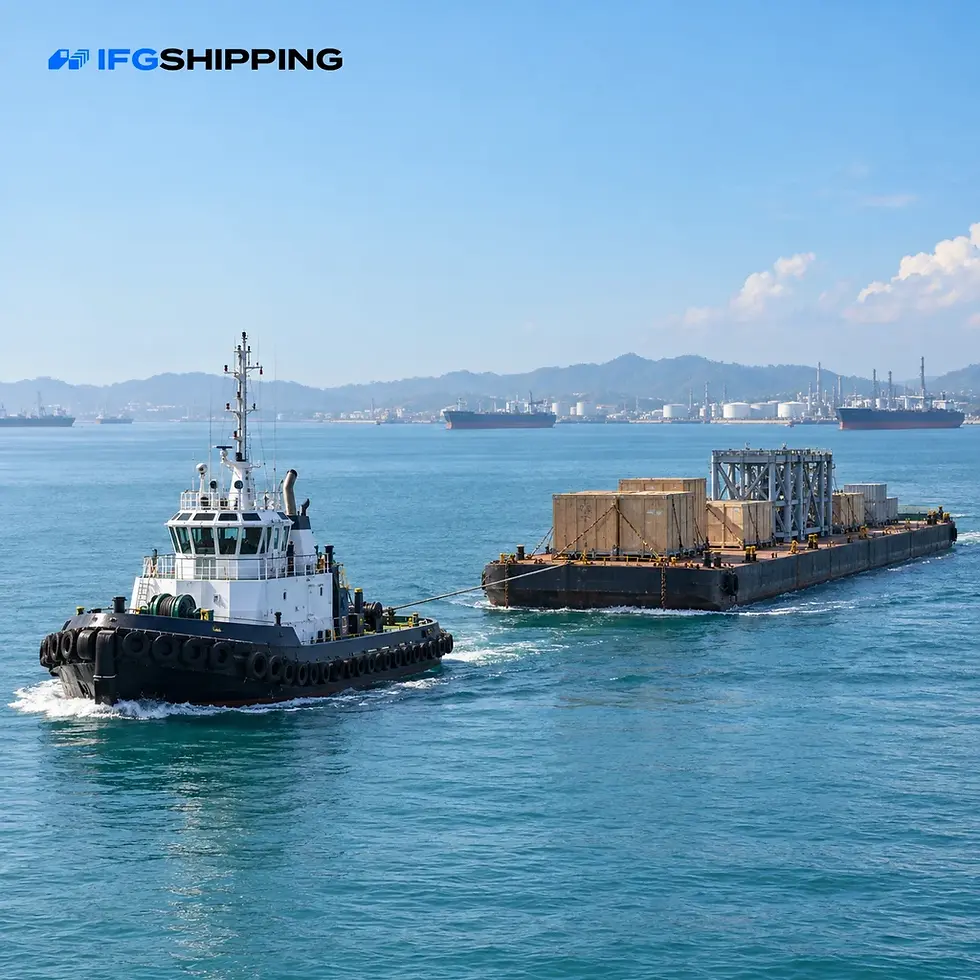
Breakbulk shipping means moving cargo as individual lifted pieces rather than inside a box. Each piece is craned aboard and secured on its own. It is used for machinery, transformers or plant modules too heavy, too big or too awkward for container equipment.
The line between the two modes is softer than the words suggest. Hapag-Lloyd's special cargo brochure says it carries out-of-gauge cargo "as pre-lashed or break-bulk". Pre-lashed cargo is secured to an open top or flat rack before it reaches the terminal. For break-bulk, the brochure describes laying several 40-foot high cube flat racks side by side to form the base the cargo sits on.
That leaves three options:
A closed box or open top: the piece fits inside, and the floor can carry it on the length it rests on.
A flat rack, pre-lashed: the piece is too big or too concentrated for a box, but within the rack's limits.
Breakbulk: on a liner's platform of racks, or on a chartered or multipurpose ship, where a charter party decides who loads, lashes and pays.
Which one you are in decides who carries the risk, and that matters more than the word on the quote.
Does Your Piece Fit a Box, a Flat Rack or Neither?
Start with the length the weight rests on. Hapag-Lloyd's weight distribution guideline defines the floor limit of a box as weight per running metre. A wooden-floor 20-foot box takes 4.8 tonnes per metre: 9.6 tonnes on 2 metres, 19.2 tonnes on 4. A 40-foot box takes 6 tonnes on 2 metres and 12 tonnes on 4.
Flat racks are built for concentrated loads, but the same rule applies. The guideline says a rack's stated payload "can only be utilized if the weight of the load is distributed over the entire length of the main beams". It also says "half of the payload can be loaded in any way, regardless of the length of the load". The carrier's container specification adds that "heavy cargo must rest on the main girder".
Here are the figures the checker uses, one named Hapag-Lloyd series per type:
Equipment (Hapag-Lloyd) | Door or length limit | Max payload | Allowed on 2 m of bearing | Allowed on 4 m |
20' box, wooden floor | Door 2,340 × 2,292 mm | 30,200 kg | 9.6 t | 19.2 t |
40' high cube box, wooden floor | Door 2,340 × 2,597 mm | 28,600 kg | 6 t | 12 t |
20' flat rack (42.1 t series) | Length 5,638 mm | 42,100 kg | 25.2 t | 31.5 t |
40' high cube flat rack (49 t series) | Length 11,652 mm | 49,100 kg | 25.6 t | 29.4 t |
40' high cube flat rack (54.2 t series) | Length 11,652 mm | 54,200 kg | 29.5 t | 32.5 t |
40' platform as breakbulk base | n/a | Static load up to 85,000 kg | Carrier planning | Carrier planning |
Two things move these numbers. First, timber or steel beams can extend the resting length, but by no more than 100 cm at each end, the guideline says. Second, the rack series: the brochure's "up to 54-ton payload" is the strongest one. The specification lists 40-foot racks at 44,050, 49,100, 49,150 and 54,200 kg.
The source also disagrees with itself once. On its flat-rack page, the guideline's drawing labels "2m = max. 26.8t", while its table gives 25.6 tonnes for the same 49-tonne rack. The checker uses the lower table figure.
A working rule, not a carrier rule: if a piece is heavy and short, ask for the breakbulk quote first. If it is heavy but long and evenly supported, a flat rack is still in play.
Eleven Cargo Cases, Worked Two Ways
Each case was worked by hand from the tables above, then run through the checker. The answers agreed in 11 of 11 cases. These are constructed test cases, not real shipments: they show how the rules behave at their edges.
Case | Piece (L × W × H) | Weight | Rests on | Verdict | Why not a normal box |
C01 Machine on full skid | 5.0 × 2.1 × 2.0 m | 18 t | 4 m | 20' box | It fits: 19.2 t allowed on 4 m |
C02 Same machine on two runners | 5.0 × 2.1 × 2.0 m | 18 t | 2 m | 20' flat rack | Box floors allow 9.6 t (20') and 6 t (40') on 2 m |
C03 Compact transformer | 2.5 × 2.0 × 2.8 m | 32 t | 2 m | Breakbulk | Too tall for any door; strongest rack allows 29.5 t on 2 m |
C04 Press frame | 5.5 × 2.2 × 2.9 m | 12 t | 5 m | 40' open top, over-height | Too tall for any door; the 20' roof opening is 5,338 mm long |
C05 Steel beam bundle | 13.0 × 1.0 × 0.8 m | 8 t | 13 m | 40' flat rack, over-length | Longer than any box |
C06 Long crate | 11.0 × 2.3 × 2.6 m | 10 t | 11 m | 40' flat rack, over-height | 3 mm taller than the 2,597 mm high cube door |
C07 Wide skid | 6.0 × 2.9 × 2.5 m | 20 t | 6 m | 40' flat rack, over-width | Wider than the 2,340 mm door; under-deck stowage still possible |
C08 Wide, long module | 11.8 × 2.9 × 2.5 m | 20 t | 11.8 m | 40' flat rack, on deck only | Over-width cargo longer than 1,160 cm |
C09 Heavy block with bedding | 3.0 × 2.2 × 2.5 m | 26 t | 2 m + 1 m beams each end | 20' flat rack, over-height | 40' box allows 12 t on 4 m |
C10 Reactor | 9.0 × 4.0 × 4.0 m | 120 t | 9 m | Breakbulk, above the platform base | Over 85 t, the platform base figure |
C11 Bad input | 3.0 m long, said to rest on 4 m | 10 t | n/a | Rejected | Resting length longer than the piece |
Read C01 against C02 first: the same machine, same weight, same size. On a full-length skid it rides in a 20-foot box. On two short runners, no box floor in these tables can carry it, and it moves to a flat rack. Nothing about its dimensions changed.
C09 shows why bedding matters. With 1 m beams at each end, the block bears on 4 m and a 20-foot rack allows 31.5 tonnes. Without the beams, the checker sends it to the 54.2-tonne rack series, because the 49-tonne rack allows only 25.6 tonnes on 2 m.
C06 is the boundary case people trip on. A crate 2.6 m tall clears a 40-foot high cube's 2,700 mm inside height but not its 2,597 mm door: a gap of 3 mm.
Breakbulk vs Container: The Decision Table
Here is break bulk cargo vs container, row by row. Each row names its source; which column a row falls in is a judgement call, not a carrier rule.
Question | Points to container (box or flat rack) | Points to breakbulk | Source |
Weight on its resting length | Within the box floor or rack row for that length | Above the strongest rack's row (29.5 t on 2 m) | Hapag-Lloyd guideline |
Total weight | Up to the rack series payload | Above it; platform base up to 85 t, beyond that a heavy-lift ship | Hapag-Lloyd specification |
Width | Within the corner-post line (244 cm outer width) | Over-width and longer than 1,160 cm on a 40' rack: deck only | Hapag-Lloyd flatrack guide |
Who secures the cargo? | Shipper, with a lashing certificate for Singapore and Port Klang | Charterer under GENCON-style terms | Hapag-Lloyd; GENCON 1994 |
How the port bills it | Per box | Per tonne, weight or measure | Jurong Port, 2026 |
Singapore import clearance | Containerised sea cargo: no checkpoint presentation | Conventional cargo: goods and printed permit presented | Singapore Customs |
If three or more rows point right, get a breakbulk quote even if you think a flat rack will do.
Who Lifts, Who Lashes and Who Pays?
This is where two similar-looking quotes stop being comparable. The freight may be close; the work each leaves to you is not.
On a flat rack, the lashing is yours. Hapag-Lloyd's lashing certificate requirements list both Singapore and Port Klang as ports where 20-foot and 40-foot flat racks need one. The test is the original port of loading or the final port of discharge. A trans-shipment call at either port doesn't trigger it.
The carrier's flatrack loading and lashing guide (2015) lets the carrier check a loaded rack before it goes aboard and turn it away if the securing falls short of SOLAS or looks unsafe. The guide also counts lashing gear inside the out-of-gauge measurements you declare. Get them wrong and the cargo can be mis-rated or shut out.
On any special cargo booking, the carrier wants detail first. Before it quotes, the brochure wants the dimensions and the gross weight with packing, plus where the lifting and lashing points sit and how many there are.
On a charter, read clause 5. Under the GENCON 1994 form, the charterers load, stow, lash, secure and discharge the cargo, "free of any risk, liability and expense whatsoever to the Owners". They also provide and lay the dunnage. Unless your fixture amends that clause, the crane, riggers and timber sit on your side of the ledger.
So low charter freight can carry a loading bill the container quote never had. Check your cover too, because a lashing failure becomes a claim. Our guides to marine cargo insurance for SMEs and who pays when cargo is damaged or lost explain why carrier liability rarely covers a high-value piece.
Breakbulk Shipping Terms: Liner Terms, FIO, Laycan and Laytime
Breakbulk quotes use vocabulary container quotes don't. Four terms decide who pays at the quay and for how long.
Liner terms and FIO. On liner terms, the freight normally includes loading and discharging by the carrier's stevedores, as far as its terms and the port's practice go. Under free in and out (FIO) terms, the cargo side arranges and pays for both ends, and GENCON clause 5 is the standard example. There is no single universal definition of "liner terms", so ask for the handling split in writing.
What is laycan in breakbulk shipping?
Laycan, short for laydays and cancelling, is the window in which a chartered ship must be ready to load. Under GENCON 1994 clause 9, if the vessel isn't ready by the cancelling date in Box 21, the charterer may cancel. Warned of a delay, the charterer must decide within 48 running hours. For you, it is also a deadline: cargo, permits and lifting gear must be ready when the window opens.
Laytime and demurrage. The BIMCO Laytime Definitions for Charter Parties 2013 treat laytime as the agreed time the owner keeps the ship available for loading or discharging without payment beyond the freight. Once it runs out, demurrage is the agreed sum owed for the delay. It is charged on the ship, unlike container demurrage and detention in Singapore, which is charged on the box.
How Does Jurong Port Bill Breakbulk?
Jurong Port is a multipurpose port operator that takes general and break bulk cargo such as machinery and project pieces, and it offers its own quay, open yard, stevedores and lifting equipment. It is a licensed public port whose Free Trade Zone covers 127 hectares, and customs can inspect cargo on site.
Its Schedule of Rates (1 April 2026) counts a tonne as 1,000 kg or one cubic metre, whichever is greater. Local general cargo on the liner scheme pays S$3.90 per tonne in service charge plus S$2.75 in wharfage, S$6.65 per tonne in all. A laden local 40 ft conventional container pays a S$173.50 service charge per box.
So a 2-tonne crate measuring 10 m³ is billed as 10 tonnes: light but bulky breakbulk pays for air. On the same tariff, 60 revenue tonnes of general cargo comes to S$399 in service and wharfage, against S$173.50 for one laden 40 ft box. Those are port lines only, not the full cost of either mode, but they show why the per-tonne basis must be priced before you compare.
Heavy lifts have their own tariff lines. Under the Jurong Port schedule, a mobile harbour crane costs S$3,000 for its first 8 hours, then S$375 an hour. A floating crane permit costs S$1,000 per application, and cargo declared below its true tonnage carries a S$5.00 per tonne penalty.
What Changes at Singapore Customs?
Conventional cargo is presented, not just filed. Singapore Customs does not ask containerised sea imports to show the permit at the inward checkpoint. For conventional cargo, the goods, a printed permit, the invoice, the packing list and the bill of lading all have to be produced there. The paperwork must be right on the day, so our list of why cargo is held at Singapore Customs applies with more force.
Weighing works differently too. Under the IMO's SOLAS weighing rule, in force since 1 July 2016, a packed container is not loaded until its gross mass has been verified. For a loose breakbulk piece, the weight and measure you declare are what the Jurong Port tariff bills.
When a Charter Beats Both
You'll often read that breakbulk costs more, but the claim never says more than what. Sometimes the answer is a whole ship: when the parts only work together, when the lift is beyond the platform base, or when the lane has no regular service.
IFG has moved this shape of cargo. Our About page records eight ROV units moved from Vungtau, Vietnam, to Gelang Patah, Malaysia, by charter vessel. Our guide to moving an ROV spread through Singapore sets out the ladder: oversized in more than one axis means flat rack or break bulk, and beyond that, charter.
The campaign legs either side have their own costs, set out in where MOB and DEMOB freight leaks money. If one urgent part can't wait for any vessel, read about moving critical spares when the asset is down.
Seven Checks Before You Book Either Mode
Get the drawing, not an estimate. Length, width and height including lashing gear, gross weight, centre of gravity, and lifting and lashing points.
Measure the resting length. Skids, runners or feet: how many metres actually touch the floor?
Check the floor row. Compare the weight with the box or rack limit for that resting length, not with the payload on the door.
Ask which rack series you will get. A 49-tonne and a 54.2-tonne rack differ by almost 4 tonnes on 2 m of bearing.
Ask who lashes. Pre-lashed means your lashing certificate for Singapore or Port Klang; a charter means clause 5.
Get the handling split in writing. Liner terms or FIO, and who pays for dunnage, cranes and riggers at each end.
Price the port basis and the paperwork. Per tonne for breakbulk, per box for containers, and conventional cargo presented with a printed permit on arrival.
Method
The checker (fitcheck.py, version 1.0) uses only Hapag-Lloyd's published figures: its Container Specification, its weight distribution guideline, its 2015 flatrack loading and lashing guide and its two flat-rack specification pages, all fetched on 5 October 2026. It tries a closed box (20-foot, 40-foot, 40-foot high cube), then an open top loaded through the roof, then a flat rack, then breakbulk. Resting length is rounded down to the nearest table row.
The eleven cases, their expected answers and the decision ladder were written down and hashed before the checker existed. Each case was worked by hand from the tables first. A case counts as a match only when the verdict and the reason a normal box was rejected both agree. Result: 11 of 11. The case file, the expected answers and the script are kept with this study and can be rerun with one command.
Limits
This tests one carrier's published limits, one named series per equipment type. Other carriers and other series differ, and steel-floor boxes carry more than the wooden-floor rows used here. The checker is not a stowage plan, a lashing calculation or a carrier acceptance; road, crane and vessel limits are outside it.
The cases are constructed, not observed shipments, so they say nothing about how often real cargo falls into each class. The hand-working and the checker came from the same reading of the same tables, so a shared misreading would still count as a match. Treat 11 of 11 as a consistency test, not proof that the tables are right for your piece.
Cite this
IFG Shipping (2026). "Container or breakbulk? A checker on Hapag-Lloyd's published limits, tested on 11 cargo cases." Collected 5 October 2026; published October 2026 on this page. Dataset: breakbulk-fitcheck-cases.csv, version 1.0, published with this article.
Learn to Read the Quote, or Hand It to IFG
Learn to read it yourself. Follow me on LinkedIn, or on TikTok as @freightsifu, where I post shipping lessons. You can also ask me a question on WhatsApp at +60 14 325 8325. It costs nothing, and there's no course or certificate behind it.
Or hand the decision to IFG. Our sea freight and heavy-lift services cover vessel chartering, heavy lift transport, MOB and DEMOB, and customs documentation. Send IFG the drawing, the gross weight, the resting length and the centre of gravity, or WhatsApp the same number, and we will scope the box, flat rack and breakbulk options before anything is booked.
Frequently Asked Questions
Can a flat rack carry a 30-tonne machine?
Sometimes, but it depends on what the machine rests on. Hapag-Lloyd's 40-foot high cube racks come in series from 44,050 to 54,200 kg payload. On its table, the 49-tonne rack allows 25.6 tonnes on 2 m of bearing and 32.7 tonnes on 6 m. A compact 30-tonne piece needs bedding, a stronger series, or breakbulk.
Do I need a lashing certificate for a flat rack from Singapore?
With Hapag-Lloyd, yes. Its requirements name Singapore and Port Klang for 20-foot and 40-foot flat racks when either is the original port of loading or the final port of discharge. A trans-shipment call at either port doesn't count. Other carriers set their own rules, so ask at booking.
Which carriers are best for oversized or out of gauge cargo?
No published source we checked ranks them, so there is no honest "best". Compare what each carrier publishes: rack series and payloads, weight-per-metre tables, lashing certificate rules and the details it asks for before quoting. The carrier that can show you its limits for your resting length is easier to hold to them.
Disclaimer: For breakbulk shipping and container moves alike, ratings, lashing rules, charter terms, tariffs and customs procedures differ between carriers, ports and contracts. The figures here come from the named sources as published on 5 October 2026. Check with your carrier, the port operator, a qualified lifting engineer and Singapore Customs before you book. Nothing here promises a customs or carrier outcome.
Content production support: SingRank, an SEO and AI search (GEO) agency in Singapore.


Comments