
House Bill of Lading vs Master Bill of Lading: 5 Differences

Your forwarder sent you one bill of lading, the shipping line's tracking page doesn't recognise its number, and nobody has said who pays if the cartons arrive crushed. On 5 October 2026 we read 22 English explainers on the house bill of lading vs master bill of lading. Only 5 of 22 told the shipper who it can claim against under a house bill.
Short answer: a house bill of lading (HBL) is issued to you by a forwarder acting as an NVOCC. A master bill of lading (MBL) is issued to that forwarder by the shipping line. Your contract, and your claim, sit on the house bill. The line, the terminal and the Singapore permit work off the master.
Two questions from one public shipping forum thread sum up the confusion:
"What advantage is there for the importer to have a HBL issued AND MBL (by way of telex release), over the more simpler procedure of just having a MBL issued and then getting the DO after surrendering the original MBL?" And: "does it not mean that in lieu of the MBL, once a telex release is provided, the HBL is irrelevant?" (reader comments on a public shipping forum, 3 July 2017)
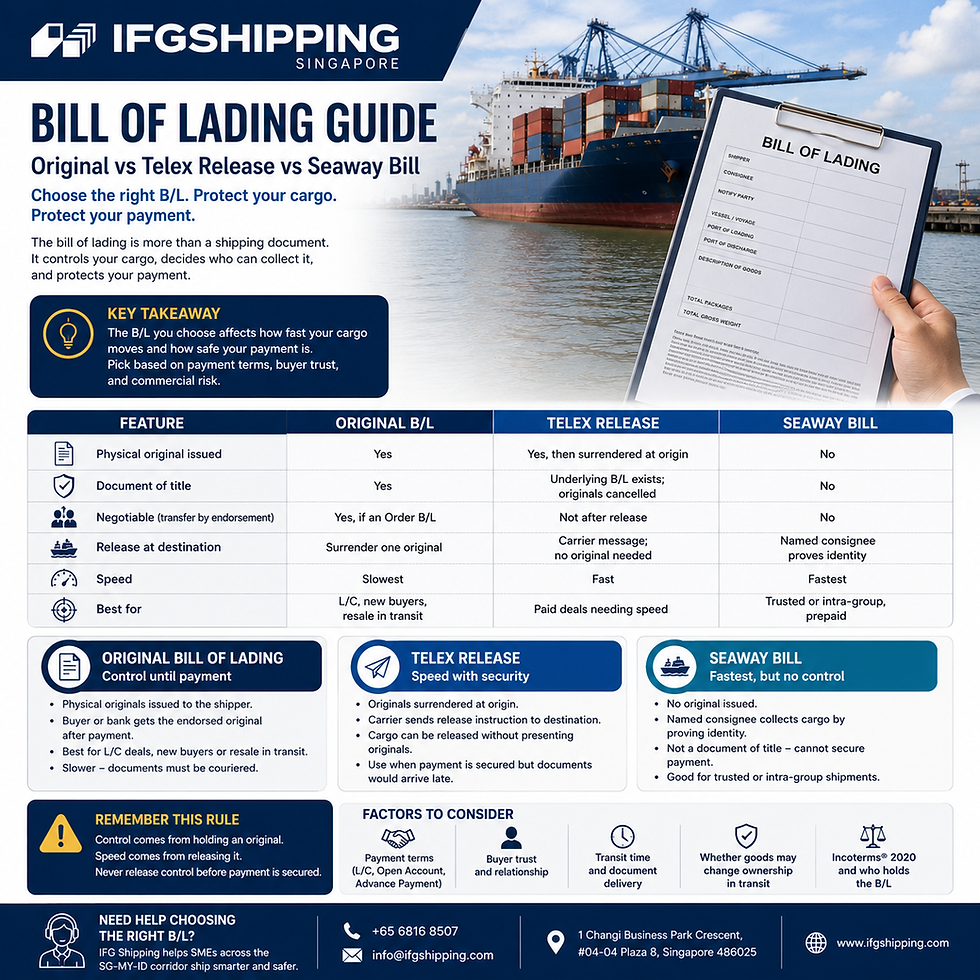
The house bill is not irrelevant. This page covers who issues which bill and what that changes for you. For the release types (original, telex and sea waybill), see our guide to original, telex or seaway release.
Checked 5 October 2026 · By Iman Yusoff, IFG Shipping
What Is a House Bill of Lading?
A house bill of lading is the bill a forwarder issues in its own name when it takes your cargo as a carrier. The US Federal Maritime Commission describes that forwarder, the NVOCC, as a carrier that issues its own house bill but operates no vessels. That is the house bill of lading meaning in one line.
The house bill names the forwarder as carrier and you as shipper, with your consignee and your cargo. If you ship LCL, it is the bill you will hold. Our explainer on what a freight forwarder actually does makes the same point: an NVOCC issues its own bill of lading without owning a ship.
Forwarders also have a form of their own. FIATA, the world federation of forwarders' associations, maintains a negotiable multimodal bill for its members, the FBL, now also in a secured digital version.
What Is a Master Bill of Lading?
The master bill of lading meaning is simple: it is the bill the shipping line issues to whoever booked the space with it. In a consolidation, that is the forwarder, not you. The US Shipping Act definitions in 46 U.S.C. 40102 call the line an ocean common carrier that operates the vessels.
In an LCL box, as our guide to how LCL consolidation works in Singapore explains, each shipper gets its own house bill from the consolidator, and the line gives the consolidator one master bill for the whole box.
As for master bill of lading vs bill of lading, there is no difference in kind. A master bill is the carrier's own bill of lading, called "master" because house bills hang beneath it. When you book directly with a line, there is no house bill: the carrier's bill is yours. Some forwarders call that a direct master bill of lading.
House Bill of Lading vs Master Bill of Lading: 5 Differences
Here is the comparison I would walk a new importer through. Each row changes what you do, not just what you call the paper.
Difference | House bill (HBL) | Master bill (MBL) |
1. Who issues it | The forwarder acting as NVOCC, in its own name as carrier | The shipping line that operates the vessel |
2. Who the parties are | You as shipper and your buyer as consignee, with the forwarder as carrier | The forwarder as shipper and its destination agent as consignee, with the line as carrier |
3. Who you can claim against | The forwarder that issued it, under the contract in that bill | Usually not you: the forwarder holds these rights, on the line's terms |
4. Who releases against it | The forwarder's agent in Singapore, to you | The line's agent, to the forwarder's agent |
5. What Singapore Customs keys the permit to | Declared under its master | One permit per master bill |
Rows 3 to 5 are where shippers get caught out, so the sections below take them in turn.
Why Does One Shipment Carry Two Bills?
Because the forwarder sits between two contracts. US law puts the role clearly: under 46 U.S.C. 40102, an NVOCC runs no ships of its own and counts as a shipper when it deals with the ocean carrier. To you, the NVOCC is the carrier. To the line, it is one more shipper. Each relationship gets its own bill.
Shipping lines plan for this. Clause 2.4 of ONE's bill of lading terms covers an NVOCC that accepts ONE's bill and then signs its own carriage contracts. The NVOCC promises ONE that no claim will be brought against ONE except on ONE's terms, and that its own house bills will bind its customers to those terms, law and jurisdiction clause included. So the master bill's terms can reach you through the house bill, even though you never signed with the line.
I founded IOL Shipping in 2009 as an NVOCC operator, so I have sat on the side that issues house bills. Two bills for one box is not a trick. You just need to know which contract you are in.
Who Can You Claim Against Under Each Bill?
Against the party that issued the bill you hold. Section 2(1) of Singapore's Bills of Lading Act 1992 (on Singapore Statutes Online, sso.agc.gov.sg/Act/BLA1992) lets whoever lawfully holds a bill of lading sue on the carriage contract it contains, just as if they had signed that contract themselves.
On a house bill, that contract is with the forwarder that issued it, so a claim for loss or damage starts there, not with the shipping line. This is the point 17 of the 22 explainers we read left out.
That is not a weakness in itself. As our guide to who pays when cargo is damaged or lost explains, a forwarder that acts as principal and issues its own bill owns the outcome of the shipment. The catch is that the forwarder's standing becomes your risk. So ask three questions:
Is the house bill issued in the forwarder's own name as carrier, or only "as agent" for someone else?
Whose terms and whose jurisdiction does its back page apply? Under clause 2.4 of ONE's terms, the line expects those terms to include its own.
If the forwarder closed tomorrow, who would you claim against?
Liability limits are a separate question, covered in our marine cargo insurance guide for SMEs. As our damage guide notes, a forwarder's own liability cover is not cargo insurance held for you. Insure the goods either way.
Is a House Bill of Lading a Document of Title?
It can be, but not automatically. Section 1(2) of the same Act excludes from its meaning of "bill of lading" any document that cannot be transferred by indorsement or as a bearer bill. Transferability is the test. A negotiable house bill, made out "to order", can work as title. A straight house bill, made out to one named consignee, is not a bill of lading under that Act.
Section 1(3) treats a sea waybill separately, as a receipt that evidences the contract of carriage and names who takes delivery. So "house" tells you who issued the paper. The words "to order", "straight" or "waybill" tell you what it can do.
Which Number Do the Line, the Terminal and Customs Use?
The master. Release runs down a chain: the line's agent releases to the forwarder's agent against the master, and that agent releases to you against your house bill. Our guide to who issues your delivery order in Singapore maps each case. At the terminal, Jurong Port says the agent creates the electronic delivery order in exchange for the bill of lading.
That is why a telex-released master does not make your house bill irrelevant. The line has let go of the box, but the forwarder's agent still holds your cargo until you surrender the house bill and settle the agent's invoice. Meanwhile the carrier's clock runs. ONE's Singapore import tariff charges no demurrage for the first 72 hours from discharge, but miss that window and it charges back to discharge. Our worked example on demurrage and detention in Singapore shows a 40ft dry box one day late owing SGD 315, not SGD 90.
For the permit, the official Singapore Customs Q&A says one permit cannot cover several bills: each master bill needs its own permit. Give whoever lodges your permit the master number, and read our guide to Singapore customs clearance for importers for the rest.
Tracking works the same way. A line's tracking page looks up the bills, bookings and containers that line issued, so it is unlikely to know a house bill number your forwarder issued. Our guide to master and house air waybills gives the same advice for air consolidations: get both references.
FCL, LCL and the Direct Master Bill
On LCL you will hold a house bill, because the consolidator books the container. FCL can go either way. If the forwarder books the box as NVOCC, you get a house bill over its master. If you, or a forwarder acting only as your agent, book directly with the line, the carrier's bill names you as shipper.
This matters most under a letter of credit. Our LCL guide warns that some letters of credit require a master bill and will not accept a house bill. Our comparison of FCL vs LCL for SMEs gives the fix: ship FCL, or have the bank amend the credit to accept a house bill. For the trade-offs of each payment route, see letter of credit vs open account.
My Verdict: Hold the House Bill, Know the Master
For most SME imports into Singapore, a house bill is fine. LCL does not work without one. What is not fine is holding one without knowing who issued it and which master sits behind it. My calls:
LCL, a few cartons, paid in advance: take the house bill, agree the release type with your supplier, and get the master and container numbers.
FCL under a letter of credit: read the credit first. If it demands a carrier's bill, book direct or have the credit amended before loading.
High-value cargo: check that the house bill is issued in the forwarder's own name as carrier, and insure the goods. A house bill moves your claim to the forwarder. It does not make the claim any bigger.
One more risk sits behind a stuck house bill. Under clause 21.3 of ONE's bill of lading terms, goods left unclaimed for a reasonable period, not exceeding 45 days, may be sold or disposed of. A stand-off between two agents does not stop that clock. For what else to check before you appoint anyone, see how to choose a freight forwarder in Singapore.
Your HBL and MBL Checklist Before the Ship Sails
Ask which bill you will get, house or the carrier's own, and in whose name as carrier.
Check the transport-document clause of any letter of credit against that answer.
Agree the release type on the house bill with your supplier: original, telex release or sea waybill.
Get the carrier's name, the master bill number and the container number.
Get the name and contact of the forwarder's agent in Singapore, who will release your cargo.
Pass the master number to whoever lodges your permit.
Read the house bill's terms for its law and jurisdiction clause.
Arrange cargo insurance if losing the goods would hurt.
The same list works with any forwarder, IFG included. A forwarder that answers all eight in writing has passed.
What We Found When We Read 22 Explainers
We wanted to know whether the pages a shipper finds first answer the questions in that checklist. Of the 22 explainer pages we could read on 5 October 2026:
What the page tells the shipper | Pages |
Who it can claim against under a house bill | 5 of 22 |
Who releases the cargo to the holder of a house bill | 5 of 22 |
At least three concrete things to check on a house bill | 4 of 22 |
A named law, regulator or carrier's terms | 4 of 22 |
Any Singapore rule or authority | 0 of 22 |
The first three together | 2 of 22 |
Few pages went beyond who issues which bill to what that changes for the person holding a house bill, and none tied it to Singapore. That gap is why this guide exists.
Method
On 5 October 2026 we ran two searches, "house bill of lading vs master bill of lading" and "hbl vs mbl difference", through a self-hosted metasearch engine set to English, Singapore. They returned 32 results. We kept one page per business whose subject was the HBL vs MBL comparison, and dropped social posts, videos, general bill-of-lading pages and a second page from the same business. That left 27 pages, frozen before any page was read.
A script fetched each page once, with one retry, under a named user-agent that honours robots.txt. Five pages could not be fetched: a failed secure connection, an empty response twice, an access refusal and an unreadable response. They are excluded, not counted as "no", so the base is 22. Each saved page was read in full and coded with AI assistance against written definitions fixed before collection, and every "claim against" decision was checked a second time.
Limits
This is a snapshot of what one metasearch engine returned for two wordings on one day, not Google's own ranking and not every explainer in English. We read one page per business, so another page on the same site may say more. One coding pass made the calls, with a second check only on the claim question. Three of the five "yes" answers on the claim question were borderline and were given to the page, so a stricter reading gives 2 of 22, not 5. The study says nothing about the quality of any business's actual bills or service, and we name none of them.
Cite this
IFG Shipping, "House vs master bill of lading: explainer census", collected 5 October 2026, published 10 October 2026 on the IFG Shipping blog at /post/house-bill-vs-master-bill-of-lading. Dataset version 1.0: hbl-mbl-explainer-census-2026-10-05.csv, 27 rows (22 coded, 5 logged fetch failures), anonymised, published with this page.
Learn It With Iman, or Hand It to IFG
If you want to read a bill of lading well enough to check your forwarder, start with our roadmap for learning international shipping, which costs nothing to read. I also post short lessons on LinkedIn and on TikTok as @freightsifu, and you can ask me directly. I have worked in shipping since 1999, across forwarding and NVOCC work.
If you would rather have someone else check the paperwork, IFG is a forwarder and can do that for you. Send IFG your shipment details or WhatsApp +60 14 325 8325 with the booking, the bill you have been given and your payment terms. We will reply with what is missing before the cargo sails.
Frequently Asked Questions
Does a telex-released master bill make my house bill irrelevant?
No. The telex release lets the forwarder's agent take the container from the line. Your cargo is then released to you against your house bill, once you surrender it (or it is telex released) and pay the agent's charges. Each bill has its own release step, with its own agent and its own invoice.
Can I ask my forwarder for the master bill of lading?
You can ask for its number, the carrier's name and the container number, and a good forwarder will give them. You usually will not receive the master itself, because it is the forwarder's contract with the line. Your document is the house bill, and that is the one you surrender.
Is a master bill of lading the same as an original bill of lading?
No. "Master" says who issued the bill: the shipping line. "Original" says what form it takes: a paper original surrendered to release cargo. A master or a house bill can each be issued as originals, telex released or as a sea waybill.
Disclaimer: This guide to the house bill of lading vs master bill of lading is general education, not legal, banking or customs advice. Bill of lading terms differ by carrier and forwarder, and rules change. We checked the sources named on 5 October 2026. Confirm your position with your forwarder, your bank or Singapore Customs before you act.
Content production support: SingRank, an SEO and AI search (GEO) agency in Singapore.

Comments