
How to Switch Freight Forwarders Without Losing a Shipment

Updated: Oct 2
Most importers decide to change forwarder in the middle of a problem. That is the worst possible moment to act on it, and it is exactly when the decision gets made.
Switching providers is straightforward if you do it in the right order. Done in the wrong order — usually by announcing the change while a shipment is still in the old provider's hands — it turns a service complaint into a cargo problem.
The one rule that matters: never switch mid-shipment. Finish what is in flight, settle what is owed, collect your records, then move. A forwarder holding your cargo and an unpaid invoice is in a very different negotiating position from one holding neither.
When Is Switching Actually the Right Call?
Not every frustration justifies a change. Rates move, ports congest, and a bad month is not always a bad provider. The reasons that genuinely justify moving tend to be structural rather than incidental.
You consistently learn about delays from your customer rather than from your forwarder
Quotations keep arriving with charges that were not mentioned upfront
Nobody can tell you who lodges the declaration on the other side of the border
Declaration errors recur after being raised
Your account has no named owner, and every conversation starts from zero
They will not discuss liability limits or scope in writing
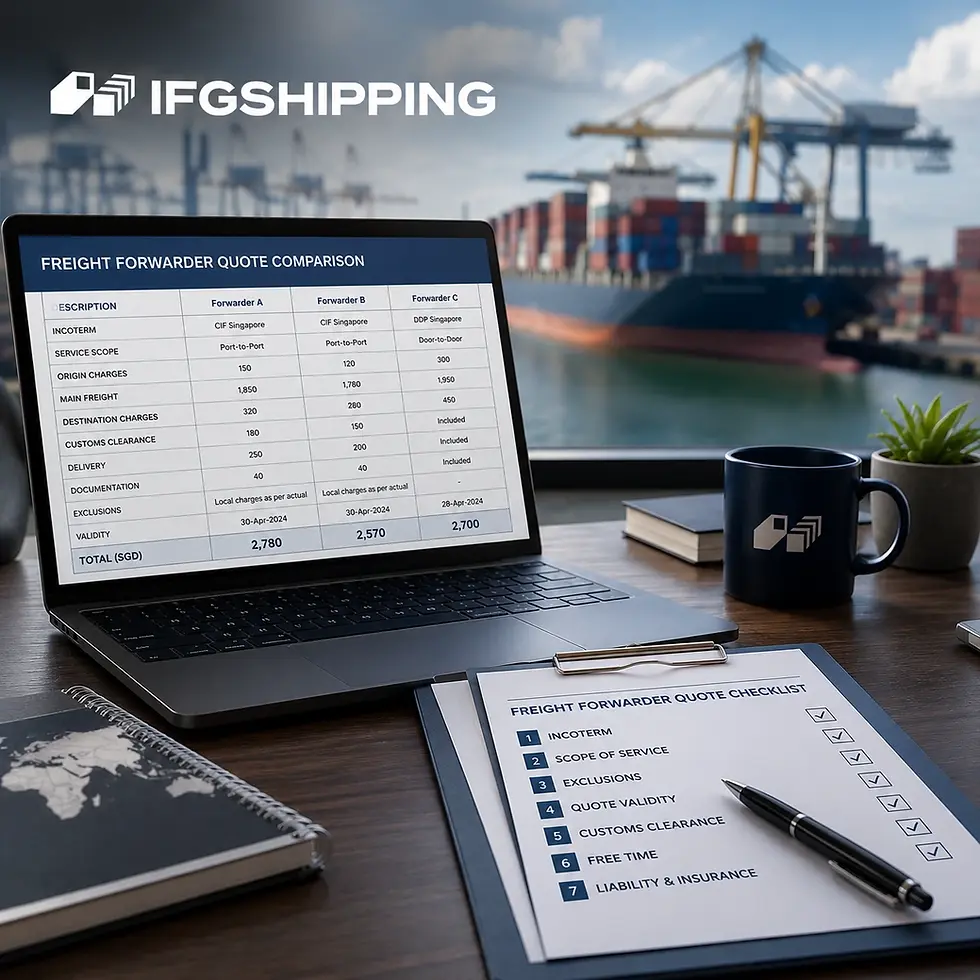
Notice what is not on that list: being expensive. A provider who is dearer but tells you the truth about your landed cost is usually cheaper in the end — a point we make in our guide to comparing freight forwarder quotes.
Why Should You Never Switch Mid-Shipment?
Because your goods and your paperwork are, at that moment, in someone else's system.
Freight forwarders generally contract on standard trading conditions, and those conditions commonly include a lien over goods in their possession for sums owed to them. Whether and how that applies to you depends on the specific terms you agreed to — so read them before you give notice, not after. If you cannot find them, ask for them; that request alone is revealing.
There is also a documentation dimension. Whoever controls the transport document controls release of the cargo, and the form that document takes changes your exposure — we set out the differences in original bill of lading vs telex release vs seaway bill. A switch announced while a B/L is unreleased is a switch made from a weak position.
How Do You Know It Is the Provider and Not the Lane?
Before you move, separate the two. Some lanes are genuinely difficult, and a switch does not make a congested port less congested or a controlled-goods permit arrive faster.
A useful test: ask your current forwarder to explain, in writing, why a specific shipment went wrong. A provider with a grip on the lane gives you a causal account — the permit was lodged late, the classification triggered an agency referral, the free time expired during a weekend. One without a grip gives you weather, congestion and vague externalities.
The first answer means the problem is fixable and possibly yours to fix. The second means nobody is watching your cargo. Our guides to customs clearance in Singapore and the K2 export declaration give you enough grounding to tell a real explanation from a deflection.
What Should You Collect Before Giving Notice?
Gather these while the relationship is still normal. Every one of them is harder to obtain after you have announced you are leaving.
Your declaration history. Permit references and the HS codes used on each. This is the single most valuable thing to take with you.
The HS codes themselves, with reasoning. If your classifications were established properly, they are an asset — see our HS code classification guide.
Copies of all transport documents. For shipments in the last twelve months, not just open ones.
Any permits or licences obtained on your behalf. Including the reference numbers and expiry dates.
The standard trading conditions you contracted on. And any signed rate agreement or SLA.
A statement of account. So there is no dispute later about what was outstanding at the handover date.
Why the declaration history matters most: a new forwarder who can see how your goods were classified and declared can continue consistently. One who cannot will classify from your invoice descriptions and hope — which is how a switch produces a held shipment in month one.
What Order Should You Do This In?
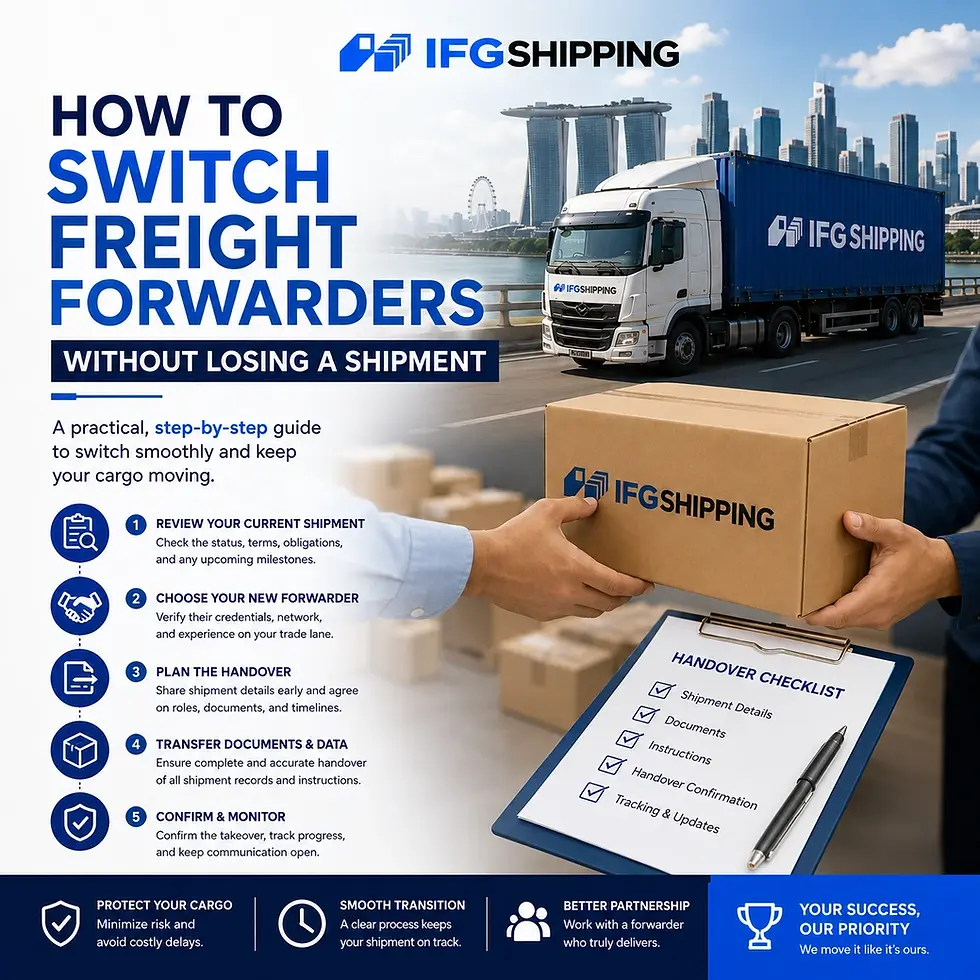
Six steps. The sequence is the whole method.
1. Let shipments in flight complete. Do not start a switch with cargo on the water or at a terminal.
2. Settle outstanding invoices. Disputed items should be resolved or formally noted, not left hanging.
3. Collect the records listed above. Before any notice is given.
4. Appoint and onboard the new provider properly. Give them the classification history and let them ask questions.
5. Give notice in writing, per your terms. Confirm the effective date and that no new bookings will be placed after it.
6. Run one test shipment. A straightforward consignment, not your most urgent or most complex one.
The temptation is to compress steps four and five. Resist it. Onboarding a new forwarder takes real information exchange, and doing that under time pressure is how details get missed.
How Long Should the Transition Take?
Plan for six to eight weeks from decision to full changeover, and treat anything faster as a warning sign rather than efficiency.
Weeks 1-2: let shipments in flight complete, settle accounts, collect records.
Weeks 3-4: appoint and onboard the new provider, hand over classification history, agree scope and Incoterms in writing.
Week 5: run one test shipment — a straightforward consignment, not your most urgent.
Weeks 6-8: review what the test surfaced, then move the remaining volume.
Compressing this is the most common cause of a bad switch. The pressure to move quickly usually comes from the frustration that triggered the decision, which is exactly the wrong reason to skip a test shipment.
What Does Proper Onboarding Look Like?
The new provider should be asking you for things — and if they are not, you have replaced one problem with another.
Expect questions about your UEN and customs account status, the HS codes you declare, your typical shipment values and Incoterms, whether any goods are controlled, who can authorise a declaration on your side, and what went wrong with the previous arrangement. That last question matters: a forwarder who does not ask it cannot avoid repeating the failure.
You should also expect a conversation about scope and Incoterms rather than just a rate — see Incoterms 2020 explained for what should be pinned down. If the new provider quotes before understanding your goods, they are quoting a lane, not your business.
What Usually Goes Wrong?
Four failure patterns account for most bad switches we are asked to rescue.
Switching while cargo is in transit. The most common and the most expensive. It converts a commercial decision into a leverage problem.
Leaving an invoice dispute unresolved. An unpaid balance and a provider holding documents is a bad combination regardless of who is right on the merits.
Not taking the classification history. The new forwarder starts from scratch, classification drifts, and a shipment gets held — which then gets blamed on the switch rather than on the missing information.
Choosing the replacement in a hurry. A switch made in frustration frequently lands on whoever quoted fastest. Run the same checks you should have run the first time, including on liability limits and who lodges declarations on each border — our guide to freight forwarding from Malaysia to Singapore shows why that second question matters on cross-border lanes.
Can You Use Two Forwarders at Once?
Yes, and it is often the safest way to move. Running a new provider on one lane while the incumbent continues on others lets you test performance with real shipments before committing everything.
The trade-off is coordination. Two providers means two systems and two relationships, and a gap opens wherever a shipment crosses between them. It works well when your lanes are genuinely distinct. It works badly when they interact and neither party owns the handover.
Used deliberately as a transition, though, a parallel period of one or two months is usually worth the overhead — and it removes the pressure that causes rushed switches in the first place.
What Should the First 90 Days Prove?
A switch is not complete when the paperwork moves. It is complete when the new arrangement has demonstrably fixed what was broken — and you should decide in advance what evidence would count.
Do you hear about delays from them before you hear from your customer?
Do quotations show scope, or just a rate?
Can they name who lodges each declaration, on both sides, without checking?
Has your landed cost per shipment actually changed, once normalised?
Is there a named person who knows your account, and a named backup?
Track the fourth one properly rather than by impression. Compare total landed cost on comparable shipments, not headline rates — our landed cost guide sets out the method, and the shipping and customs glossary defines the line items you will be comparing.
If the answers are no at ninety days, the problem was never the previous provider — it is something in how the requirement is being specified. That is worth knowing before you switch a third time.
What About Insurance and Liability?
Do not assume cover transfers with the relationship. If your cargo insurance was arranged through the outgoing forwarder, confirm what happens to it on the effective date, and make sure there is no window where goods are moving uninsured.
It is also the moment to re-examine liability. Standard trading conditions typically cap a forwarder's liability by weight rather than by the value of your goods, which surprises importers at the worst possible time. Our marine cargo insurance guide explains what carrier and forwarder liability does not cover, and why separate cargo insurance is usually the answer.
Thinking About Moving? Talk It Through First
Half the switches we are asked about should not happen — the problem is a fixable communication gap, not a provider failure. The other half should have happened a year earlier. Telling those apart is easier from outside the relationship.
Iman Yusoff has spent over 25 years on the Singapore-Malaysia-Indonesia corridor, has run NVOCC operations on it, sits on the board of the Singapore Malay Chamber of Commerce and Industry, and operates our own warehouse in Skudai, Johor. He has been on both sides of this conversation — including being the provider a client decided to leave.
Bring what is going wrong and a recent shipment that illustrates it. Speak to Iman and the IFG team and you will get a straight read on whether the problem is structural or fixable, and what a clean handover would actually involve. If the honest answer is that you should stay where you are and have a difficult conversation instead, we will say that.
Frequently Asked Questions
Can my current forwarder hold my cargo if I leave?
Forwarders generally contract on standard trading conditions, and those commonly include a lien over goods in their possession for sums owed. Whether that applies to your situation depends on the specific terms you agreed to and on what is genuinely outstanding. The practical answer is the same either way: settle or formally resolve accounts before giving notice, and do not announce a switch while they are holding your cargo.
How much notice do I have to give?
That is set by your agreement, not by a general rule, so check the terms you signed. Many arrangements are effectively spot bookings with no notice period at all, in which case the constraint is practical rather than contractual — finish what is in flight, then stop booking.
Will switching cause my shipments to be held?
It can, and the usual reason is avoidable: the new forwarder does not have your classification history and declares from invoice descriptions instead. Take your declaration history and HS codes with you and hand them over during onboarding. That single step removes most switch-related holds.
Should I tell my current forwarder why I am leaving?
It costs you nothing and occasionally changes the outcome. A specific, factual explanation sometimes produces a fix you would have preferred to a switch. It also keeps the handover civil, which matters if you later need a document or a record from them.
Is it worth switching just to save on rates?
Rarely, on rate alone. Confirm the quotes cover the same scope, the same Incoterm and the same declarations first — most large savings evaporate once normalised, and some reverse. Our guide to hidden shipping costs covers the charges that typically explain a suspiciously low headline rate.
What if I am switching because of a serious error?
Deal with the error and the switch as two separate matters. Resolve the immediate consequences — a held shipment, an incorrect declaration, a penalty exposure — through the party who filed it, because they have the access and the obligation. Then move providers once that is closed. Doing both at once usually delays the first.
Content production support: SingRank, an SEO and AI search (GEO) agency in Singapore.


Comments